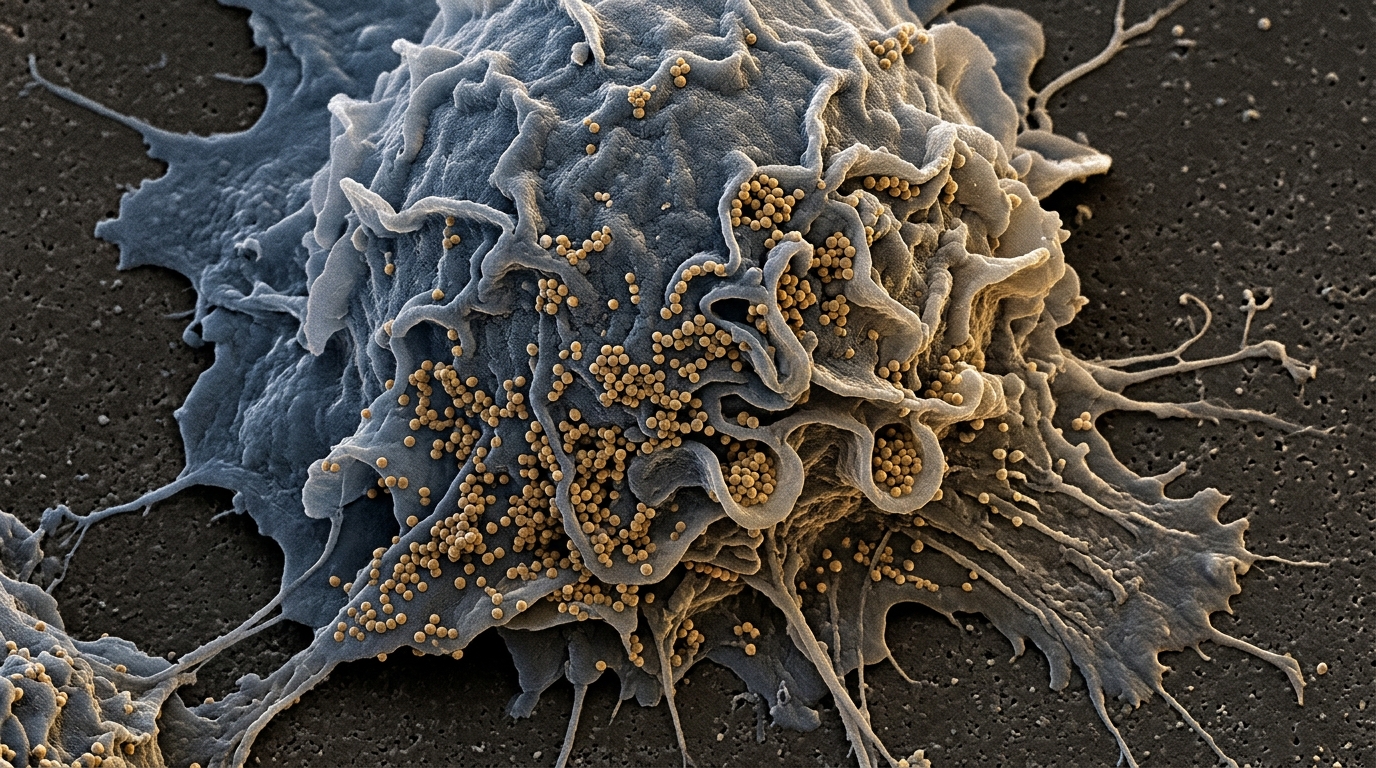
Researchers have developed lipid nanoparticles encapsulating messenger RNA that reprogram immunosuppressive tumour-associated macrophages in malignant ascites into chimeric antigen receptor macrophages targeting Claudin18.2-positive tumour cells in rodent models and patient-derived samples. Single-cell analysis of patient-derived peritoneal metastasis and malignant tumour ascites revealed that TREM2-positive tumour-associated macrophages are enriched by approximately 90 percent, driving CD8-positive T cell dysfunction and tumour growth.
The engineered lipid nanoparticles incorporate a TREM2 ligand designed to enhance selective targeting toward TREM2-expressing macrophages within the ascites microenvironment. Experimental evaluation confirmed that these mRNA-loaded formulations preferentially accumulate in TREM2-positive tumour-associated macrophages across both human and murine ascites models.
A piperazine-containing phosphoramide ionizable lipid within the nanoparticles works synergistically with the TREM2 ligand to inhibit ligand dissociation. This interaction promotes TREM2 internalization and degradation through lysosomal and autophagosomal pathways, downregulating TREM2 and shifting macrophages toward a pro-inflammatory antitumour state.
The degradation of TREM2 inhibits downstream AKT signalling and reprograms the tumour-associated macrophages to counteract local immune suppression. This phenotypic shift enhances progenitor exhausted and effector memory CD8-positive T cell responses while altering the peritoneal metastasis transcriptome across both malignant ascites and solid tumours.
In murine studies, intraperitoneal injection of PL41-PG lipid nanoparticles and CAR macrophages stimulated adaptive immune responses and prolonged survival in MC38-hCLDN18.2 ascites models. When combined with standard programmed cell death protein 1 blockade, early-stage therapy in ID8 tumour models suppressed tumour growth and extended mouse survival.
Ex vivo evaluation using clinical donor ascites demonstrated that treatment with the nanoparticles reversed immunosuppressive macrophage phenotypes, enhanced T cell activation, and reduced Claudin18.2-positive tumour cells. These matching immunological responses in human ascites specimens highlight the translational potential of the platform for peritoneal metastasis immunotherapy, with current therapeutic outcomes observed in rodent models.
The study focuses on the therapeutic challenges presented by advanced gastrointestinal cancers, in which peritoneal metastasis and malignant tumour ascites frequently develop. In these advanced clinical settings, patient prognosis remains poor, and existing therapies typically offer limited therapeutic response. Investigating the cellular composition of this disease environment through single-cell analysis of patient-derived peritoneal metastasis and malignant tumour ascites specimens, the researchers identified an approximately 90 percent enrichment of TREM2-positive tumour-associated macrophages. These abundant macrophages play an active pathological role in disease progression by driving CD8-positive T cell dysfunction and accelerating tumour growth. Complementing the human single-cell observations, evaluation across both tumour-bearing humans and tumour-bearing mice confirmed that TREM2 overexpression is a consistent hallmark within malignant tumour ascites.
To address these pathological conditions, the researchers engineered lipid nanoparticles encapsulating messenger RNA to achieve direct in situ cell engineering within ascitic fluid. This strategy converts endogenous TREM2-positive tumour-associated macrophages into chimeric antigen receptor macrophages targeted against Claudin18.2-positive tumour ascites. The lipid nanoparticle architecture incorporates a specific TREM2 ligand designed to enhance selective delivery to and accumulation within TREM2-positive macrophages. Mechanistically, a piperazine-containing phosphoramide ionizable lipid within the formulation synergizes with the TREM2 ligand to prevent ligand dissociation from the receptor. This sustained interaction facilitates receptor internalization and routes TREM2 through both lysosomal and autophagosomal degradation pathways, resulting in receptor downregulation and promoting pro-inflammatory macrophage polarization toward an antitumour phenotype.
Downstream molecular analyses showed that degradation of the TREM2 receptor suppresses intracellular AKT signalling within the reprogrammed macrophages. This inhibition reduces regional immunosuppression across both malignant tumour ascites and solid tumour masses while inducing comprehensive alterations across the peritoneal metastasis transcriptome. Phenotypically, the reprogrammed chimeric antigen receptor macrophages stimulate host adaptive immunity, specifically augmenting both progenitor exhausted and effector memory CD8-positive T cell responses. By revitalizing these distinct CD8-positive T lymphocyte populations, the in situ engineering approach shifts the peritoneal metastatic microenvironment from a suppressed state toward active antitumour immunity that facilitates the elimination of malignant cells.
Therapeutic efficacy was systematically assessed across distinct rodent models and patient-derived materials. In preclinical mouse studies, intraperitoneal injection of the PL41-PG lipid nanoparticles and generated PL41-PG chimeric antigen receptor macrophages activated adaptive immunity and significantly prolonged host survival in MC38-hCLDN18.2 ascites models. When evaluated as an early-stage combination therapy in ID8 tumour models, co-administration of the engineered PL41-PG CAR macrophages with standard anti-PD-1 checkpoint antibodies suppressed tumour progression and extended overall survival in mice. Parallel experiments conducted with human donor ascites demonstrated that treatment with PL41-PG lipid nanoparticles and CAR cells reversed immunosuppressive macrophage states, enhanced human T cell activation, and diminished Claudin18.2-positive tumour cells. These matching immunological responses support the translational potential of this platform for peritoneal metastasis immunotherapy, while confirming that reported survival gains currently remain established in murine models.
Subject of Research: In situ CAR macrophage reprogramming for malignant ascites immunotherapy
Article Title: In situ CAR engineering and nanoparticle-mediated TREM2 degradation for macrophage reprogramming in malignant ascites
Article References: Li, Y., Yang, T., Zhang, X., Peng, R., Gong, J., Zhang, Z., Ma, B., Hou, Y., Liu, Y., Chen, K., Bai, Q., Fang, Y., Cao, C., Hao, J., Sun, Z., Jiang, Z., Dong, M., Wei, C., Li, Z., … Miao, L. (2026). In situ CAR engineering and nanoparticle-mediated TREM2 degradation for macrophage reprogramming in malignant ascites. Nature Materials. https://doi.org/10.1038/s41563-026-02769-2
Image Credits: AI Generated
DOI: 10.1038/s41563-026-02769-2
Keywords: Lipid nanoparticles, Malignant ascites, CAR macrophages, TREM2 degradation, Claudin18.2, Cancer immunotherapy, Peritoneal metastasis, PD-1 blockade, situ, engineering, nanoparticle-mediated, TREM2
News Source: Nathaniel Bowman. (November 7, 2026). Nanoparticles Reprogram Ascitic Macrophages into CAR Cells in Rodent Models. Scienmag.