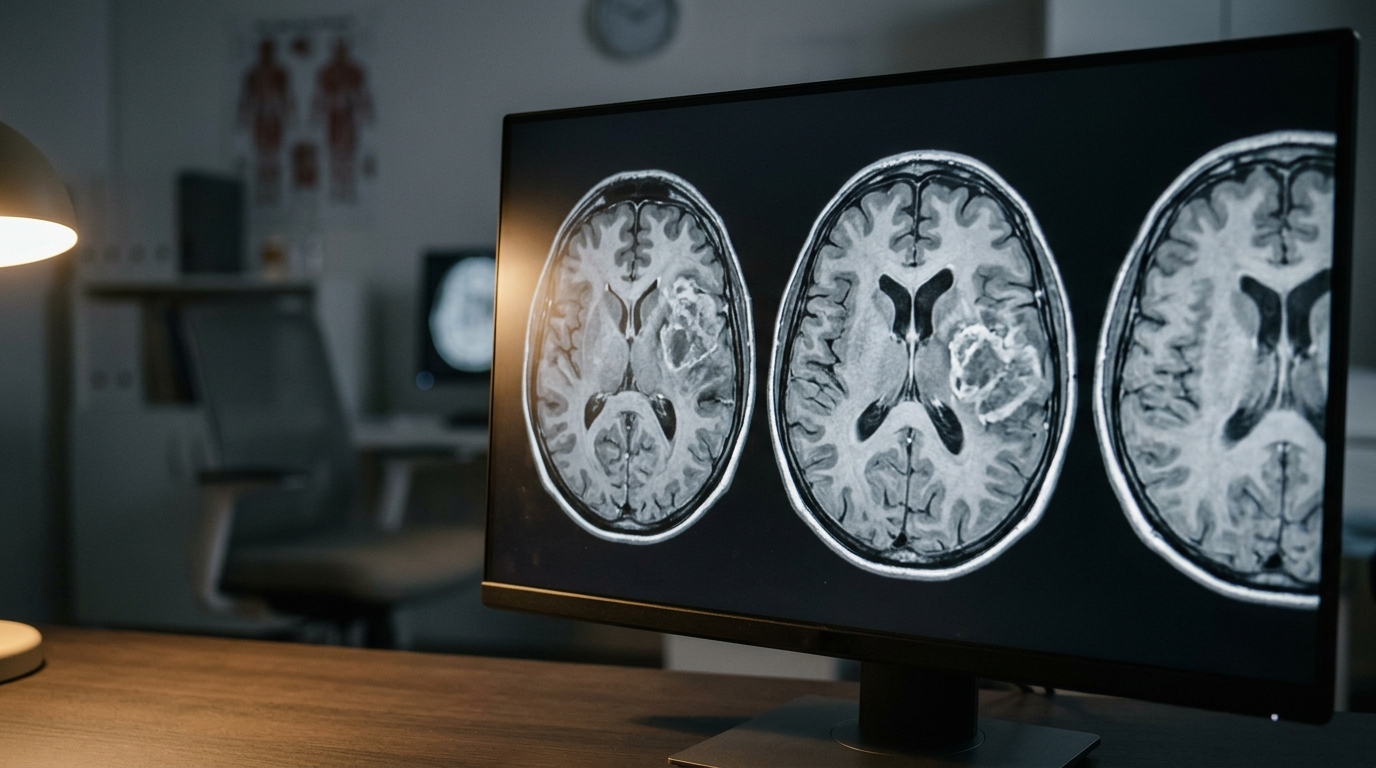
A multimodal machine learning nomogram that integrates clinical, deep learning radiomics, and weakly-supervised pathomics signatures improves overall survival risk stratification in patients with IDH-wildtype glioblastoma, according to an internally validated single-center study. The prognosis for glioblastoma remains dismal, making accurate prognostic stratification crucial for guiding clinical decisions. To address this clinical challenge, researchers established and evaluated the combined multimodal model for individualized survival risk assessment.
The study was conducted using a multimodal dataset comprising 194 consecutively enrolled patients with IDH-wildtype glioblastoma. To evaluate model development and performance, the full patient cohort was split into a training set of 136 patients and a test set of 58 patients using stratified random sampling based on 1-year overall survival status. Feature screening within the training cohort was carried out using LASSO-Cox regression paired with 10-fold cross-validation.
The investigation examined three distinct feature modalities to establish individual prognostic signatures. Clinical features were analyzed using Cox regression to yield a clinical signature model, although these clinical features demonstrated suboptimal performance in prognosis analysis. For imaging data, deep learning neural networks—specifically ResNet101, DenseNet121, and Inception_v3—were applied to extract radiomics features, generating a deep learning radiomics signature designated DL-Rad_Sig. In parallel, pathomics features were extracted from hematoxylin and eosin (H&E)-stained whole slide images, producing a pathomics signature designated Path_Sig.
Both the deep learning radiomics and pathomics models achieved effective prognostic stratification for glioblastoma patients, and pathomics features extracted from H&E-stained whole slide images were significantly associated with clinical outcomes. In evaluation metrics, the DL-Rad_Sig model achieved concordance index values of 0.852 in the training cohort and 0.721 in the test cohort. Modeling for the Path_Sig signature utilized six selected pathomics features, resulting in concordance index values of 0.821 in the training cohort and 0.762 in the test cohort.
When researchers evaluated the fusion of clinical, radiomics, and pathomics signatures against each individual signature, the combined nomogram demonstrated superior predictive performance. For overall survival, the integrated model achieved a C-index of 0.887 in the training cohort and 0.791 in the test cohort. Kaplan-Meier survival curves generated for the combined nomogram showed a statistically significant difference in overall survival rates between high-risk and low-risk patient groups. Furthermore, receiver operating characteristic curve analysis of the nomogram for predicting 1-, 2-, and 3-year overall survival produced area under the curve values of 0.871, 0.725, and 0.833, respectively.
While the multimodal fusion nomogram serves as a non-invasive tool for prognostic evaluation, the authors noted several important constraints. The study performed only single-center internal validation without independent external cohorts, and patch-level pathomics models exhibited obvious training-set overfitting requiring cautious interpretation. Consequently, external multi-center validation remains necessary to verify the generalizability of the findings.
Subject of Research: Multimodal machine learning for glioblastoma survival risk stratification
Article Title: Multimodal data integration using machine learning improves prognosis risk stratification of glioblastoma patients
Article References: Zhou, Q., Ke, X., Zhang, B., Zhang, P., Xue, C., Kang, J., Man, J., Zhao, Z., Zhao, J., & Zhou, J. (2026). Multimodal data integration using machine learning improves prognosis risk stratification of glioblastoma patients. BMC Medical Imaging. https://doi.org/10.1186/s12880-026-03014-7
Image Credits: AI Generated
DOI: 10.1186/s12880-026-03014-7
Keywords: glioblastoma, machine learning, radiomics, pathomics, prognostic stratification, deep learning, overall survival, medical imaging, Multimodal, data, integration, machine
News Source: Blake Davidson. (November 6, 2026). Machine Learning Model Integrates Multimodal Data to Stratify Glioblastoma Survival Risk. Scienmag.