A physics-informed Graph Attention Network model achieved an overall average prediction accuracy of 92.48% for the fatigue life of industrial robotic arms evaluated on a mixed full-condition test set. Across specific operational subsets, the proposed model attained prediction accuracies of 96% to 97% under low-load conditions, 94% to 97% under medium-load conditions, and 93% to 95% under heavy-load conditions. In comparative evaluations, benchmark comparison models reached 91% to 94% accuracy under low-load conditions but decreased to between 88% and 92% under heavy-load conditions.
The research addresses operational settings where industrial robotic arms experience changing load conditions over extended time periods, leading to joint fatigue accumulation that can trigger sudden operational failures. To overcome limitations in conventional life-prediction methods that struggle to integrate spatial topology, temporal degradation patterns, and physical mechanics, the architecture maps robotic arm joints into a topology-mechanics graph. Spatiotemporal features are extracted through dynamic graph attention and temporal units, while a joint loss function incorporates physics regularization.
The framework directly embeds the Miner damage criterion alongside a stiffness-degradation model to achieve end-to-end fatigue-life prediction under variable-load scenarios. Conducted by researcher Jia Guo at Sias University, the investigation demonstrated improved accuracy and robustness under varying load conditions. The author noted that the approach provides technical support for predictive maintenance and health management of industrial robotic arms.
Subject of Research: Fatigue life prediction in industrial robotic arms using physics-informed neural networks
Article Title: Fatigue life prediction of variable-load industrial robotic arms based on physics-informed graph neural networks
Article References: Guo, J. (2026). Fatigue life prediction of variable-load industrial robotic arms based on physics-informed graph neural networks. Frontiers in Mechanical Engineering, 12, Article 2006613. https://doi.org/10.3389/fmech.2026.2006613
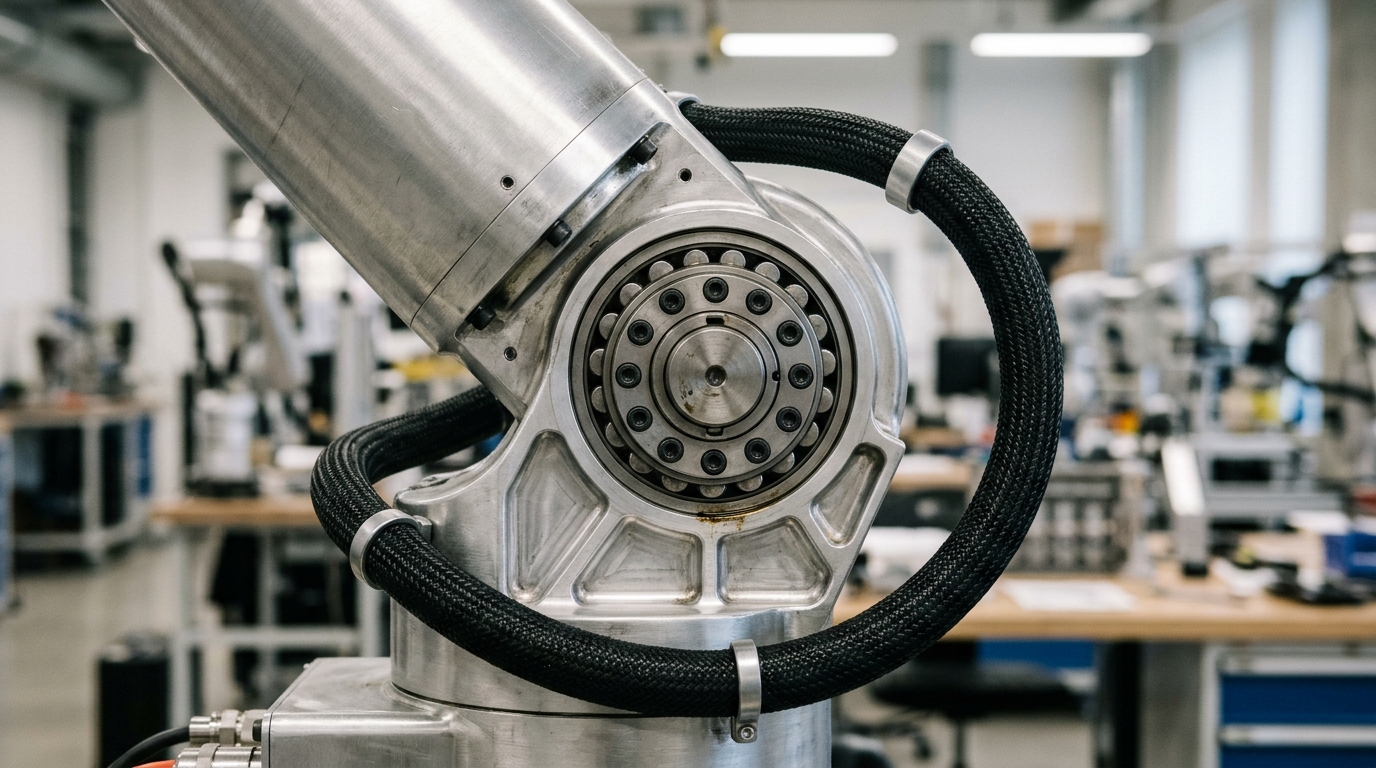
Image Credits: AI Generated
DOI: 10.3389/fmech.2026.2006613
Keywords: Robotic arms, Fatigue life prediction, Graph neural networks, Physics-informed machine learning, Miner damage criterion, Predictive maintenance, Multi-body simulation, Structural mechanics, Fatigue, life, prediction, variable-load
News Source: Katie Riggs. (November 6, 2026). Physics-Informed Graph Network Improves Fatigue Life Prediction for Robotic Arms. Scienmag.