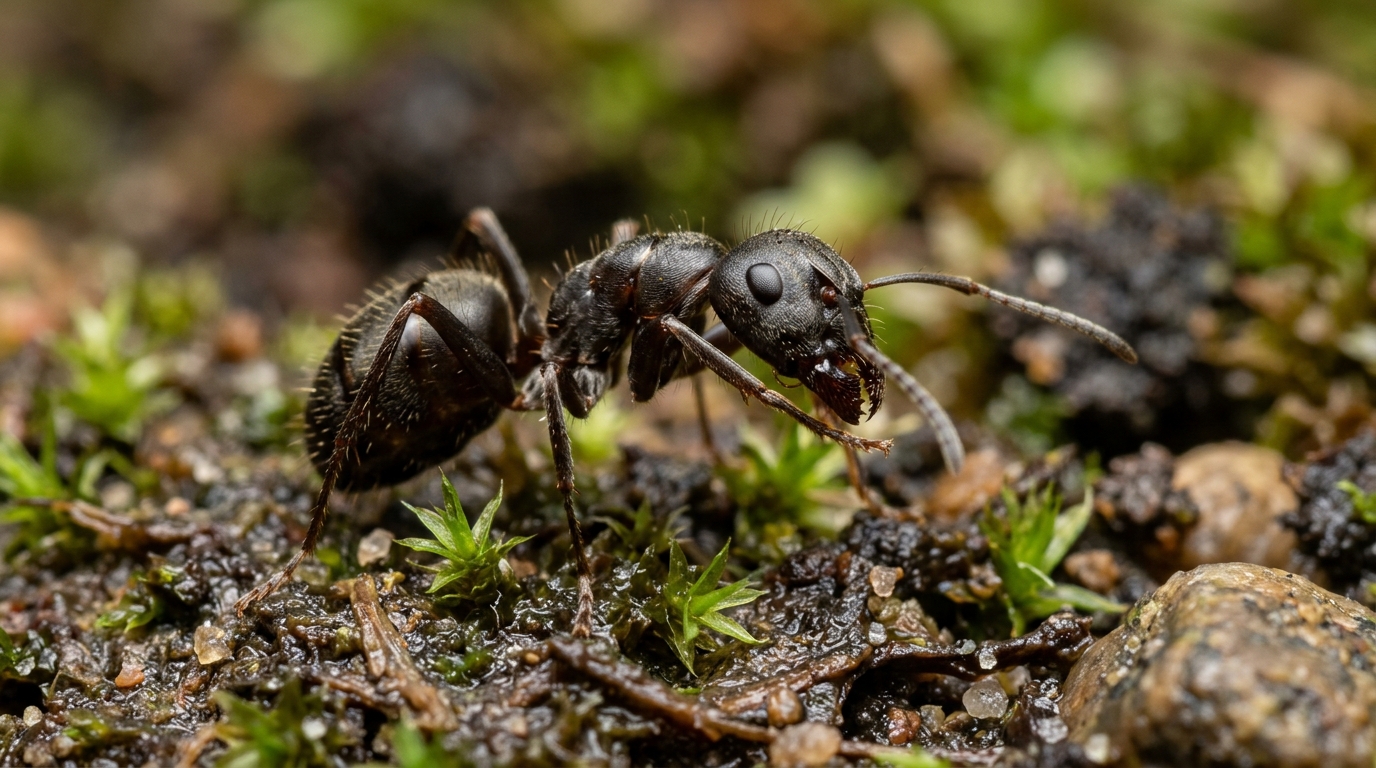
Researchers studying black garden ants have observed behavioural evidence of chronic pain-like sensitization following peripheral injury, marked by the presence of allodynia and time-limited hyperalgesia. In a newly published study appearing in the journal BMC Biology by researchers Moana Vorjans, Meghan Barrett, and Tomer Joseph Czaczkes, injured ants demonstrated an earlier onset of responsiveness to sublethal but increasingly noxious temperatures compared to uninjured sham-control ants.
The study set out to assess behavioural indicators of nociceptive processing that are already well-established in vertebrate research following tissue damage. In vertebrates, tissue trauma frequently induces allodynia, defined as a pain response triggered by normally non-noxious stimuli, as well as hyperalgesia, which manifests as an increased sensitivity to noxious, painful stimuli. Because allodynia and hyperalgesia serve as classic hallmarks of pain sensitization after injury in vertebrate animals, the authors sought to determine whether comparable sensory phenomena could offer valuable insights into nociceptive processing in invertebrates.
To test for these sensory phenomena, the researchers evaluated black garden ants (Lasius niger, an ant species belonging to the insect family Formicidae within the order Hymenoptera). The investigation systematically examined behavioural responses following two specific types of peripheral injury: tarsus amputation and thermal burning. These two injured groups were compared directly against ants that received an uninjured sham treatment. Following the administration of injury or sham procedures under anaesthesia, the ants were systematically evaluated across three distinct recovery intervals: twenty minutes, twenty-four hours, and ninety-six hours post-anaesthesia.
The behavioural assessments were conducted using a ramping hot plate assay designed to deliver sublethal, but increasingly noxious, thermal temperatures. Within this specialized testing environment, the research team quantified two specific behavioural parameters: locomotor speed and the proportion of time spent moving. Specifically, an increased responsiveness exhibited at normally non-noxious temperatures was quantified to detect allodynia, while exaggerated locomotor responses recorded at higher, increasingly noxious temperatures were quantified to evaluate hyperalgesia.
The experimental observations revealed an earlier onset of responsiveness on the ramping hot plate in ants with tarsus amputations and burns compared to the control group, a pattern consistent with allodynia. This allodynia was stronger and more consistent in the tarsus-amputated ants and became more pronounced at later time points. Conversely, the evidence for hyperalgesia proved to be limited and strictly time-dependent. Ants with tarsus amputations displayed a steeper increase in behavioral response at higher temperatures during earlier time points, but this exaggerated effect was absent by ninety-six hours post-anaesthesia. Meanwhile, burn-treated ants demonstrated less consistent evidence of allodynia and showed no detectable evidence of hyperalgesia.
From these observations, the researchers concluded that sensitization in Lasius niger extends beyond the acute injury phase, reinforcing the view that insects possess mechanisms for chronic, pain-like processing. The team also addressed the divergence in outcomes between the two injury types. Because the burn treatment was evaluated as a new injury model in insects, the authors noted that the procedure needs to be refined. Alternatively, they suggested that the underlying physiological mechanisms responsible for burn-induced responses may differ from the mechanisms involved in classic, amputation-induced nociceptive sensitization.
Subject of Research: Chronic pain-like nociceptive sensitization in black garden ants
Article Title: Chronic pain-like responses revealed by allodynia and hyperalgesia in the ant Lasius niger
Article References: Vorjans, M., Barrett, M., & Czaczkes, T. J. (2026). Chronic pain-like responses revealed by allodynia and hyperalgesia in the ant Lasius niger. BMC Biology. https://doi.org/10.1186/s12915-026-02784-4
Image Credits: AI Generated
DOI: 10.1186/s12915-026-02784-4
Keywords: Lasius niger, black garden ants, nociception, allodynia, hyperalgesia, chronic pain, insect behaviour, sensory sensitization, Chronic, pain-like, responses, revealed
News Source: Drew Townsend. (November 6, 2026). Black Garden Ants Display Chronic Pain-Like Responses Following Peripheral Injury. Scienmag.