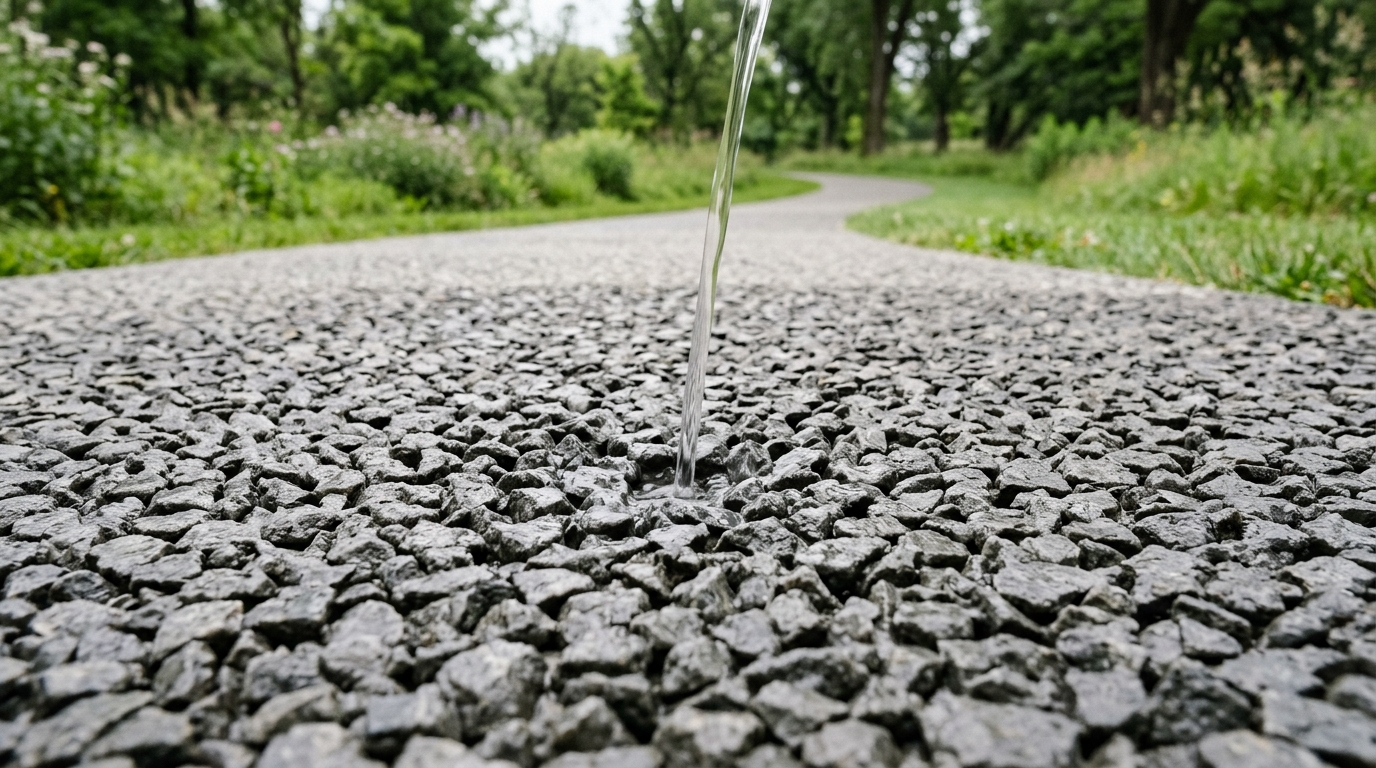
Researchers investigating sustainable paving materials have demonstrated that multi-source solid waste geopolymer pervious concrete can successfully reconcile the traditional engineering conflict between mechanical load capacity and water drainage efficiency. By combining construction and demolition waste powder, ground granulated blast furnace slag, Class II fly ash, and recycled concrete aggregates, the investigation established how interconnected pore networks dictate physical performance. The resulting concrete achieved twenty-eight-day compressive strengths ranging from 14.1 to 18.7 megapascals alongside water permeability coefficients between 6.7 and 11.4 millimeters per second across interconnected porosities of 12.9 to 21.6 percent. Pervious concrete serves as a critical infrastructural component in modern sponge city development because of its capacity to capture stormwater runoff, regulate urban flooding, recharge subsurface aquifers, and provide evaporative cooling. Replacing Portland cement with an alkali-activated binder derived from industrial byproducts provides an effective avenue for solid waste valorization while drastically reducing carbon emissions.
The functional performance of permeable pavements stems directly from their unique internal geometry, which replaces dense sand-and-gravel matrices with an open skeleton of coarse aggregate bound together by thin envelopes of hardened cementitious paste. In conventional configurations, pervious concrete contains fifteen to twenty-five percent interconnected pores, yielding water permeability coefficients generally spanning zero point two to zero point six centimeters per second. While extensive pore channels facilitate rapid drainage, they inevitably diminish the internal cross-sectional contact area available to transfer applied stresses, creating an inherent compromise between structural endurance and fluid conductivity. Prior investigations have explored isolated aspects of alternative geopolymer binders. Chen and colleagues incorporated recycled masonry waste, Azad and colleagues evaluated alkali-activated binder dosages, Luo and colleagues examined aggregate gradation, Liu and colleagues studied vertical channels under acid rain erosion, and Onutai and colleagues emphasized aggregate skeleton optimization. Nevertheless, the coupled effects of multi-precursor solid waste systems on pore network evolution and strength-permeability synergy remained uncharacterized.
To construct an effective multi-source binder, the experimental investigation utilized three distinct industrial and demolition byproducts: construction and demolition waste powder, ground granulated blast furnace slag, and Class II fly ash. The demolition waste powder was prepared by crushing and grinding discarded structural bricks and concrete through a seventy-five micrometer sieve, exhibiting a density of 2.4 grams per cubic centimeter and specific surface area of 340 square meters per kilogram. S105-grade slag had a density of 2.9 grams per cubic centimeter and surface area of 471 square meters per kilogram, while fly ash showed 1.3 grams per cubic centimeter and 519 square meters per kilogram. Demolition waste contained 54.87 percent calcium oxide and 26.49 percent silicon dioxide by weight, while slag supplied 42.46 percent calcium oxide and 30.29 percent silicon dioxide. Fly ash was dominated by silicon dioxide at 53.69 percent and aluminum oxide at 26.67 percent. Sodium silicate and sodium hydroxide formed the alkaline activator, combined with recycled concrete aggregates and natural sand.
The mixture formulation was systematically designed using a volumetric framework based on the geometric relationship among aggregate skeleton, geopolymer binder paste, and void spaces. An optimal precursor mass ratio of five parts construction waste powder to four parts slag and one part fly ash was selected. When activated with a sodium silicate modulus of 1.2, a solid content of fourteen percent, and a water-to-binder ratio of 0.32, the binder met C10 strength criteria. Adopting the volumetric design approach of Nguyen and colleagues, the baseline target interconnected porosity was established at twenty percent under volume additivity principles. Using this baseline, the researchers tested binder-to-aggregate mass ratios of 0.25, 0.26, 0.27, and 0.28, sand-to-binder ratios of 0.1, 0.2, 0.3, and 0.4, and large aggregate proportions of ten, twenty, and thirty percent. Mixtures were prepared in two stages, cast in layers, compacted by vibration, sealed for twenty-four hours, demolded, and cured at twenty degrees Celsius and ninety-eight percent relative humidity.
Mechanical and hydrological evaluations followed rigorous testing protocols to capture the influence of internal structural variations on physical behavior. Compressive and flexural strengths were measured in compliance with GB/T 50081-2019 standards across three parallel specimens per mix. Interconnected porosity was quantified according to T/CSTM 00040-2019 through twenty-four-hour water immersion and submerged versus surface-dry mass measurements. Water permeability coefficients were determined using a constant-head testing apparatus conforming to JC/T 2558-2020, sealed with soft rubber putty to prevent leakage, with effluent volume recorded and adjusted for water dynamic viscosity relative to fifteen degrees Celsius. To obtain detailed morphological data beyond bulk porosity measurements, longitudinal cross-sections taken from the central core of specimens were analyzed using Image-Pro Plus 6.0 software. Threshold segmentation separated black pore regions from the white solid matrix, and two-dimensional equivalent diameters were calculated for individual pores within the field of view to analyze pore size distributions.
Digital image analysis and physical porosity tests demonstrated that mixture parameters fundamentally transformed the internal void architecture of the geopolymer concrete. As the binder-to-aggregate ratio increased from 0.25 to 0.28, interconnected porosity declined steadily before dropping sharply at 0.28. Binarized cross-sections revealed an expansion of solid matrix areas, reduced pore counts, smoother void perimeters, and a transition from open flow paths to isolated pores as thickening paste filled interconnected channels. Variations in the sand-to-binder ratio produced a non-monotonic effect: interconnected porosity remained stable between ratios of 0.1 and 0.3, but plummeted to 16.3 percent at 0.4. Moderate sand additions enhanced paste flowability and aggregate packing, whereas excessive sand filled void spaces. Statistical analysis showed that higher sand contents reduced large three-to-five millimeter pores from 34.5 percent to 22.7 percent while expanding one-to-two millimeter pores from 35.9 percent to 45.3 percent. Large aggregate additions altered skeleton packing without fundamentally disrupting overall pore connectivity.
The evolution of internal pore architecture directly dictated the development of mechanical strength across early and mature curing stages. Testing showed that twenty-eight-day compressive strength increased consistently with higher binder-to-aggregate ratios, climbing from 14.1 megapascals at 0.25 to 18.6 megapascals at 0.28. Thicker geopolymer paste enlarged aggregate contact areas and reduced stress concentrations in the interfacial transition zone, although excessive densification increased brittleness and diminished flexural strength. The influence of fine sand varied by curing age: at three days, compressive strength initially improved and then declined, showing that skeleton-filling effects were most prominent early on. At twenty-eight days, structural compactness dominated, and the porosity reduction at a sand-to-binder ratio of 0.4 produced a compressive strength of 18.7 megapascals. Adding large aggregates reduced compressive strength from 16.5 megapascals to 14.6 megapascals and flexural strength from 4.2 megapascals to 3.3 megapascals at twenty percent content, before both partially rebounded at thirty percent due to improved particle gradation.
Hydraulic testing confirmed that water transport through the hardened geopolymer concrete was strictly governed by interconnected pore continuity rather than total void volume alone. As the binder-to-aggregate ratio rose from 0.25 to 0.28, the permeability coefficient exhibited a continuous decline from 11.4 millimeters per second down to 7.6 millimeters per second as surplus paste blocked internal seepage paths. Raising the sand-to-binder ratio from 0.1 to 0.2 increased permeability from 6.7 to 8.3 millimeters per second by improving channel continuity, but further sand additions obstructed flow paths. Large aggregates maintained permeability within a stable range between 7.0 and 8.1 millimeters per second, reaching its lowest point at twenty percent content. A logarithmic model demonstrated a clear positive correlation between interconnected porosity and permeability. When interconnected porosity approached twenty percent, permeability exhibited a sharp non-linear increase, aligning with percolation theory where isolated voids coalesce into continuous macroscopic conduits.
Underpinning these macroscopic behaviors was the chemical interaction of the multi-source precursors and recycled aggregates. Dissolution of calcium, silicon, and aluminum phases under alkaline activation precipitated calcium- and sodium-aluminosilicate hydrate binding gels, C-(A)-S-H and N-A-S-H, strengthening interfacial bonding despite porous adhered mortar on recycled aggregates. Regression analysis between compressive strength and permeability revealed a moderate negative correlation coefficient of minus 0.53, with a linear equation of compressive strength equaling 21.1 times permeability coefficient minus 0.6 and an R-squared of 0.28. This scatter confirmed that strength and permeability respond differently to pore dimensions, tortuosity, and local defects. When benchmarked against prior research by Anwar and colleagues on recycled aggregate geopolymer pervious concrete—which reported compressive strengths of 1.8 to 12.9 megapascals and permeability coefficients of 1.31 to 4.08 millimeters per second—the present multi-source system demonstrated superior simultaneous performance, maintaining compressive strengths of 14.1 to 18.7 megapascals and permeability of 6.7 to 11.4 millimeters per second across comparable porosities.
To resolve the competing demands of structural bearing capacity and water infiltration, the researchers implemented a multi-objective optimization framework combining response surface regression and the non-dominated sorting genetic algorithm II, known as NSGA-II. Quadratic regression models were constructed using binder-to-aggregate ratio, sand-to-binder ratio, and large aggregate content as design variables. Analysis of variance verified high predictive accuracy, yielding P-values below 0.05, F-values of 8.48 and 11.04, and R-squared values of 0.88 and 0.90 for compressive strength and permeability, respectively. Executing NSGA-II produced a Pareto-optimal front mapping the trade-offs between properties. Three representative points were identified: P1 provided a balanced solution with 16.20 megapascals compressive strength and 10.91 millimeters per second permeability; P2 maximized strength at 20.54 megapascals with 7.47 millimeters per second permeability; and P3 maximized permeability at 11.60 millimeters per second with 16.02 megapascals strength. The researchers highlighted P1 as the preferred design for balanced urban drainage and structural safety, while recommending multiscale characterization for future work.
Subject of Research: Mechanical and permeability performance of solid waste geopolymer pervious concrete
Article Title: Synergistic relationship between interconnected pore structure and mechanical-permeability properties of multi-source solid waste geopolymer pervious concrete
Article References: Wang, Y., Hai, R., Guan, Q., Liu, J., Zhai, S., Cui, L., & Wang, M. (2026). Synergistic relationship between interconnected pore structure and mechanical-permeability properties of multi-source solid waste geopolymer pervious concrete. Case Studies in Construction Materials, 25, Article e06647. https://doi.org/10.1016/j.cscm.2026.e06647
Image Credits: AI Generated
DOI: 10.1016/j.cscm.2026.e06647
Keywords: pervious concrete, geopolymer, solid waste valorization, interconnected porosity, permeability coefficient, compressive strength, NSGA-II optimization, recycled concrete aggregate, Synergistic, relationship, between, interconnected
News Source: Denise Maddox. (November 6, 2026). Solid Waste Geopolymer Pervious Concrete Balances Strength and Water Permeability. Scienmag.