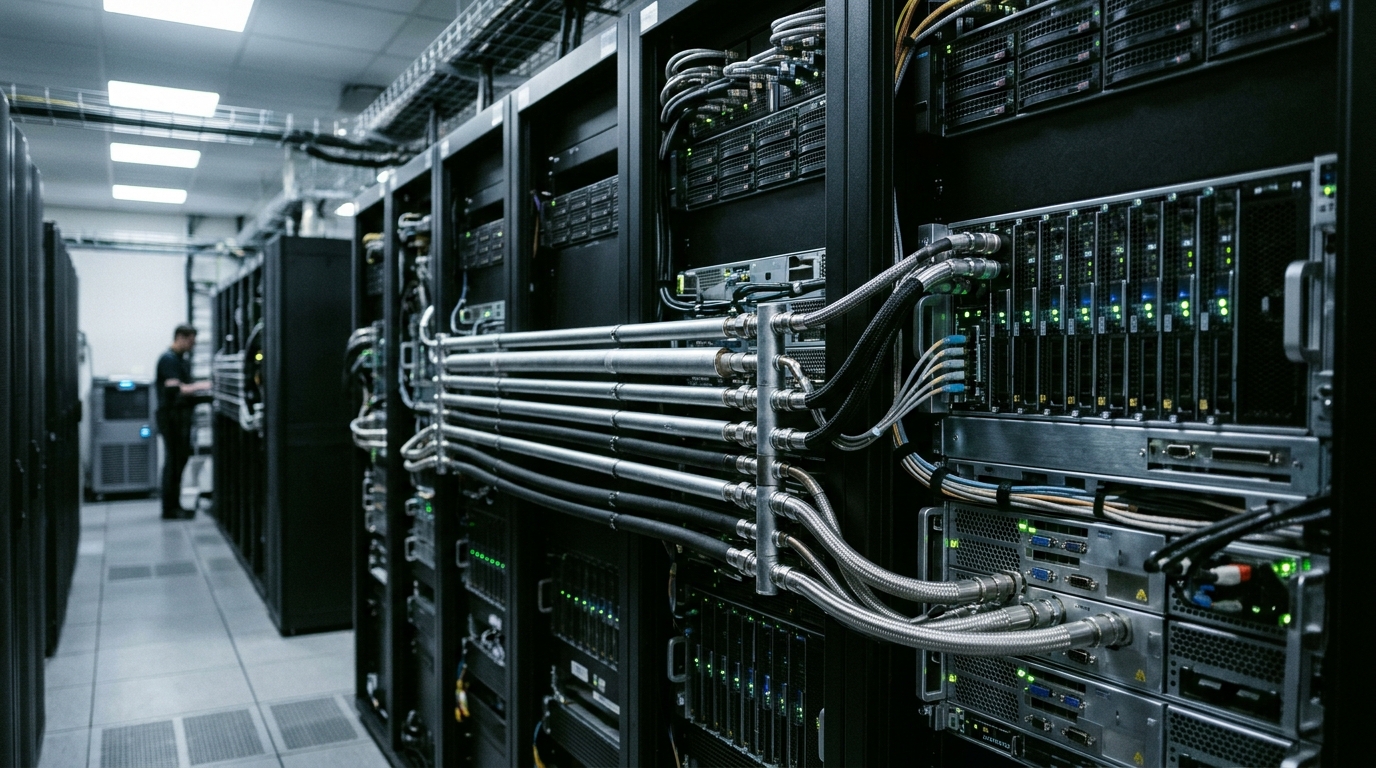
Operating shared computing infrastructure in academic research presents a persistent environmental dilemma when facilities are housed within aging institutional architecture. Modern enterprise data centers frequently implement aggressive structural upgrades to achieve favorable power usage effectiveness ratings, but departmental clusters often operate under severe physical constraints. At a prototype mid-scale computing cluster supporting physics data analysis in research and teaching, scientists addressed this operational barrier by shifting the focus from hardware retrofitting to user-centered efficiency measures. The VISPA facility, situated within an institute building constructed in the 1970s, shares a pre-existing cooling system with several other computing deployments where baseline facility power consumption cannot be altered or separately measured. Because conventional structural modifications offered negligible prospective energy savings, researchers deployed a comprehensive framework that pairs component-level energy accounting and renewable power scheduling with behavioral feedback mechanisms designed to foster voluntary resource conservation across the scientific community.
The physical computing environment comprises a central portal access point, a shared storage system, network architecture, and thirteen worker nodes configured with diverse central processing units and graphics processing units. The cluster orchestrates workloads using the HTCondor batch processing system to serve approximately 3,000 registered accounts, although regular daily usage is driven by a core population of fifty to one hundred coursework students alongside fifteen dedicated research group members. Operational records reveal that while student engagement fluctuates according to academic schedules, doctoral researchers conducting analyses for experimental physics collaborations contribute the overwhelming majority of total compute runtime. To establish an empirical baseline for environmental interventions, investigators integrated metered power distribution units to capture real-time electrical metrics across twelve of the thirteen execution machines, temporarily excluding a single worker medium node due to unit power capacity limits. Monitored records spanning a full calendar year confirmed that cluster demand occurs in intermittent bursts rather than continuous peak load, providing the operational flexibility needed to test schedule adjustments and system suspensions.
Quantifying environmental impacts at the level of individual user tasks required developing an automated energy estimation architecture combining device telemetry with external power metering. Because compute jobs execute concurrently across shared hardware, researchers separated per-job electrical consumption into dedicated central processing unit, graphics processing unit, and machine-level overhead components. Central processing unit energy is derived from Running Average Power Limit readings and distributed according to average utilization percentages captured by operating system control groups relative to concurrent tasks. Graphics processing unit consumption is tracked through the NVIDIA Management Library by weighting total card energy with per-process compute utilization sampled at ten hertz. Remaining node power—encompassing memory, cooling fans, voltage regulators, and interconnects—is calculated by subtracting total processor draws from rack-level distribution unit measurements and allocating overhead proportionally according to job runtimes within the measurement window. To preserve fairness, accounting excludes infrastructure external to the execution nodes, such as shared storage, login servers, and networking hardware.
Validation experiments conducted on isolated workloads executing alone on dedicated nodes demonstrated that component-level approximations align closely with external meter readings, achieving an operational calibration accuracy at or better than the ten percent level. However, technical analysis revealed occasional transient underestimations in graphics processing unit accounting when tasks execute immediately following extended idle periods. This discrepancy stems from intrinsic limitations in streaming multiprocessor utilization metrics, which struggle to record brief initial bursts of computational activity after dormancy. Because observed deviations consistently produce underestimations rather than overestimations of electrical use, system administrators inform cluster participants that generated values represent a reliable lower bound of physical consumption. The accounting system logs completed job metrics multiple times per day within a centralized database, reporting both proportionally shared overhead and full workstation-style baseline allocations so researchers can interpret resource commitments from multiple analytical viewpoints.
To support informed operational choices, researchers established direct integration with electrical grid indicators published by the Fraunhofer Institute for Solar Energy Systems. This public data service provides real-time classifications and forecasted proportions of renewable generation within the German electrical load, categorizing grid conditions into a standardized traffic-light status updated hourly following an evening next-day projection. The signal reports green when the renewable fraction exceeds ninety-five percent or rises more than ten percent above the rolling five-year monthly average, transitions to red when renewable supply drops more than ten percent below that historical baseline, and remains yellow during intermediate conditions. An automated administrative daemon queries the public programming interface every two hours, appending the latest grid classification directly into the cluster batch management configuration by updating machine attributes every fifteen minutes. These external environmental signals establish the technical foundation for carbon-aware workload coordination across the entire facility.
Workload orchestration translates environmental grid data into actionable execution policies through voluntary user parameters submitted alongside standard batch instructions. Users can declare a sustainability preference flag designating green, yellow, or default red execution criteria within submission descriptions or via custom command-line arguments. During scheduling matchmaking cycles, the job manager strictly pairs pending tasks with compute nodes whose published grid attribute meets or exceeds the declared preference, postponing execution until renewable availability satisfies the threshold. To prevent indefinite queue delays caused by persistent meteorological lulls, developers introduced an optional maximum waiting time parameter specified in hours. Once this declared interval elapses without encountering favorable grid conditions, the scheduler overrides the environmental constraint and launches the waiting job as soon as computational hardware becomes available. This dual-flag mechanism enables scientists to seek maximal sustainability while guaranteeing that numerical analyses complete prior to scheduled deadlines or project milestones.
Behavioral interventions and transparent resource reporting are unified under a specialized software suite named PETRA, which functions as both an internal chat service and an interactive terminal environment. The application broadcasts daily forecasts of renewable grid availability, enabling power users to coordinate manual submission timings with anticipated surpluses in clean electricity generation. Beyond general grid signaling, the terminal utility grants users direct access to personal consumption summaries covering recent days, individual tasks, and aggregated project portfolios presented via descriptive ASCII bar graphs. By allowing researchers to append standardized project labels to job metadata at submission, the platform consolidates multi-job energy totals that can be formally reported in peer-reviewed scientific publications to quantify environmental footprints. Migrating these analytical features to a standalone terminal tool ensured full institutional access, decoupling consumption transparency from proprietary messaging platforms and allowing researchers to inspect personal energy footprints directly from their shell workflows.
A parallel optimization targeted computational memory over-provisioning, which frequently degrades cluster throughput and scheduling density. Empirical evaluations of workloads submitted across a three-month observation period revealed that fewer than half of all executed jobs utilized fifty percent or more of their requested memory resources. Because unexpected memory exhaustion terminates active calculations, scientists routinely declare excessive safety margins, reserving capacity that sits unused while blocking subsequent queue submissions. To remedy this structural inefficiency, developers implemented an unobtrusive submission helper that automatically queries past job records for identical commands and executables. Before launching a task, the tool displays historical memory and graphics memory utilization statistics, allowing users to right-size resource requests to fit actual consumption profiles. The workflow preserves existing automation pipelines by proceeding automatically after a brief countdown or confirming immediately upon keystroke input, improving node packing without disrupting unattended multi-job execution frameworks.
To evaluate potential sustainability interventions quantitatively, investigators constructed an accelerated digital twin of the cluster running on a single workstation. The simulation environment deploys unmodified software instances within containerized nodes using production configuration parameters, ensuring identical matchmaking logic and scheduling behavior. Simulated instances emulate expanded hardware profiles, while the underlying framework advances internal clock time ten times faster than physical wall-clock execution, rescaling output energy metrics to represent real-time cluster operations. Workload occupancy traces—capturing peak memory allocations alongside time-averaged processor utilizations—are processed through a five-layer deep neural network trained on seven weeks of minute-level production logging comprising 244,025 empirical samples. Evaluating instantaneous power consumption against physical rack-level distribution unit measurements, the power prediction model achieved a ninety-four percent Pearson correlation coefficient and an aggregate test error of just two percent, providing an accurate engine for comparative policy assessments.
Applying the digital twin to an artificial academic scenario involving four thousand identical jobs submitted across two daily batches illuminated key performance trade-offs among distinct sustainability policies. Assuming perfect resource declarations by users increased node packing factors between 2.2 and 4, substantially decreasing queue waiting times and slightly reducing power consumption, though carbon equivalent emissions rose due to intensified execution during an initial three-hour red grid phase. Implementing dynamic machine shutdown—suspending idle nodes after five minutes of inactivity—reduced power demand and emissions while introducing negligible waiting latency under instantaneous wake-up conditions. Restricting execution strictly to green grid windows lowered emissions but extended median queue delays by roughly ninety minutes. Combining accurate requests with dynamic machine shutdown produced substantial power reductions without delay penalties, while uniting all three interventions generated the lowest overall energy consumption and greenhouse gas emissions while maintaining median waiting times below unmanaged baseline levels.
A subsequent simulation replaying eleven consecutive days of physical cluster history—comprising 9,768 actual jobs characterized by ninety percent machine idleness and four percent graphics processor usage—demonstrated how operational context dictates policy efficacy. In this heavily underutilized environment, dynamic machine shutdown emerged as the single most consequential measure, curtailing total electrical consumption and greenhouse gas emissions by approximately ninety percent. Conversely, retrofitting exact resource declarations without automated shutdowns unexpectedly prolonged queue delays due to slot partitioning and fragmentation artifacts in historical batch dependencies. Furthermore, enforcing unconstrained green-window scheduling in an underutilized environment generated modest emission reductions while occasionally forcing job delays exceeding twenty-four hours, primarily because idle machine baselines cannot be time-shifted and rolling five-year grid references included lower pandemic-era consumption baselines. These findings highlight that dynamic hardware suspension yields immediate gains during low-utilization regimes, while carbon-aware scheduling requires balanced delay caps to deliver sustainable academic computing.
Subject of Research: Sustainable computing interventions and emission simulation in shared institute infrastructure
Article Title: Enabling Users to Work Sustainably on Shared Institute Computing Resources
Article References: Eich, N., Erdmann, J., Erdmann, M., Fischer, B., Gilles, P., Hauptreif, T., & Kelleter, J. (2026). Enabling Users to Work Sustainably on Shared Institute Computing Resources. EPJ Research Infrastructures, 10(1), Article 13. https://doi.org/10.1007/s41781-026-00168-5
Image Credits: AI Generated
DOI: 10.1007/s41781-026-00168-5
Keywords: sustainable computing, carbon footprint, cluster computing, HTCondor, digital twin, energy monitoring, resource allocation, greenhouse gas emissions, Enabling, Users, Work, Sustainably
News Source: Denise Maddox. (November 6, 2026). Research report: Enabling Users to Work Sustainably on Shared Institute Computing Resources. Scienmag.