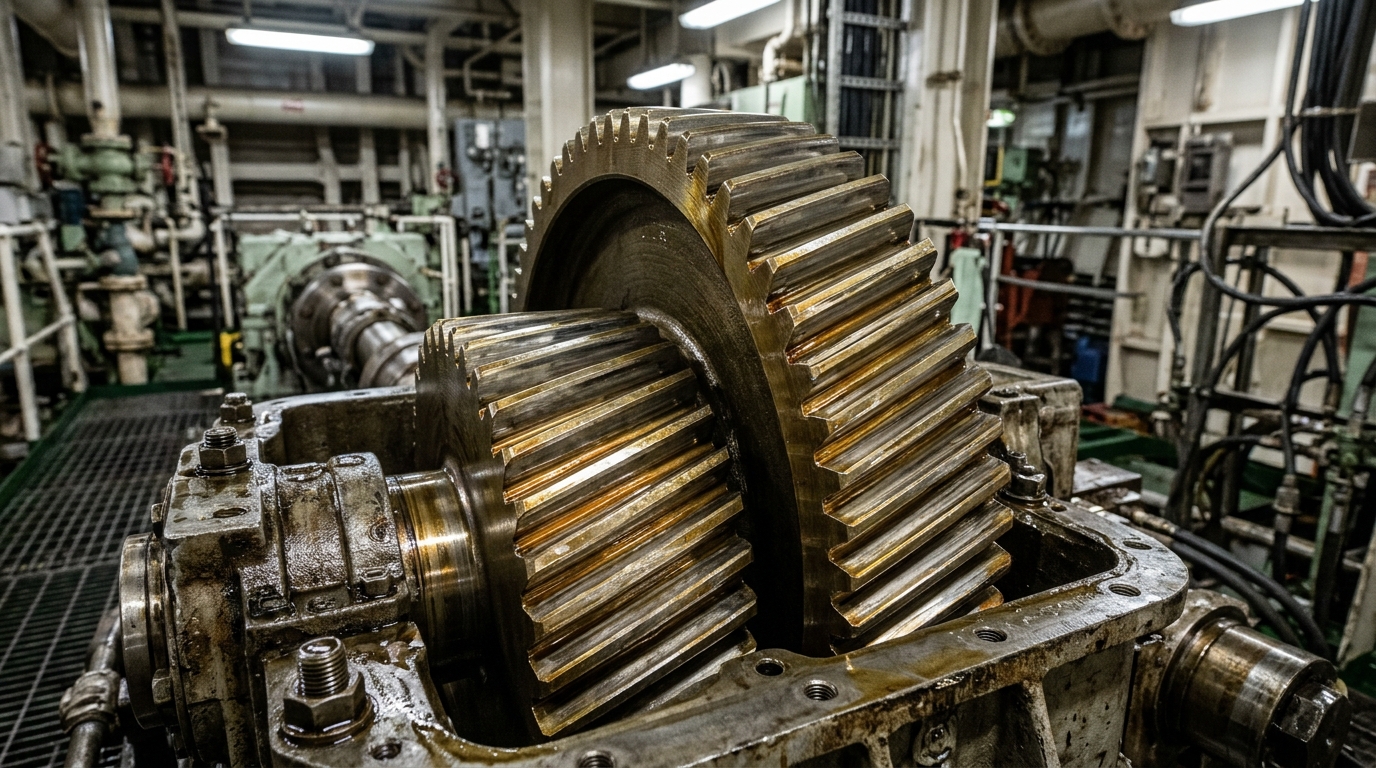
Marine propulsion engineers investigating mechanical drivetrain reliability have determined how diaphragm coupling misalignment degrades tooth contact and amplifies low-frequency vibration in multi-stage gear systems. In a study published in Mechanical Sciences, researchers Jingyi Gong, Kaiyang Chen, Ruikai Dai, Haipeng An, Guanghao Dai, and Bing Yuan analyzed the quasi-static contact characteristics and dynamic responses of a marine transmission chain under parallel and angular coupling misalignment. The research team constructed an integrated framework combining a mechanical coupling model, a sliced static equilibrium formulation, and loaded tooth contact analysis to simulate non-ideal tooth engagement. Their findings reveal that coupling misalignment introduces significant mesh stiffness fluctuations occurring at twice the shaft rotational frequency, alongside asymmetric load distribution across double-helical gear teeth. Under light operating loads, this misalignment induces partial tooth separation and extensive contact loss, while resonant operation substantially escalates dynamic meshing forces.
Rotating machinery across maritime vessels frequently experiences alignment discrepancies, with historical failure data associating rotor misalignment with over sixty percent of rotating equipment faults. Experimental testing shows that misalignment typically increases gearbox vibration amplitudes by twenty to forty percent, accelerating bearing damage and component distress. While flexible diaphragm couplings are widely used in marine propulsion because they accommodate minor offsets, true coaxial alignment cannot be sustained during vessel operation. Base height deviations, assembly errors, dynamic hull deformations, and variable operational stresses inevitably impose parallel and angular misalignments across connected gearbox units. In multi-engine marine propulsion gear trains, several gearboxes are commonly linked in series, creating multiple sources of mesh excitation and coupling misalignment. Interactions among series-connected gearboxes generate coupled vibration throughout the drivetrain, where flexible transmission elements interact with time-varying misalignment forces and moments to produce complex operational instability.
To establish the physical mechanisms governing these interactions, the study analyzed a representative marine propulsion transmission line comprising an engine designated M1, an intermediate clutch gearbox identified as GB1, and a secondary parallel gearbox designated GB2. In this architecture, individual engines drive propeller shafts either independently or jointly through clutch engagement and disengagement sequences. The gear pairs within the gearboxes feature double-helical configurations with wide-faced designs, where the face width on each helical side exceeds ten times the gear modulus. Symmetrically arranged sliding journal bearings support the rotating gear shafts on either side of each gear pair. Hydrodynamic lubrication theory determines the direct and cross-coupled dynamic stiffness and damping coefficients of these journal bearings, adopting formulations from prior studies. The flexible diaphragm coupling connecting the gearbox units introduces mechanical compliance, whose bending and radial stiffness characteristics dictate how parallel and angular shaft misalignments transfer reactionary forces and bending moments into adjacent rotating elements.
The researchers formulated an analytical model capturing both planar parallel misalignment and three-dimensional angular misalignment across the diaphragm coupling. Based on kinematic deformation at bolt holes on the coupling diaphragm, trigonometric expressions describe the relative displacements of the coupling halves to calculate resultant radial forces, axial forces, and tilting moments. In parallel misalignment, relative lateral offsets produce cyclic deformation across diaphragm bolt locations, generating periodic reactionary forces. Under angular misalignment, tilting angles separate the coupling halves axially and produce bending moment components that rotate with shaft angular position. These misalignment forces and moments are directly applied to corresponding nodes within a sliced static equilibrium model. Discretized into Timoshenko beam elements, discrete bearing supports, and sliced gear contact elements, each gear slice possesses twelve generalized degrees of freedom. In this formulation, whenever the calculated relative displacement along the line of action becomes negative, the slice is identified as disengaged, setting its instantaneous mesh stiffness to zero.
To determine realistic tooth engagement under load, the authors coupled the sliced static formulation with loaded tooth contact analysis through an iterative numerical procedure. The loaded contact model partitions structural deformation into macroscopic bending compliance of shafts and gear blanks and microscopic elastic contact deformation across individual contact points. Initial geometric gaps caused by shaft bending are assigned to contact points, incorporating gear mesh misalignment derived from international standards. The computational process begins by discretizing the transmission assembly, computing coupling misalignment forces, and estimating initial slice stiffnesses. Solving the global static equilibrium equations yields nodal shaft deformations, from which actual mesh misalignments are determined. These updated clearances are reintroduced into the contact analysis equations to recalculate slice stiffnesses and static transmission error. Iterations repeat until the relative error between consecutive nodal deformation vectors drops below a convergence tolerance, outputting converged mesh stiffness, static transmission error, tooth load distributions, and mesh misalignments.
The foundational modeling framework was experimentally corroborated using an isolation-mounted, power-circulating double-helical gear test rig established in previous research by the authors. This specialized testing apparatus enabled precise measurement of rotational vibration acceleration, applied shaft torque, and structural resonance frequencies under controlled operating conditions. Numerical predictions generated by the underlying transmission model exhibited close agreement with experimental observations across vibration responses, torque influences, and resonance frequencies. This consistency confirmed that the sliced finite-element formulation and contact mechanics accurately reproduce the global dynamic response of wide-faced double-helical gear machinery. Having validated the core modeling framework, the researchers applied it to systematically investigate coupling misalignment. To isolate individual kinematic effects, the authors defined a baseline reference condition with parallel offsets of zero point zero five millimeters along both transverse axes, an axial separation of zero point twenty-five millimeters, and an angular offset of zero point twenty-five degrees, scaling individual parameters from two to six times baseline values.
Single-factor sensitivity analysis revealed that the transverse parallel offset along the horizontal axis exerts the most substantial influence on meshing stiffness, followed by the vertical parallel offset, whereas angular misalignment shows a weak, non-monotonic effect and axial separation has no significant impact. The authors explained that gear mesh misalignment responds primarily to torsional and bending shaft deflections, while axial displacement produces negligible line-of-action alterations. When evaluating the g2 double-helical gear pair across varying misalignment levels, the mesh stiffness curve exhibited distinct long-period fluctuations occurring at twice the shaft rotational frequency, matching the cyclic coupling force frequency. Because the central relief groove divides the herringbone gear into two isolated helical sections, the left and right tooth surfaces experience differing mesh misalignments. During meshing cycles forty-two through eighty-six and one hundred forty-two through one hundred eighty-six, the left helical gear maintains full contact, stabilizing mesh stiffness. Outside these intervals, localized tooth disengagement substantially reduces contact line length and drops mesh stiffness.
Examining specific meshing cycles demonstrated how misalignment forces distort tooth engagement symmetry between opposing helices. In the thirteenth mesh cycle of the g2 gear pair, the left tooth exhibited significantly greater mesh misalignment than the right tooth, with left-side misalignment escalating as coupling misalignment increased. This shaft bending reduced the actual contact line length on the left tooth, causing left mesh stiffness to drop sharply. Meanwhile, the peak misalignment on the right tooth reached only eleven point fourteen micrometers across all six misalignment cases, preserving full tooth contact and steady right-side stiffness. In contrast, by the sixty-sixth mesh cycle, rising coupling misalignment progressively reduced mesh misalignment on the left tooth while increasing misalignment on the right tooth. Tooth surface contact patterns consequently evolved from local disengagement on the left tooth in case one to full contact on the left tooth and disengagement on the right tooth in case six, confirming that coupling misalignment redistributes contact stresses rather than producing uniform degradation.
The investigation also evaluated operating load torque across six values ranging from three thousand seven hundred eighty-four to twenty-two thousand seven hundred five Newton-meters. Under light load conditions, gear meshing forces are minimal, allowing coupling misalignment moments to govern shaft bending deflections. Consequently, extensive contact loss develops across tooth surfaces, causing pronounced long-period fluctuations in mesh stiffness. As transmitted torque increases, the larger tooth meshing forces dominate structural deformation, diminishing the disengaged tooth area until complete surface contact is established, thereby suppressing long-period stiffness fluctuations. In the g2 pair, which sits closer to the misaligned coupling, the left helical gear exhibits more pronounced stiffness fluctuations than the right helical gear. The g3 pair, located farther from the coupling, experiences smaller misalignment forces, displaying symmetric mesh misalignment and sinusoidal stiffness variations. At higher torque levels, increased shaft torsional deflection causes slightly higher misalignment on the right tooth surface of the g3 pair due to its proximity to the output end.
Incorporating coupling misalignment into the system differential equation of motion revealed strong dynamic interactions, solved via frequency-domain Fourier series expansion. Coupling-misalignment excitation produced an acute resonance peak in the g2 gear pair at two thousand three hundred fifty revolutions per minute, accompanied by an unmistakable spectral band at twice the shaft frequency. Dynamic meshing force spectra also displayed inter-gearbox coupling resonance between GB1 and GB2 at two thousand three hundred revolutions per minute, with the gear meshing frequency modulated by twice the shaft frequency to generate distinct sidebands. Bearing reaction forces increased significantly under coupling misalignment; bearings b3 and b4 in GB1 displayed a major resonance peak at three thousand one hundred revolutions per minute, while bearings b5 through b10 in GB2 exhibited peaks at two thousand three hundred fifty and three thousand one hundred revolutions per minute. At the two thousand three hundred fifty revolutions per minute resonance, root mean square dynamic meshing forces of the g2 left gear escalated from nine hundred nine point zero six Newtons when aligned to thirty thousand five hundred seventy-nine point forty-six Newtons in case one, sixty thousand five hundred fifty point nineteen Newtons in case two, and ninety-one thousand two hundred thirteen point eighty-two Newtons in case three. Concurrently, spectral amplitudes at twice the shaft frequency under nine hundred revolutions per minute rose from one thousand nine hundred thirty-six point sixty-four Newtons to three thousand seven hundred thirty-five point sixteen Newtons across cases one to three. Although increasing misalignment intensified vibration amplitudes, it did not alter resonance speeds, and load torque predominantly governed mesh-frequency vibration responses. The researchers concluded that incorporating backlash and two-way contact coupling will further enhance drivetrain reliability.
Subject of Research: Quasi-static contact and dynamic vibration analysis of misaligned marine gear systems
Article Title: Quasi-static and dynamic characteristics analysis of a marine gear system under coupling misalignment
Article References: Gong, J., Chen, K., Dai, R., An, H., Dai, G., & Yuan, B. (2026). Quasi-static and dynamic characteristics analysis of a marine gear system under coupling misalignment. Mechanical Sciences, 17(2), 1003-1021. https://doi.org/10.5194/ms-17-1003-2026
Image Credits: AI Generated
Keywords: marine engineering, gear transmission, coupling misalignment, mesh stiffness, vibration dynamics, double-helical gears, loaded tooth contact analysis, naval propulsion, Quasi-static, dynamic, characteristics, analysis
News Source: Denise Maddox. (November 6, 2026). Coupling Misalignment Alters Tooth Contact and Escalates Marine Gear System Vibration. Scienmag.