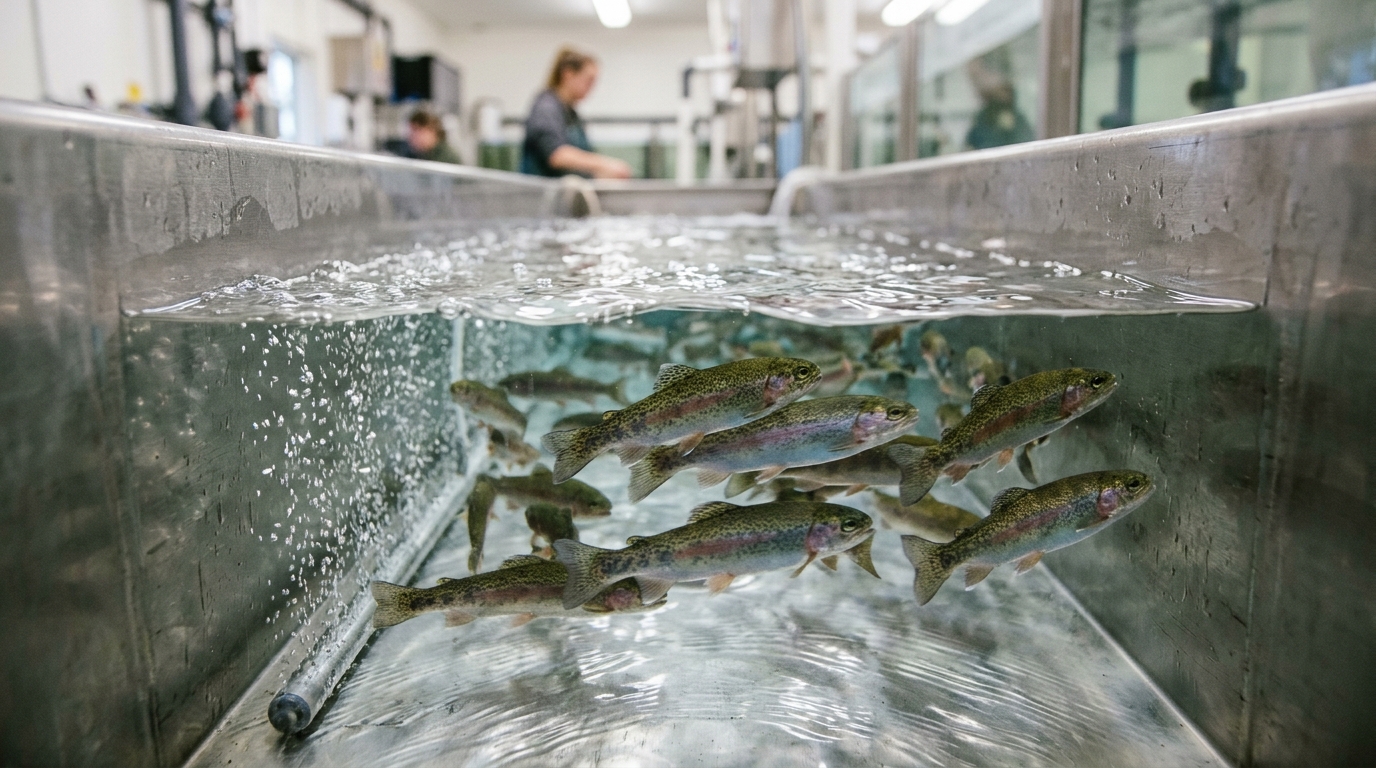
A controlled aquaculture breeding study conducted in the high-altitude conditions of Jammu and Kashmir has demonstrated that crossing geographically differentiated rainbow trout populations, when coupled with modern steel incubation technology and age-structured broodstock protocols, substantially enhances juvenile growth, feed efficiency, and early life survival. Published in Aquaculture Science and Management, the research evaluated six complete diallel cross-breeding combinations alongside three pure-bred control groups, monitoring growth performance over a six-month duration of 180 days while assessing reproductive metrics, age-dependent broodstock capacity, and incubation tray efficiencies during the winter spawning period. Across all tested groups, the cross between North Kashmir males and South Kashmir females achieved the highest growth metrics, attaining an average body weight of 28.4 grams and a total length of 18.7 centimeters, while displaying a mid-parent heterosis value of 45.3 percent. Simultaneously, the deployment of modern stainless steel incubation systems increased overall embryonic survival from fertilization to the swim-up fry stage by 83.1 percent relative to traditional mesh systems, delivering an empirical framework for cold-water salmonid production.
The investigative trials were carried out at the Faculty of Fisheries within the Sher-e-Kashmir University of Agricultural Sciences and Technology of Kashmir, located at Rangil in Ganderbal District at an elevation of approximately 1,619 meters above sea level. Water supplies were continuously sourced through flow-through concrete raceways measuring 10 meters in length, 2 meters in width, and 1.5 meters in depth, fed directly by cold-water streams originating from Himalayan snowmelt. Environmental monitoring confirmed that raceway water temperature was maintained at 12 plus or minus 2 degrees Celsius, dissolved oxygen concentrations remained strictly above 8 milligrams per liter, and water pH stayed consistently within the neutral range of 7.0 to 7.5 throughout the culture period. The experimental animals comprised 600 total parent fish drawn from three distinct demographic sources: 220 individuals collected from high-altitude natural streams in the South Kashmir districts of Anantnag and Kulgam, 180 individuals sourced from lower-altitude water systems in the North Kashmir districts of Baramulla and Kupwara, and 200 domesticated individuals obtained from a local commercial hatchery facility.
To evaluate genetic combining abilities and reciprocal parental effects, the researchers established a full diallel crossing matrix consisting of North males crossed with South females, South males with North females, North males with Hatchery females, Hatchery males with North females, South males with Hatchery females, and Hatchery males with South females, alongside pure North, South, and Hatchery lines. Artificial fertilization was executed using the standard dry fertilization method, drawing gametes from cohorts of 15 mature males and 20 mature females per population to minimize individual parental bias and maintain representative genetic diversity. Each mating combination was established in triplicate, with every experimental replicate receiving a standardized minimum baseline of 1,000 fertilized eggs. Rearing of progeny across the 180-day growth trial was accompanied by routine monthly morphometric tracking, wherein random samples of 50 individuals per replicate were assessed for body weight on precision digital balances to within 0.01 grams, alongside standard length and total length measurements recorded to within 0.1 centimeters.
Growth assessment over the 180-day evaluation interval revealed statistically significant divergence in growth velocity and nutritional conversion across the nine experimental combinations. Progeny derived from the North male and South female cross led all cohorts with a final mean body weight of 28.4 plus or minus 3.2 grams and a total length of 18.7 plus or minus 1.8 centimeters, followed closely by the South male and Hatchery female cross, which attained 26.8 plus or minus 2.9 grams and 17.9 plus or minus 1.6 centimeters, and the Hatchery male and North female cross at 25.6 plus or minus 3.1 grams and 17.4 plus or minus 1.7 centimeters. Across the entire trial, the specific growth rate varied between 1.82 and 2.14 percent per day, with the fastest daily rates observed among the top-performing hybrid lines. Feed efficiency mirrored these growth increments, as feed conversion ratios ranged from 1.32 to 1.68 across cohorts, representing a 12.4 percent improvement in feed conversion efficiency for the North male and South female cross compared to the less efficient rearing cohorts.
Quantitative analysis of hybrid vigor uncovered broad variations in mid-parent heterosis for body weight, extending from negative 0.7 percent up to positive 45.3 percent across the various crossing combinations. The extraordinary positive heterosis of 45.3 plus or minus 2.1 percent achieved in the North male by South female cross highlights pronounced genetic complementarity between the semi-wild populations from North and South Kashmir. This hybrid vigor reflects the masking of deleterious recessive alleles accumulated within locally adapted stocks and the expression of favorable epistatic interactions between distinct genomic complexes. In sharp contrast, the cross between North Kashmir males and Hatchery females produced negative heterosis of minus 0.7 plus or minus 1.5 percent, documenting outbreeding depression. This depressive outcome suggests that crossing the semi-wild North Kashmir population with the commercially selected Hatchery stock disrupted co-adapted gene complexes that had evolved separately through natural environmental adaptation on one side and domestic commercial selection on the other.
Diallel evaluation using Griffing fixed-effects modeling demonstrated that general combining ability and specific combining ability operate through distinct genetic pathways within these cold-water trout populations. The commercial Hatchery stock exhibited the highest positive general combining ability for growth traits, scoring plus 2.84 plus or minus 0.42 for final body weight, whereas the high-altitude South Kashmir stock exhibited a negative general combining ability value of minus 1.95 plus or minus 0.41 for the same parameter. Nevertheless, when the South Kashmir stock was mated with the North Kashmir stock, the specific combining ability effects exceeded the additive predictions of the parental general combining ability values, generating the top-performing cross of the trial. These findings demonstrate that general combining ability alone is inadequate for forecasting commercial cross performance in rainbow trout, underscoring the critical necessity of empirically measuring specific combining ability to identify pairs that exhibit synergistic genomic compatibility.
Reproductive evaluations carried out during the natural spawning season from December through February identified significant variations in female fecundity and progeny viability across cross combinations and calendar months. Among all tested lines, the cross between South Kashmir males and Hatchery females yielded the highest relative fecundity at 2,234 plus or minus 156 eggs per kilogram of body weight, closely trailed by the Hatchery male and South female cross at 2,187 plus or minus 142 eggs per kilogram, and the North male and South female cross at 2,156 plus or minus 163 eggs per kilogram. While fertilization success remained consistently robust across all tested groups at rates exceeding 85 percent, subsequent hatching rates showed greater inter-group dispersion. Monthly seasonal assessments revealed that total egg production reached its zenith in February, yielding an average of 942 plus or minus 45 eggs per female, whereas the highest embryonic survival rates were recorded in January, reflecting temporal shifts in environmental conditions and egg quality across the winter breeding window.
Evaluation of female broodstock age cohorts comprising 2-plus, 3-plus, and 4-plus year-old fish, stratified by scale reading and historical records with 50 females per age group, demonstrated clear age-dependent performance thresholds. Female trout in the 3-plus age category achieved optimal reproductive productivity, recording a mean relative fecundity of 1,998 plus or minus 65 eggs per kilogram alongside a hatchling survival rate of 78.2 percent. Conversely, 4-plus year-old broodstock exhibited significant reproductive senescence, with relative fecundity declining by 21 percent down to 1,576 plus or minus 54 eggs per kilogram and hatchling survival dropping to 55.4 percent. Interestingly, although older 4-plus females exhibited lower overall egg quantity and reduced offspring survival, they produced significantly larger individual eggs, averaging 65.5 plus or minus 0.7 milligrams compared to 60.0 plus or minus 0.9 milligrams in the 3-plus cohort. Fertilization rates remained stable above 78 percent across all age brackets, indicating that reproductive decline in older fish was primarily driven by maternal ovarian factors rather than fertilization failure.
Direct technological comparisons between modern stainless steel incubation trays and traditional mesh systems demonstrated substantial survivability gains across all critical developmental phases. Across three replicated trials using 500 fertilized eggs per replicate from each mating group, total cumulative survival from fertilization through to the swim-up fry stage reached 50.9 plus or minus 3.2 percent in steel incubation trays compared to only 27.8 plus or minus 2.1 percent in traditional mesh trays. This absolute gain of 23.1 percentage points represents an 83.1 percent relative survival improvement attributable to superior surface biosecurity, optimized hydrodynamic water flow, and enhanced dissolved oxygen distribution. The survival advantage of modern steel trays was particularly pronounced during the fragile eyed ova stage, where survival reached 65.0 plus or minus 2.8 percent in steel units versus 42.0 plus or minus 3.2 percent in mesh units, effectively mitigating early pathogen colonization, including water molds such as Saprolegnia parasitica which frequently cause severe losses in high-altitude salmonid hatcheries.
The study highlights practical economic and managerial implications for cold-water salmonid aquaculture, where feed inputs represent 50 to 60 percent of total production expenditure and early fry mortality often exceeds 50 percent in conventional systems. The 12.4 percent improvement in feed conversion ratio achieved by the top-performing hybrid, paired with the 83.1 percent relative surge in incubation survival, provides a concrete pathway to reduce unit production costs while lowering metabolic waste output in pristine mountain waterways. To translate these empirical findings into sustainable commercial practices, the authors recommend implementing structured broodstock rotation systems centered around 3-plus year-old females, standardizing modern steel incubation hardware, and adopting planned cross-breeding programs that capitalize on specific combining ability. Future research priorities outlined by the investigative team include resolving the molecular mechanisms governing heterosis, creating genomic selection markers for thermal tolerance, and establishing regional genetic repositories to support resilient cold-water aquaculture across mountain environments.
Subject of Research: Cross-breeding performance, broodstock age dynamics, and incubation technology in rainbow trout aquaculture
Article Title: Breeding performance and growth pathways in rainbow trout: towards sustainable aquaculture practices
Article References: Rather, M. A., Ahmad, I., Khan, I. A., Bhat, I. A., Aga, A. F., Amin, A., & Ghara, S. (2025). Breeding performance and growth pathways in rainbow trout: towards sustainable aquaculture practices. Aquaculture Science and Management, 2(1), Article 22. https://doi.org/10.1186/s44365-025-00028-0
Image Credits: AI Generated
DOI: 10.1186/s44365-025-00028-0
Keywords: rainbow trout, Oncorhynchus mykiss, aquaculture, crossbreeding, heterosis, broodstock management, incubation systems, feed conversion ratio, Breeding, performance, growth, pathways
News Source: Alan Morgan. (November 6, 2026). Crossbreeding and Steel Incubators Boost Rainbow Trout Growth and Hatchery Survival. Scienmag.