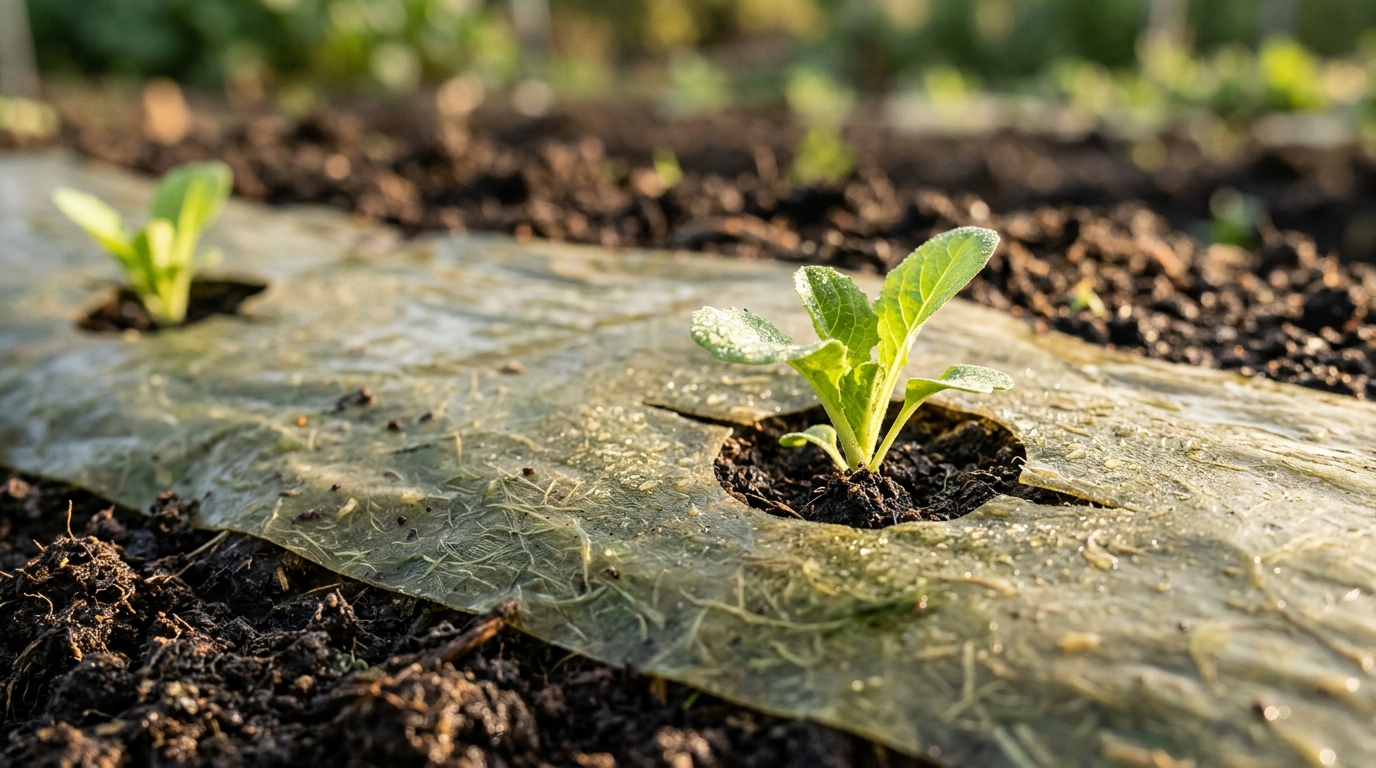
In pots of Italian red chicory, plants grown under the seaweed mulch developed larger leaves and accumulated more biomass than plants grown under black polyethylene mulch or with no mulch at all.
The biomass was washed, dried at 40 °C, ground into a powder finer than 50 micrometers, and then subjected to mild alkaline hydrolysis: one gram of powder was mixed with 20 milliliters of 1 M ammonium hydroxide and incubated at 40 °C for 24 hours. This treatment disrupts the algae’s cellular structure, releasing endogenous polymers and other constituents into the film-forming mixture, which was then cast into films and dried under a fume hood for 48 hours. No purification step followed, so the films retained the full composition of the seaweed, including sulfated polysaccharides known as ulvans, proteins, minerals, and pigments.
Because raw hydrolyzed seaweed films were too brittle to handle, the researchers screened a bio-derived plasticizer, diglycerol, at 10, 20, and 30 weight percent. Diglycerol is a low-molecular-weight polyol whose extra hydroxyl groups form more hydrogen bonds with the polysaccharide network than glycerol can. Mechanical testing showed the trade-off clearly: Young’s modulus fell from 47.3 megapascals at 10 percent diglycerol to 21.5 megapascals at 30 percent, while elongation at break rose to 21.5 percent at the highest loading. Tensile strength dropped by roughly half at 30 percent diglycerol. The intermediate 20 percent formulation, designated HU_20DG, offered the best balance of flexibility, strength, and thermal stability, and scanning electron microscopy revealed a compact, homogeneous cross-section rather than the fractures and voids seen in unplasticized films.
To give the films some resistance to water, the team blended natural rubber latex — a biodegradable elastomer harvested from Hevea brasiliensis — into the HU_20DG base at 10, 20, and 30 weight percent. Latex is hydrophobic, so it partially offsets the inherent hydrophilicity of the polysaccharide matrix. As latex content rose, moisture content fell to around 15 percent across all latex-containing samples, and water solubility dropped markedly: films with 20 and 30 percent latex showed solubility values 10 and 32 percent lower, respectively, than films with little or no latex. Water vapor permeability also declined slightly, from 8 × 10⁻⁹ to 6.19 × 10⁻⁹ grams per meter per second per pascal at the highest latex loading, though the authors note these permeability differences were not statistically significant. Infrared spectroscopy found no evidence of covalent bonding between the components; the interactions appear to be physical, governed by hydrogen bonding and mechanical interlocking.
The optical behavior of the films matters for weed suppression, since opaque mulches block the photosynthetically active radiation that weed seeds need to germinate. Films without latex or with 10 percent latex transmitted less than 5 percent of incident light across the 400–700 nanometer range, making them highly opaque. Adding 20 percent latex raised transmittance to below 15 percent, and 30 percent latex produced the most translucent films, reaching about 30 percent maximum transmittance at an average thickness of 0.017 millimeters.
Mechanically, the latex-blended films became more elastomer-like as latex content increased. Young’s modulus dropped from 47.3 megapascals in the latex-free base to 19.6 megapascals at 30 percent latex, and tensile strength fell from 10.32 to 2.64 megapascals, while elongation at break climbed to 28 percent. Pure latex itself stretches to 1355 percent before breaking, and the rubbery phase acts as a soft domain that absorbs deformation energy. The authors acknowledge that the films remain mechanically inferior to low-density polyethylene and commercial biodegradable polyesters such as PLA and PHA, but they judged the performance sufficient for handling and greenhouse testing.
Soil burial tests put the film’s degradability to the test. Discs of 20DG20LX were sealed in polyethylene mesh bags and buried in pots of commercial potting soil held at 60 percent moisture and an average indoor temperature of 21 ± 2 °C. After seven days the films had lost roughly 16 percent of their mass; by 15 days the loss reached 62 percent, and after one month it stood at 65.18 percent. During this period the films grew visibly thinner but stayed macroscopically intact, with no perforations. By 60 days, rupture and fragmentation were evident, and the remaining fragments adhered strongly to the surrounding soil. The authors caution that they did not investigate the specific degradation mechanisms or the contribution of individual film components, so the observed mass loss reflects progressive disintegration rather than a fully characterized breakdown pathway.
The greenhouse experiment compared three treatments — seaweed mulch, commercial black polyethylene mulch, and bare soil — each applied to ten independent pots containing one Italian red chicory seedling. After 30 days, plants under the seaweed mulch showed an 18 percent larger leaf area than those under polyethylene and 16 percent larger than unmulched controls. Fresh weight was 32 percent higher than the bare-soil control and 14 percent higher than the polyethylene treatment, with a similar trend in dry weight. Chlorophyll fluorescence measurements of photosystem II efficiency, however, showed no significant differences among treatments, with Fv/Fm values of about 0.80 in all three groups, indicating the photosynthetic apparatus remained fully functional regardless of mulch type.
Why the seaweed mulch promoted growth remains unresolved. The authors note that gradual degradation of the film could potentially release compounds naturally present in U. lactuca biomass, and seaweed products are well documented as plant biostimulants when applied as extracts or soil amendments. But the study did not measure nutrient-release kinetics, phytohormone-like compounds, root development, plant nutrient status, or soil chemical changes, so the relative contribution of these mechanisms cannot be determined. An elemental analysis of the film by inductively coupled plasma spectroscopy confirmed the presence of potassium, calcium, magnesium, phosphorus, iron, zinc, and manganese, but the authors explicitly state that the film’s mineral content alone provides no information about nutrient release, bioavailability, or plant uptake under cultivation conditions.
The broader context is a mulch film market projected to grow from €5.1 billion to €8.7 billion by 2031, dominated by low-density polyethylene films that cover roughly 25 million hectares annually and consume an estimated 2.5 million tons of plastic per year. Those films are non-biodegradable, and their disposal often requires labor-intensive collection or leads to burning or landfilling. Most commercially available biodegradable mulches, meanwhile, are compostable rather than soil-degradable and few are fully bio-based. The authors frame their work as a proof of concept: whole seaweed biomass can be converted into a soil-degradable mulch film through a simplified alkaline hydrolysis and casting route, achieving agronomic performance under controlled greenhouse conditions. They emphasize that validation under real field conditions, where environmental variability will influence both degradation and crop response, is the necessary next step, along with studies of film durability under realistic irrigation regimes.
Subject of Research: Development of soil-degradable mulch films from whole Ulva lactuca seaweed biomass as bio-based alternatives to plastic agricultural mulches.
Article Title: Whole-biomass Ulva lactuca-derived soil-degradable mulch films for sustainable agriculture
Article References: Febo, C., Petti, L., Athanassiou, A., Lugli, P., & Merino, D. (2027). Whole-biomass Ulva lactuca-derived soil-degradable mulch films for sustainable agriculture. Polymer Bulletin, 84(1), Article 4. https://doi.org/10.1007/s00289-026-06751-5
Image Credits: AI Generated
DOI: 10.1007/s00289-026-06751-5
Keywords: Ulva lactuca, biodegradable mulch film, seaweed bioplastic, green macroalgae, natural rubber latex, diglycerol plasticizer, soil disintegration, greenhouse chicory trial, sustainable agriculture, polyethylene mulch alternative, alkaline hydrolysis, whole-biomass valorization
News Source: Alan Morgan. (November 6, 2026). Research report: Whole-biomass Ulva lactuca-derived soil-degradable mulch films for sustainable agriculture. Scienmag.