Citizen scientists monitoring transit microenvironments in Madrid, Spain, have recorded fine particulate matter concentrations in urban road tunnels and underground train lines that repeatedly exceed international air quality benchmarks. Parallel assessments conducted throughout the municipal subway network revealed platform concentrations averaging 20 micrograms per cubic metre, alongside carriage levels that consistently remained above World Health Organization annual recommendations. Because municipal transparency portals and road management agencies maintain no publicly accessible particulate datasets for these subterranean transport arteries, the observational initiative was undertaken to generate independent exposure records across travel microenvironments navigated daily by hundreds of millions of transit passengers and motor vehicle occupants.
The public health rationale for assessing particulate concentrations within subterranean transit routes rests upon substantial epidemiological evidence indicating that inhaled fine particles contribute to systemic and respiratory illnesses even following transient exposures lasting only hours or days. The study authors highlight that fine particulate pollution is clinically linked to asthma exacerbations, chronic obstructive pulmonary disease, and lung malignancies, while ultra-small particulates can cross the alveolar-capillary membrane to enter the bloodstream and reach critical organs including the heart, brain, and kidneys. Global health assessments cited by the researchers estimate that approximately one million premature deaths annually between 2000 and 2019 were attributable to short-term fine particulate exposures, representing roughly 2.08 percent of all deaths per hundred thousand residents worldwide. Furthermore, published meta-analyses referenced in the investigation demonstrate that every daily rise of 10 micrograms per cubic metre in fine particle concentration correlates with increased daily all-cause mortality, reinforcing contemporary medical consensuses that establish no entirely safe exposure threshold for airborne particulate contamination.
The metropolitan transit network of Madrid presents an extensive subterranean infrastructure characterized by high passenger volumes but limited publicly accessible environmental monitoring. The M30 ring road incorporates approximately 10 kilometres of underground highway segments, including a primary section that spans 16.4 kilometres when accounting for entrance and exit access ramps, supporting the transit of approximately 374 million vehicles and 487.5 million occupants during 2023. Although the tunnel facility is equipped with one thousand mechanical ventilation fans, ninety water extraction pumping wells, and nineteen particulate filtration stations, municipal authorities provided no continuous particulate monitoring data to the public. Correspondingly, the Madrid Metro network encompasses thirteen underground lines, 303 individual passenger stations, and 295 route kilometres, servicing 662 million passenger journeys in 2023 and rising to nearly 737 million recorded trips throughout 2025. Facing unfulfilled freedom-of-information inquiries submitted to municipal portals regarding air quality inside these transport infrastructures, community groups partnered with interdisciplinary researchers to initiate civic monitoring.
To ensure measurement reliability in the absence of municipal monitoring installations, the research team validated a portable AirBeam3 optical monitoring device by pairing it against a reference-grade tapered element oscillating microbalance monitor operated by the Madrid City Council. Between December 5, 2023, and January 20, 2024, the portable monitor gathered 65,198 raw one-minute records, yielding 1,054 valid hourly averages and 6,321 coincident ten-minute observations for comparative statistical analysis in RStudio. The instrument demonstrated high fidelity against official station readings, registering a Pearson correlation coefficient of 0.9301 across validation periods and a correlation of 0.92 with an adjusted coefficient of determination of 0.865 across ten-minute averages. Two distinct empirical calibration models were formulated: Model A incorporated temperature, relative humidity, and baseline intercept adjustments, whereas Model B relied strictly upon raw particulate readings to define minimum concentration boundaries. Additional validation utilizing Bland-Altman agreement plots and receiver operating characteristic curves confirmed that the optical monitor provided reliable discriminatory accuracy around regulatory thresholds.
During fifteen experimental vehicular transits conducted through the underground sections of the M30 highway, the exterior-mounted optical monitor tracked environmental concentrations during an aggregated transit duration of approximately 3.5 hours on working weekdays. Recorded particulate levels demonstrated notable fluctuations, spanning from zero to 123 micrograms per cubic metre around an overall mean of 14.62 micrograms per cubic metre and a median of 11 micrograms per cubic metre. Data analysis revealed a distinct spatial progression throughout transits, defined by an initial moderate phase followed by pronounced particulate increases toward the terminal portion of the tunnel. Dividing transits into two equal temporal segments showed that average particulate concentrations escalated from 12.60 micrograms per cubic metre in the initial segment to 16.64 micrograms per cubic metre in the concluding segment, a divergence confirmed as statistically significant. Researchers attributed this marked increase to the mechanical piston effect of moving vehicular traffic driving air forward, combined with engine acceleration and uphill gradients near portal exits.
Evaluation of the M30 vehicular measurements against international health benchmarks revealed that concentrations exceeded the World Health Organization recommended annual guideline limit of 5 micrograms per cubic metre across 87 percent of total transit time, representing 3.3 hours of monitored driving. Concentrations likewise exceeded the European Union regulatory benchmark of 10 micrograms per cubic metre for approximately 45 percent of cumulative travel, equivalent to roughly six minutes of an average fourteen-minute tunnel traversal. A specialized in-cabin trial conducted on September 26, 2024, utilizing closed vehicle windows and standard ventilation without heating or air conditioning, revealed that cabin air exceeded 10 micrograms per cubic metre for 31 percent of a 21-minute trip, whereas external reference stations reported outdoor levels between one and 4 micrograms per cubic metre.
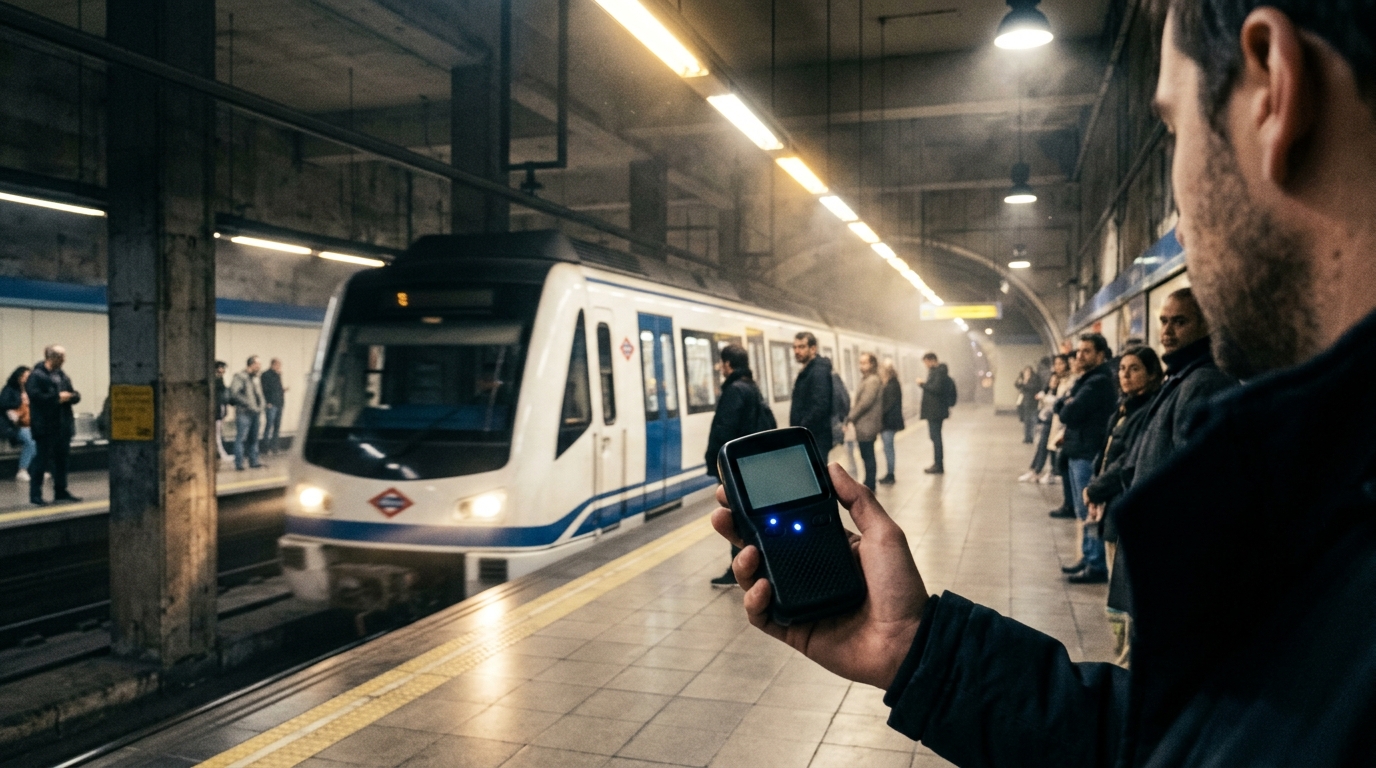
Investigating microenvironments within the Madrid Metro underground transit system demonstrated that passenger waiting platforms consistently accumulated elevated airborne particulate burdens compared to external metropolitan air. Across all evaluated stations, spot measurements recorded on boarding platforms yielded an overall average fine particulate concentration of 20 micrograms per cubic metre with a standard deviation of 9 micrograms per cubic metre, with every individual platform recording mean concentrations of at least 10 micrograms per cubic metre. Observational determinations exhibited substantial localized variation between transit nodes, ranging from a low of 10 micrograms per cubic metre at Avenida de América station to a peak of 32 micrograms per cubic metre at Oporto station. Vertical monitoring conducted at Puerta del Ángel station captured a marked exposure gradient during transit between platforms and ground-level exits, where recorded concentrations fell sharply from 25 micrograms per cubic metre on the underground platform to 9 micrograms per cubic metre upon emerging into open surface air.
Within operational Madrid Metro train carriages, volunteer investigators conducted thirteen distinct spot determinations spanning varied journey durations and transit lines, establishing an overall mean fine particulate concentration of 10 micrograms per cubic metre with a standard deviation of 5.6 micrograms per cubic metre. Average carriage concentrations consistently remained above 5 micrograms per cubic metre across every sampling run, with individual trip means spanning from 5.8 to 17.8 micrograms per cubic metre.
When juxtaposed with international transit studies reviewed in the publication, Madrid transport microenvironments demonstrated moderate absolute particulate burdens alongside consistent environmental patterns documented in major metropolitan systems globally. Traffic tunnels in China have registered extreme average concentrations reaching 77.2 and up to 468 micrograms per cubic metre, while road tunnels in Mexico recorded levels between 75 and 160 micrograms per cubic metre. In underground rail networks, published surveys from the United States have documented subway particulate levels spanning from 112 to 779 micrograms per cubic metre, while London Underground facilities averaged 88 micrograms per cubic metre on platforms and driver cabins.
The authors acknowledged several key methodological limitations inherent to their citizen science protocol, foremost being the reliance on discrete spot measurements across varying dates rather than automated continuous monitoring under controlled meteorological, vehicular speed, and traffic density variables. Emphasizing that millions of daily transit passengers, including vulnerable populations such as children, pregnant women, elderly commuters, and individuals managing preexisting cardiopulmonary conditions, regularly experience repeated transient exposures, the authors concluded that public transit authorities should deploy permanent monitoring networks throughout tunnels and underground stations.
Subject of Research: Particulate matter exposure in Madrid road tunnels and subway system
Article Title: Inhalation of small particles (PM2.5) in urban road tunnels and underground in Madrid (Spain) – a citizen science project
Article References: López-Encuentra, Á., Gil Cid, E., & Pozo Coronado, L. M. (2026). Inhalation of small particles (PM 2.5 ) in urban road tunnels and underground in Madrid (Spain) – a citizen science project. Aerosol Research, 4(2), 547-558. https://doi.org/10.5194/ar-4-547-2026
Image Credits: AI Generated
Keywords: PM2.5 pollution, citizen science, Madrid M30 tunnels, Madrid Metro, air quality monitoring, low-cost sensors, urban transit exposure, environmental health, Inhalation, small, particles, urban
News Source: Russell Cooper. (November 6, 2026). Citizen Scientists Reveal Elevated Fine Particle Levels Across Madrid Transport Networks. Scienmag.