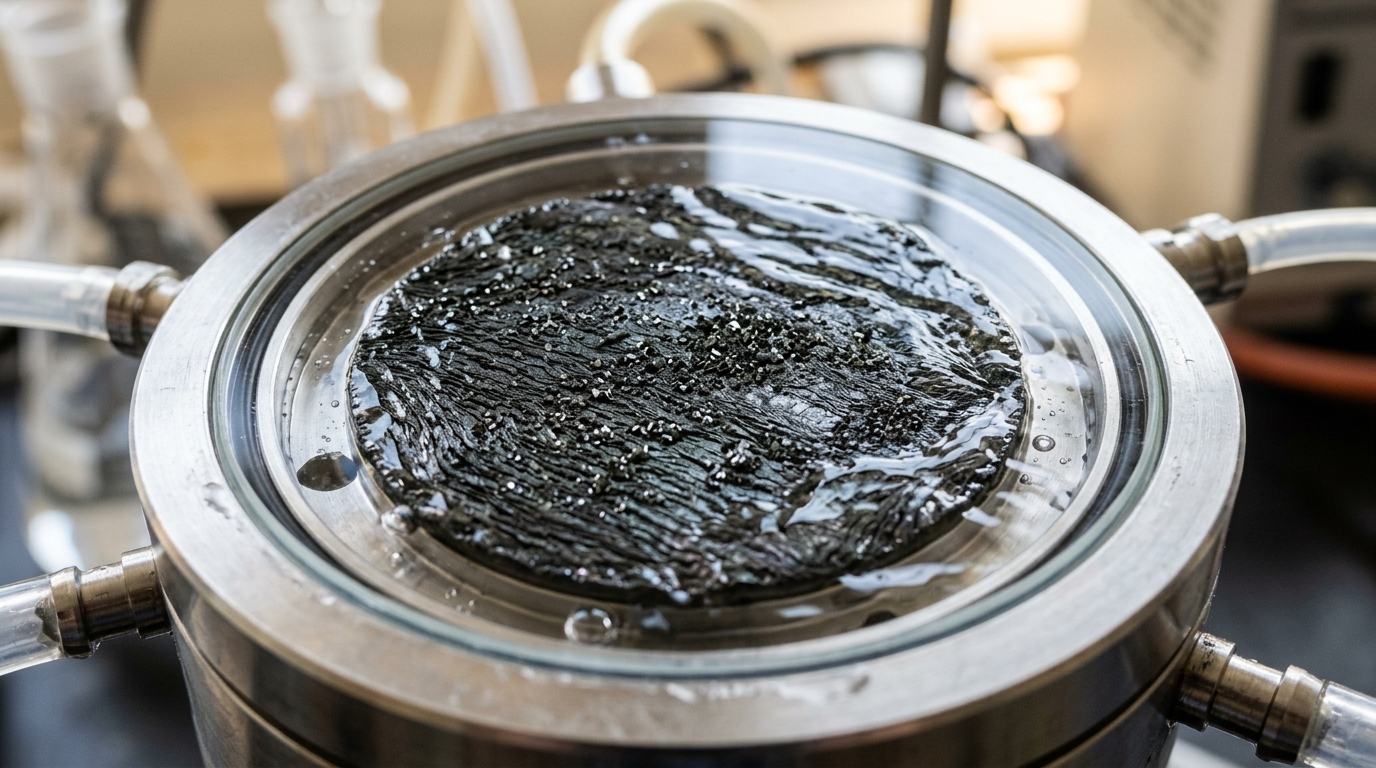
Antibiotic contamination in aquatic environments poses severe threats to ecological balance and human health. A team reporting in the Journal of Nanoparticle Research has now built a ternary photocatalyst that dismantles this antibiotic under visible light while holding up to repeated use. The regenerable ternary Ti3C2Tx/Bi2S3@MoS2 composite, designated TBM-2, was fabricated via hydrothermal synthesis combined with ultrasonic assembly.
Single semiconductors are restricted by a narrow light-response range and rapid photogenerated-carrier recombination. The ternary material builds two key interfaces: a staggered type-II Bi2S3@MoS2 heterojunction and a semiconductor-MXene Schottky contact.
Performance under visible-light irradiation was measured with tetracycline at a concentration of 20 mg/L. TBM-2 achieved 81.5 percent removal efficiency, a figure the authors attribute to the dual-interface structure that separates photogenerated carriers before they can recombine. The composite also showed distinct adsorption selectivity toward cationic and anionic organic dyes, accompanied by limited visible-light-driven photocatalytic activity for partial dye pollutants.
After five consecutive cycling tests, nearly 70 percent of the original tetracycline-removal efficiency was retained. This demonstrates good recyclability and anti-photocorrosion performance.
To understand which reactive species actually do the chemical work, the team ran radical quenching experiments. These verified that photogenerated holes act as the dominant active species in the degradation process. Hydroxyl radicals serve as an auxiliary contributor, while superoxide radicals play only a weak role. This clarifies the carrier-migration mechanism of the dual-interface MXene-sulfide composite.
The structural basis for this behavior was established through a battery of characterizations. Scanning and transmission electron microscopy revealed morphology, X-ray diffraction confirmed crystal phase, and X-ray photoelectron spectroscopy mapped surface chemical states. BET, UV–vis DRS, and photoelectrochemical tests were performed to investigate optical absorption and charge-separation behaviors.
By combining a staggered type-II heterojunction with a semiconductor-MXene Schottky contact in one regenerable material, the work offers a template for designing recyclable photocatalysts aimed at antibiotic-wastewater treatment. Visible-light-driven photocatalysis is regarded as a promising route for organic-pollutant remediation, and this composite demonstrates how interface engineering within a ternary MXene-sulfide system can convert that promise into measurable, repeatable tetracycline removal.
Even so, the combination of strong visible-light response, hole-dominated degradation chemistry and retained performance across five cycles marks TBM-2 as a credible step toward durable photocatalytic systems for treating antibiotic contamination in aquatic environments.
Subject of Research: Visible-light photocatalytic degradation of tetracycline using a regenerable ternary Ti3C2Tx/Bi2S3@MoS2 MXene-sulfide composite
Article Title: Regenerable Ti3C2Tx loaded with Bi2S3@MoS2 for efficient photocatalytic degradation of tetracycline
Article References: Xi, H., Gao, T., Huang, H., & Zheng, Z. (2026). Regenerable Ti3C2Tx loaded with Bi2S3@MoS2 for efficient photocatalytic degradation of tetracycline. Journal of Nanoparticle Research, 28(11), Article 284. https://doi.org/10.1007/s11051-026-06802-y
Image Credits: AI Generated
DOI: 10.1007/s11051-026-06802-y
Keywords: photocatalysis, tetracycline, MXene, Ti3C2Tx, Bi2S3, MoS2, heterojunction, Schottky contact, antibiotic wastewater, water treatment, photogenerated holes, recyclability
News Source: Denise Maddox. (November 6, 2026). MXene-sulfide composite breaks down tetracycline under visible light and survives repeated reuse. Scienmag.