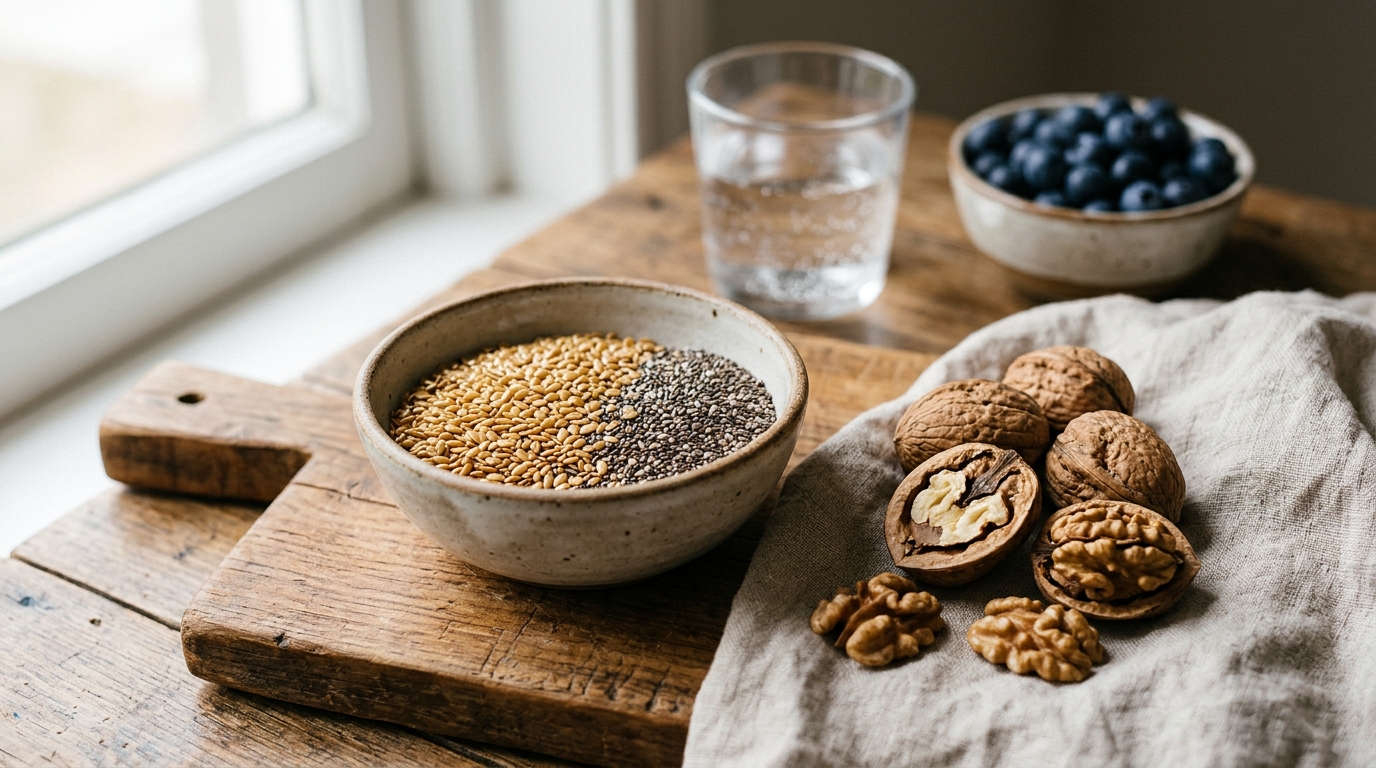
Higher intakes of the plant-based omega-3 fatty acid alpha-linolenic acid, or ALA, appear to go hand in hand with a lower risk of type 2 diabetes in American adults, but only when the diet also delivers enough of certain vitamins, a new cross-sectional analysis of national survey data suggests. Among nine vitamins examined, vitamin B12 stood out: in women with the highest B12 intake, the protective association between ALA and diabetes was markedly stronger than in women with lower B12 levels, while no comparable pattern appeared in men.
The study, published in the journal Food, Nutrition and Health, drew on eight consecutive cycles of the National Health and Nutrition Examination Survey, or NHANES, covering 2003 through 2018. NHANES is a complex, multistage probability sample of the U.S. civilian population run by the National Center for Health Statistics, combining personal interviews on diet, demographics and health with standardized physical examinations and laboratory tests. From an initial pool of 80,313 participants across the eight cycles, the researchers excluded anyone under 18, pregnant or lactating women, people with missing ALA data, those with implausible energy intakes below 500 or above 6,000 kilocalories per day, and participants lacking information on hemoglobin A1c, fasting glucose, body weight or vitamin intake. The final analytic sample comprised 12,862 adults, 6,685 of them female and 6,177 male.
Dietary intake was assessed using two non-consecutive 24-hour dietary recall interviews, the first conducted in person at the examination center and the second by telephone three to ten days later. Participants received measuring cups, spoons, a ruler and a food model booklet to help them estimate portion sizes. The researchers averaged the two recalls to estimate each person’s daily intake of ALA and of nine vitamins: A, D, E, K, B1, B2, B6, B12 and C, all calculated with the U.S. Department of Agriculture’s food composition database. Nutrient intakes were then adjusted for body weight before entering the statistical models. Type 2 diabetes was defined by any of three criteria: fasting glucose of at least 126 milligrams per deciliter, hemoglobin A1c of at least 6.5 percent, or self-reported use of diabetes medication or insulin.
The baseline picture showed that 18.6 percent of participants had type 2 diabetes, 38.0 percent had obesity and 48.7 percent had hypertension. People with diabetes were generally older and had higher rates of obesity and hypertension, lower educational attainment and lower family income ratios. They also reported significantly lower intakes of energy, ALA and most vitamins, with the exceptions of vitamins D and K.
When the researchers modeled each vitamin on its own, all nine were associated with a reduced risk of diabetes after adjustment for age, sex, race and ethnicity, education, poverty-income ratio, marital status, smoking, alcohol use, hypertension, survey year and energy intake. Almost all vitamins displayed a non-linear relationship with diabetes, vitamin C being the exception.
ALA itself told a more nuanced story. After adjustment, its association with type 2 diabetes followed a non-linear, U-shaped curve, with a statistical significance level of 0.0006 for the non-linearity. Dietary ALA was linked to a protective effect against diabetes only within a specific window of intake, roughly 17.8 to 88.1 milligrams per day per kilogram of body weight. For a 60-kilogram adult, the authors note, that translates to about 1 to 4 grams of ALA daily. The researchers caution that U-shaped associations can also arise from residual confounding, measurement error or instability at the extremes of exposure, rather than from true biological thresholds, and they call for further work to test this.
The central question of the study was whether vitamins modify the ALA-diabetes link. Participants were stratified by tertiles of each vitamin, and the relationship between ALA and diabetes was strengthened in the highest tertiles of vitamins A, D, E, B6, B12 and C, with vitamin B12 showing the strongest modification. The relationship was attenuated in the low and medium vitamin tertiles. Interaction testing revealed why the analysis then split by sex: the ALA-by-vitamin interaction was not significant in the total population, with interaction p-values of 0.3 or higher, but the ALA-by-gender-by-vitamin B12 interaction was significant at p equal to 0.007, and among women alone the ALA-by-B12 interaction reached a p-value below 0.0001. An initial likelihood ratio test had already indicated that the association between ALA and diabetes differed by sex, with an interaction p-value below 0.0001.
In women, an intake-dependent pattern emerged. Using the lowest tertile of ALA as the reference, the protective effect of ALA against diabetes grew stronger as vitamin B12 intake increased, with odds ratios and 95 percent confidence intervals ranging from 0.6, or 0.4 to 0.7, up to 0.5, or 0.3 to 0.8. In other words, women in the higher ALA tertiles who also consumed the most vitamin B12 had roughly 40 to 50 percent lower odds of diabetes than comparable women with low ALA intake. No similar trend appeared among men or within the other vitamin groups. Higher tertiles of certain other vitamins also appeared to widen the protective range of ALA against diabetes, an effect seen only in women, but weaker than the B12 effect.
Why might B12 matter? The authors frame a mechanistic hypothesis that they are careful to label as unproven in observational data. ALA is a precursor of the long-chain omega-3 fatty acids EPA and DHA, which are needed to synthesize anti-inflammatory eicosanoids, but its conversion to these longer chains faces a metabolic bottleneck of less than 5 percent, and very high ALA intake may promote lipid peroxidation and oxidative stress because of its three double bonds. Vitamins are known to participate in this metabolism: vitamin B6 deficiency impairs the conversion of ALA to EPA and DHA, vitamin C deficiency reduces the efficiency of the final step to DHA, and vitamin E helps prevent oxidation of polyunsaturated fatty acids. Vitamin B12 does not directly act on the key enzymes, but the authors suggest it may create a more favorable physiological environment for ALA by improving insulin signaling, bolstering anti-inflammatory and antioxidant responses and optimizing energy metabolism. They also point to sex-specific explanations: hormonal fluctuations during the menstrual cycle and menopause affect glucose metabolism and insulin sensitivity, and women are more susceptible to vitamin B12 deficiency, so higher B12 intake may shift their metabolic environment more noticeably.
The limitations deserve equal billing with the findings. This is a cross-sectional study, so it captures a snapshot of diet and diabetes status at the same time and cannot establish that ALA or any vitamin causes changes in diabetes risk. The two-day dietary recalls are self-reported and subject to recall bias, and averaging two days reduces but does not eliminate day-to-day variation in what people eat. Vitamin intake counted only food sources, excluding supplements, which may underestimate total intake among heavy supplement users. The NHANES database lacks the classification data and islet autoantibody measurements needed to exclude type 1 diabetes or latent autoimmune diabetes in adults, which the authors estimate make up less than 20 percent of the sample, so the results should be read as applying to adult diabetes in general, predominantly type 2. There were no serum fatty acid biomarkers to confirm ALA intake, and the authors note that findings were prioritized by effect size and biological plausibility rather than formal correction for multiple comparisons, meaning they require confirmation in independent cohorts. Within those bounds, the study adds a specific, testable idea to diabetes-prevention research: the potential benefit of a plant-based omega-3 fat may depend on the vitamin company it keeps, and in women, vitamin B12 may be the partner that matters most.
Subject of Research: Cross-sectional analysis of how dietary vitamins modify the association between alpha-linolenic acid intake and type 2 diabetes in U.S. adults
Article Title: Interactive associations of dietary vitamins and α-linolenic acid with type 2 diabetes: a cross-sectional analysis of NHANES 2003—2018
Article References: Liu, G., Xue, H., Zhai, Y., Miao, J., Yang, X., & Lang, Y. (2026). Interactive associations of dietary vitamins and α-linolenic acid with type 2 diabetes: a cross-sectional analysis of NHANES 2003—2018. Food, Nutrition and Health, 3(1), Article 21. https://doi.org/10.1007/s44403-026-00066-z
Image Credits: AI Generated
DOI: 10.1007/s44403-026-00066-z
Keywords: type 2 diabetes, alpha-linolenic acid, vitamin B12, NHANES, dietary vitamins, omega-3 fatty acids, cross-sectional study, sex differences, nutrition epidemiology, insulin sensitivity, EPA, DHA
News Source: Daisy Hatcher. (November 6, 2026). Vitamin B12 May Boost ALA’s Link to Lower Diabetes Risk in Women. Scienmag.