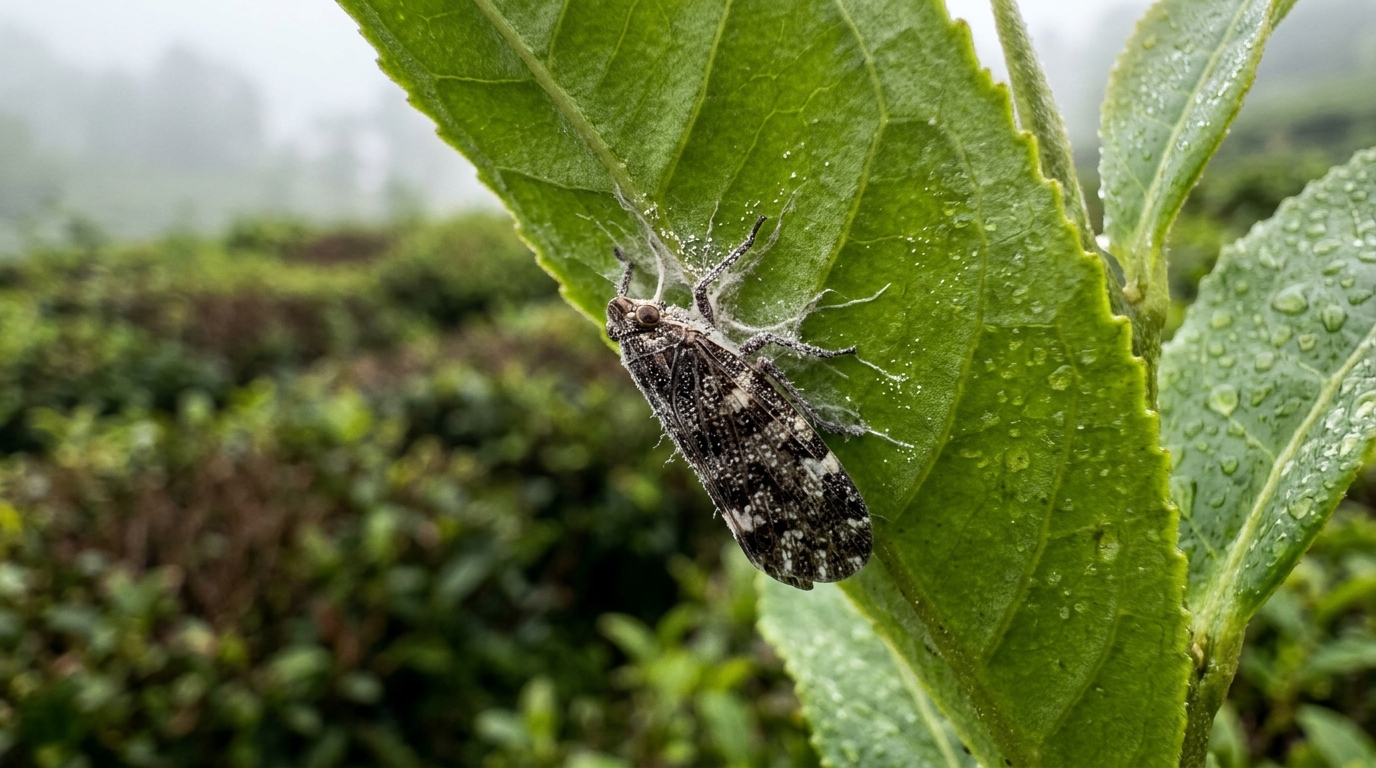
A scientific review in the Egyptian Journal of Biological Pest Control outlines how agricultural authorities and researchers in Türkiye successfully brought the invasive planthopper Orosanga japonica under control through biological suppression and integrated cultural methods without chemical pesticides. Authored by researcher Kibar Ak, the review examines the trajectory of the invasive insect from its initial detection in northeastern Türkiye through its regional expansion and eventual ecological suppression. For more than a decade, the planthopper posed serious agricultural challenges to fruit, vegetable, and cash crop systems along the Black Sea coast. However, deliberate restraint from chemical spraying allowed ecological mechanisms to take course. The turning point occurred when the entomopathogenic fungus Beauveria bassiana emerged naturally within local orchards, spreading swiftly through pest populations and bringing the infestation below damaging economic thresholds within three years.
The invasive planthopper, native to the Asian continent, first arrived in the Black Sea Region of Türkiye from the neighboring Batumi district of Georgia during the early 2000s, following a historical presence documented in Abkhazia dating to 1958. In Türkiye, entomologists first identified specimens in 2008 within the Kemalpaşa district of Artvin province, followed by genus-level documentation in scientific literature the subsequent year. Over the ensuing decade, the insect expanded steadily westward and northward from the Eastern Black Sea into the Central Black Sea Region. Infestations took hold across the provinces of Artvin, Rize, Trabzon, Giresun, and Ordu, with localized populations later detected along the Black Sea coastal strip in Sakarya, Düzce, and Istanbul. As international trade and environmental conditions facilitated non-native species introductions, the rapid establishment of Orosanga japonica raised urgent concerns for regional farming communities and natural ecosystems.
Within insect taxonomy, Orosanga japonica belongs to the family Ricaniidae under the order Hemiptera, a diverse group comprising approximately 45 genera and 450 species distributed primarily across tropical zones worldwide. The genus Ricania represents an exception, being confined exclusively to the Palaearctic region and encompassing several related species identified across Europe and Türkiye, including Ricania hedenborgi, Ricania limbata, Ricania speculum, and Ricania shantungensis, alongside the related planthopper Metcalfa pruinosa from the family Flatidae. The classification of the invasive species underwent multiple taxonomic revisions, having previously been referred to in scientific literature as Ricania simulans and Ricania japonica before morphological and molecular analyses formally confirmed its placement as Orosanga japonica.
Adult specimens of Orosanga japonica physically resemble miniature butterflies, with dark brown or blackish bodies measuring between 7 and 12 millimeters in total length, where male individuals are smaller and lighter in coloration than females. The developmental progression of the species encompasses five nymphal stages, beginning with newly hatched nymphs that exhibit a light yellowish body marked with brown spots. A distinctive anatomical feature of these developing nymphs is a prominent waxy caudal appendage extending from the posterior of the abdomen, measuring longer than the abdominal segments themselves. When disturbed or touched, the nymphs utilize rapid jumping mechanics similar to adults, while the specialized waxy filaments expand to function like a parachute, facilitating stable and controlled aerial landings on host vegetation.
Field observations and biological studies conducted in northern Türkiye indicate that Orosanga japonica typically completes a single annual generation under local temperate climatic regimes, contrasting with observations from Taiwan where two generations per year have been recorded. In the Black Sea Region, immature nymphs emerge from overwintering sites between late May and early June, completing nymphal development over 15 to 25 days. Adult planthoppers begin emerging between late June and early July, with the complete life cycle of a single generation spanning approximately 60 to 75 days. Following mating, reproductive females initiate oviposition during early August, continuing egg-laying activities into September. Each female deposits an estimated total of 40 to 60 yellowish-white, oval-shaped eggs, embedding them in straight, bead-like sequences containing 5 to 35 eggs beneath the cortical tissues of young shoots and branches.
The feeding habits of both nymphs and mature adults inflict dual damage upon agricultural hosts, with swarms aggregating densely on tender shoots and foliage to extract plant sap. This intensive sap consumption depletes vital nutrients and causes chlorosis and necrotic lesions across vegetative tissues, while predisposing host plants to secondary pathogen transmission. Beyond the metabolic strain imposed by phloem feeding, reproductive females inflict mechanical injuries on woody structures through serrated ovipositors, carving incisions into the bark of young shoots that frequently induce localized dieback and branch drying.
The agricultural landscape of the Eastern Black Sea Region is anchored predominantly by the cultivation of tea, supplemented by extensive orchards of hazelnuts and kiwifruit alongside family plots growing vegetables and field crops. A defining ecological characteristic of this regional farming system, particularly within tea plantations, is the maintenance of natural ecological balances without synthetic chemical insecticides, limiting field inputs strictly to chemical fertilizers. Consequently, state agricultural bodies and researchers explicitly excluded chemical pesticides from public intervention strategies, choosing instead to endorse coordinated cultural practices and biotechnical controls while allowing ecological balances to stabilize.
To mitigate population growth prior to natural biological control, researchers evaluated cultural and biotechnical management strategies across infested districts. Because Orosanga japonica overwinters exclusively within egg batches embedded inside dead or drying shoots, systematic cultural sanitation proved highly impactful. Field trials conducted by Altaş and Ak demonstrated that pruning infested shoots and destroying egg-bearing residues before spring nymphal emergence reduced local nymph densities by 71 to 86 percent and lowered adult populations by approximately 50 percent. Concurrently, biotechnical trapping trials evaluated the color and phototactic preferences of the planthoppers, revealing that light traps and sticky tape traps successfully captured adult insects on warm, rainless days, with light traps demonstrating superior efficiency. However, frequent rainfall and limited cloud-free days across the maritime coastal strip severely restricted the operational efficacy of biotechnical traps, confirming that cultural and trapping measures alone could not achieve comprehensive landscape-scale containment.
Recognizing the limitations of mechanical and physical interventions, research initiatives focused intensively on evaluating microbiological agents and botanical compounds capable of functioning within the humid coastal climate. Laboratory and field investigations explored entomopathogenic bacteria and fungi, discovering that isolates of Lecanicillium muscarium retrieved from native Issus planthoppers exhibited pronounced pathogenicity against Orosanga japonica nymphs, with the specific Lm4 isolate demonstrating promising biological control potential under natural conditions. Furthermore, studies on the bacterial entomopathogen Bacillus thuringiensis isolated directly from planthopper specimens demonstrated an 85 percent mortality rate against adult insects. In evaluations of botanical insecticides, the plant-derived compound azadirachtin demonstrated notable efficacy, achieving 98 percent mortality in nymphs and 70 percent in adults, while controlled comparative trials recorded laboratory mortality rates of 95 percent in nymphs and 87.5 percent in adults, alongside field mortality rates of 79 percent and 71 percent respectively.
The decisive transformation in regional pest dynamics occurred in October 2019, when researchers detected natural fungal epizootics caused by the entomopathogenic fungus Beauveria bassiana infecting both nymphs and adult planthoppers on kiwifruit foliage and shoots within Kemalpaşa, Artvin. Following this initial identification, the fungal entomopathogen proliferated rapidly across the Eastern Black Sea corridor within two to three years, driving down planthopper densities and neutralizing the insect as a major regional concern by 2022. This rapid biological suppression was heavily facilitated by the unique climatic profile of the Eastern Black Sea littoral, where annual rainfall regularly exceeds 2000 millimeters and persistent summer rains maintain elevated atmospheric moisture. Regional meteorological records demonstrate that coastal relative humidity averages 75.8 percent between May and September and maintains 75.4 percent throughout summer, providing the exact microclimatic requirements necessary for fungal conidiophores and conidial masses to germinate, infect host cuticles, and propagate epizootics.
Drawing from the twelve-year containment trajectory of Orosanga japonica, the review synthesizes an eight-point strategic framework to guide future management responses against non-native agricultural invaders. The author emphasizes that upon the introduction of an exotic species, authorities must systematically evaluate scientific literature from its native range, establish continuous distribution monitoring, and conduct thorough ecological investigations into host ranges, developmental biology, and candidate natural enemies. Critically, government agencies must resist public pressure to deploy broad-spectrum chemical sprays, prioritizing cultural sanitation and preserving the ecological integrity of beneficial organisms so that indigenous or adapting entomopathogens can exert natural population suppression, a process that typically materializes within five to ten years. Should future climatic fluctuations trigger secondary epidemics of Orosanga japonica, mass-production and controlled field application of Beauveria bassiana isolates represent viable intervention tools, provided comprehensive ecological risk assessments are performed beforehand to safeguard non-target organisms across sensitive agricultural ecosystems.
Subject of Research: Biological and cultural suppression of the invasive planthopper Orosanga japonica in Türkiye
Article Title: Current status of the invasive species, Orosanga Japonica (Melichar, 1898) (Hemiptera: Ricaniidae) under natural enemy pressure in Türkiye
Article References: Ak, K. (2026). Current status of the invasive species, Orosanga Japonica (Melichar, 1898) (Hemiptera: Ricaniidae) under natural enemy pressure in Türkiye. Egyptian Journal of Biological Pest Control, 36(1), Article 12. https://doi.org/10.1186/s41938-026-00892-5
Image Credits: AI Generated
DOI: 10.1186/s41938-026-00892-5
Keywords: Orosanga japonica, Beauveria bassiana, biological pest control, entomopathogenic fungi, invasive species, agricultural ecology, Black Sea Region, tea cultivation, Current, status, invasive, species
News Source: Drew Townsend. (November 6, 2026). Natural Fungal Control Suppresses Invasive Vampire Moth Across Türkiye’s Black Sea Region. Scienmag.