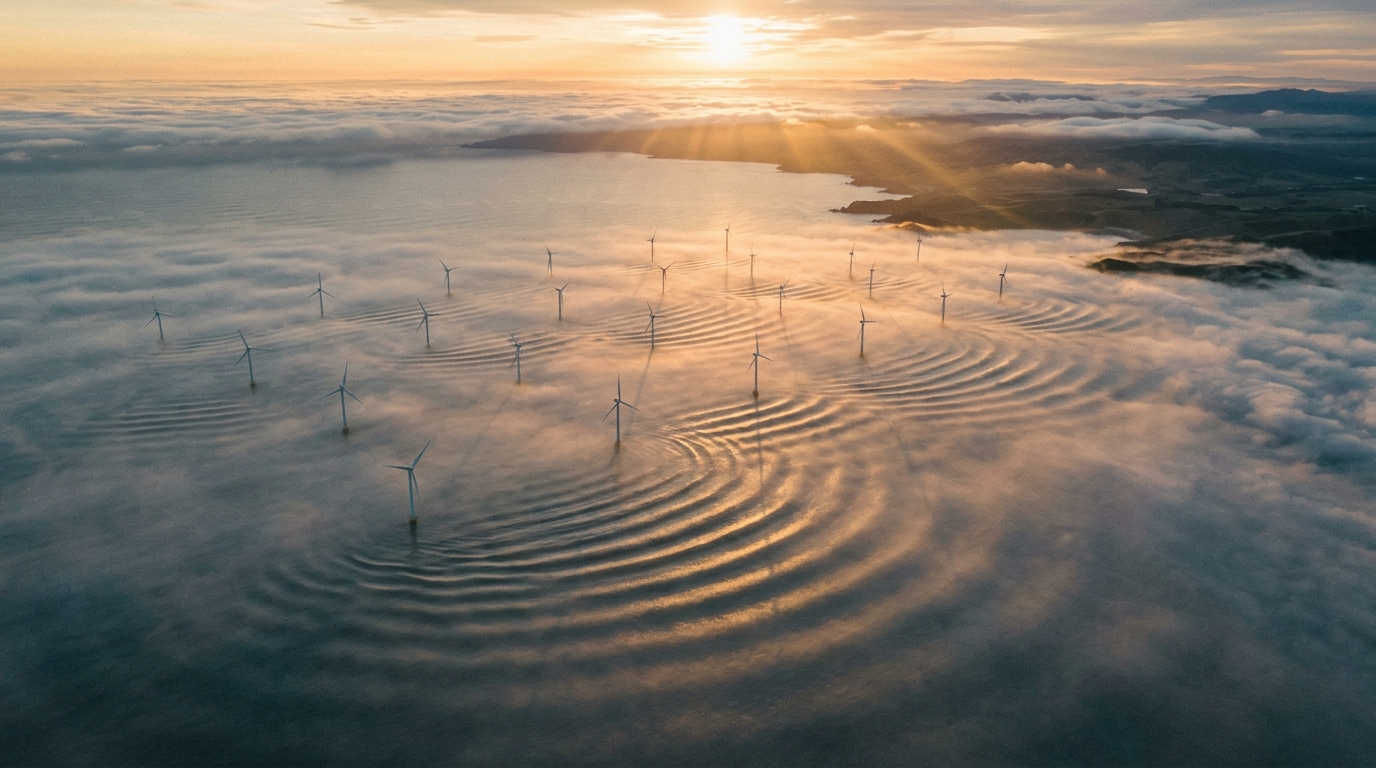
Atmospheric gravity waves induced by modern wind turbines can alter local flow fields, inducing an upstream flow deceleration that reduces power generation alongside distinct sinusoidal variations in turbine wakes. In a preprint submitted to the journal Wind Energy Science, researchers Timothy Rafferty and Christopher Vogel from the Department of Engineering Science at the University of Oxford investigated these turbine-scale interactions through computational fluid dynamics simulations, demonstrating that gravity wave effects can be effectively captured using single-turbine models.
As modern commercial wind turbines reach greater heights, their operation increasingly interacts with geostrophic layers of the atmosphere, triggering atmospheric gravity waves. Despite these interactions, scientific understanding regarding how such waves influence flows at the turbine scale has remained limited. To evaluate this behavior, the authors conducted Large Eddy Simulations incorporating an actuator line model to represent the wind turbine, tracking how turbine-generated gravity waves alter wake dynamics, structural blade loading, and overall power production.
The computational simulations demonstrated that gravity waves create an atypical flow field behind the turbine, characterized by sinusoidal variations in wake width in both horizontal and vertical directions. The wake recovery was observed to be non-monotonic, exhibiting an inverse relationship between peaks and troughs in velocity deficit and the atmospheric waves aloft. An evaluation of both turbulent and mean energy budget terms within the turbine wake indicated that the gravity waves had relatively little impact on the instantaneous flow field.
The researchers also investigated the role of turbine lateral spacing by adjusting the computational domain width. The strength of the triggered waves and the resulting wake variations were found to be negatively correlated with lateral spacing. Furthermore, a wave-induced upstream deceleration occurred in all evaluated cases, with the magnitude of this deceleration decreasing alongside wave strength as both parameters asymptotically approached non-zero values with increased lateral spacing.
By establishing that gravity waves can be initiated in a model representing only a single turbine, the study outlines a lower-cost computational methodology for future investigations. The findings also suggest that relatively small clusters of turbines may trigger atmospheric gravity waves, contrasting with earlier research that focused primarily on large wind farms containing 100 or more turbines. Additionally, simulations comparing turbulent and uniform inflows showed consistent agreement, confirming that the gravity waves and their broader flow effects remain relatively independent of instantaneous variations at the turbine scale.
Subject of Research: Atmospheric gravity wave impacts on wind turbine flows
Article Title: The Impact of Atmospheric Gravity Waves on Turbine Scale Flows
Article References: Rafferty, T., & Vogel, C. (2026). The Impact of Atmospheric Gravity Waves on Turbine Scale Flows. https://doi.org/10.5194/wes-2026-208
Image Credits: AI Generated
DOI: 10.5194/wes-2026-208
Keywords: atmospheric gravity waves, wind turbines, large eddy simulations, wake dynamics, wind energy, actuator line model, fluid dynamics, power production, Impact, Atmospheric, Gravity, Waves
News Source: Russell Cooper. (November 6, 2026). Atmospheric Gravity Waves Triggered by Wind Turbines Alter Flows and Power. Scienmag.