• HOME
  • NEWS
  • EXPLORE
    • CAREER
      • Companies
      • Jobs
    • EVENTS
    • iGEM
      • News
      • Team
    • PHOTOS
    • VIDEO
    • WIKI
  • BLOG
  • COMMUNITY
    • FACEBOOK
    • INSTAGRAM
    • TWITTER
Friday, November 6, 2026
BIOENGINEER.ORG
No Result
View All Result
  • Login
  • HOME
  • NEWS
  • EXPLORE
    • CAREER
      • Companies
      • Jobs
        • Lecturer
        • PhD Studentship
        • Postdoc
        • Research Assistant
    • EVENTS
    • iGEM
      • News
      • Team
    • PHOTOS
    • VIDEO
    • WIKI
  • BLOG
  • COMMUNITY
    • FACEBOOK
    • INSTAGRAM
    • TWITTER
No Result
View All Result
Bioengineer.org
No Result
View All Result
Home NEWS Science News Agriculture

Fermented spent coffee grounds boost mealworm growth at up to 50% of diet

by
November 6, 2026
in Agriculture
Reading Time: 2 mins read
0
Fermented spent coffee grounds boost mealworm growth at up to 50% of diet

Fermented spent coffee grounds boost mealworm growth at up to 50% of diet

Share on FacebookShare on TwitterShare on LinkedinShare on RedditShare on Telegram

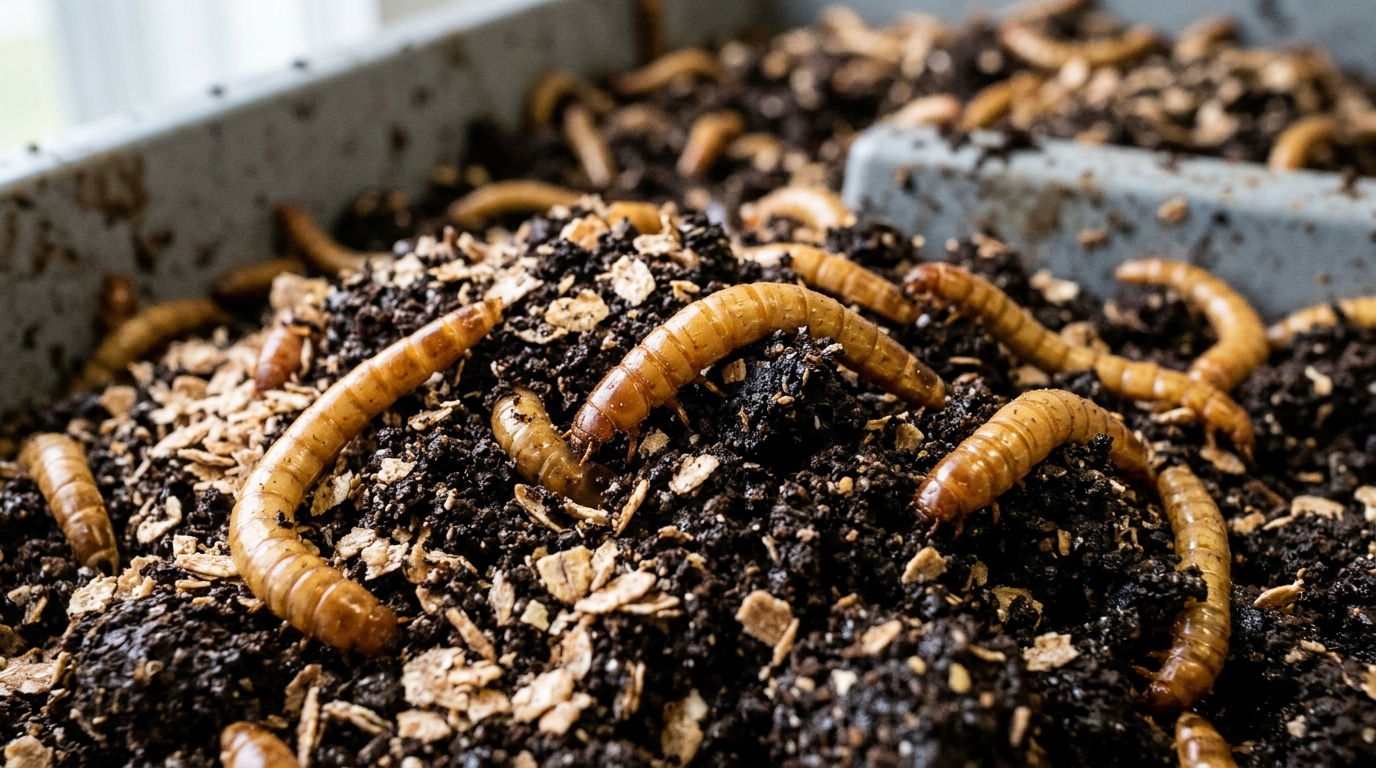
Mealworm larvae can grow well on a diet in which half of the wheat bran has been replaced by fermented spent coffee grounds, according to a study published in Food Science and Biotechnology. The study evaluated fermented spent coffee grounds as a wheat bran substitute for Tenebrio molitor larvae.

The study tested fermented spent coffee grounds, abbreviated f-SCG, as a substitute for wheat bran in the diet of Tenebrio molitor larvae. Third- to fourth-instar larvae were fed diets containing 0, 10, 30, or 50 percent f-SCG, with the remainder wheat bran, and their survival, development, and pupation were tracked through week 8.

Survival remained high across all feeding groups, exceeding 88.7 percent through week 8. Total pupation was over 91 percent in every group, and the study reports no significant difference from the control group fed wheat bran alone. Replacing up to 50 percent of the wheat bran with f-SCG showed no significant difference from the control in larval survival or total pupation.

Development was actually faster on the higher-inclusion diets. Larvae fed diets containing 30 to 50 percent f-SCG completed larval development in 8.7 to 8.9 weeks, compared with 9.3 weeks for the control group on plain wheat bran. The 50 percent f-SCG diet increased pupal weight by 14.9 percent relative to the control.

The 50 percent f-SCG mixture had a nutritional profile that was measured in the study. That mixture contained 18.1 percent crude protein and 53.7 percent dietary fiber, both higher than wheat bran, along with 131.6 milligrams of calcium per 100 grams. It had lower levels of phosphorus, potassium, and magnesium than wheat bran.

The study also assessed feed safety of the f-SCG-containing diets. Heavy metals, including lead, cadmium, and arsenic, remained low in the f-SCG-containing feed, at 0.01 to 0.08 milligrams per kilogram, and mycotoxins were non-detectable.

The authors conclude that f-SCG can replace up to 50 percent of wheat bran in T. molitor diets without compromising rearing performance or feed safety.

The work was published on 2 November 2026 as a research article in Food Science and Biotechnology, a Springer journal. The study measured larval survival, development time, pupation, pupal weight, feed composition, and contaminant levels in Tenebrio molitor larvae under the tested dietary conditions through week 8.

Subject of Research: Fermented spent coffee grounds as a partial wheat bran substitute in mealworm larval feed

Article Title: Fermented spent coffee grounds as an alternative food source for improved growth and pupal formation of Tenebrio molitor

Article References: Park, M. J., & Kim, S. Y. (2026). Fermented spent coffee grounds as an alternative food source for improved growth and pupal formation of Tenebrio molitor. Food Science and Biotechnology. https://doi.org/10.1007/s10068-026-02358-8

Image Credits: AI Generated

DOI: 10.1007/s10068-026-02358-8

Keywords: Tenebrio molitor, mealworm, spent coffee grounds, fermentation, insect farming, wheat bran, pupation, feed safety, crude protein, food waste, larval development, Food Science and Biotechnology

News Source: Daisy Hatcher. (November 6, 2026). Fermented spent coffee grounds boost mealworm growth at up to 50% of diet. Scienmag.


Tags: crude proteinfeed safetyfermentationFood Science and Biotechnologyfood wasteinsect farminglarval developmentmealwormpupationspent coffee groundsTenebrio molitorwheat bran
Share12Tweet7Share2ShareShareShare1

Related Posts

Two neighboring Tibetan townships, one shared policy, and two very different fates for their grasslands

Two neighboring Tibetan townships, one shared policy, and two very different fates for their grasslands

November 6, 2026
Deep Learning Network Reconstructs Missing Geometry in Maize Leaf Point Clouds

Deep Learning Network Reconstructs Missing Geometry in Maize Leaf Point Clouds

November 6, 2026

Winter Flooding and Drainage Sustain Arid Cropland Under Long-Term Drip Irrigation

November 6, 2026

Multi-Omics Study Reveals How Pyrus betulifolia Defends Against Fire Blight

November 6, 2026

POPULAR NEWS

  • Diabetes and pre-treatment fatigue flag men at risk of years-long exhaustion after prostate radiotherapy

    Diabetes and pre-treatment fatigue flag men at risk of years-long exhaustion after prostate radiotherapy

    29 shares
    Share 12 Tweet 7
  • Two neighboring Tibetan townships, one shared policy, and two very different fates for their grasslands

    29 shares
    Share 12 Tweet 7
  • Solid-state caloric cooling edges closer to replacing vapour compression

    29 shares
    Share 12 Tweet 7
  • Review examines microbial oil fermentation strategies and industrial scale-up barriers

    29 shares
    Share 12 Tweet 7

About

We bring you the latest biotechnology news from best research centers and universities around the world. Check our website.

Follow us

Recent News

Diabetes and pre-treatment fatigue flag men at risk of years-long exhaustion after prostate radiotherapy

Two neighboring Tibetan townships, one shared policy, and two very different fates for their grasslands

Solid-state caloric cooling edges closer to replacing vapour compression

Subscribe to Blog via Email

Enter your email address to subscribe to this blog and receive notifications of new posts by email.

Join 86 other subscribers
  • Contact Us

Bioengineer.org © Copyright 2023 All Rights Reserved.

Welcome Back!

Login to your account below

Forgotten Password?

Retrieve your password

Please enter your username or email address to reset your password.

Log In
No Result
View All Result
  • Homepages
    • Home Page 1
    • Home Page 2
  • News
  • National
  • Business
  • Health
  • Lifestyle
  • Science

Bioengineer.org © Copyright 2023 All Rights Reserved.