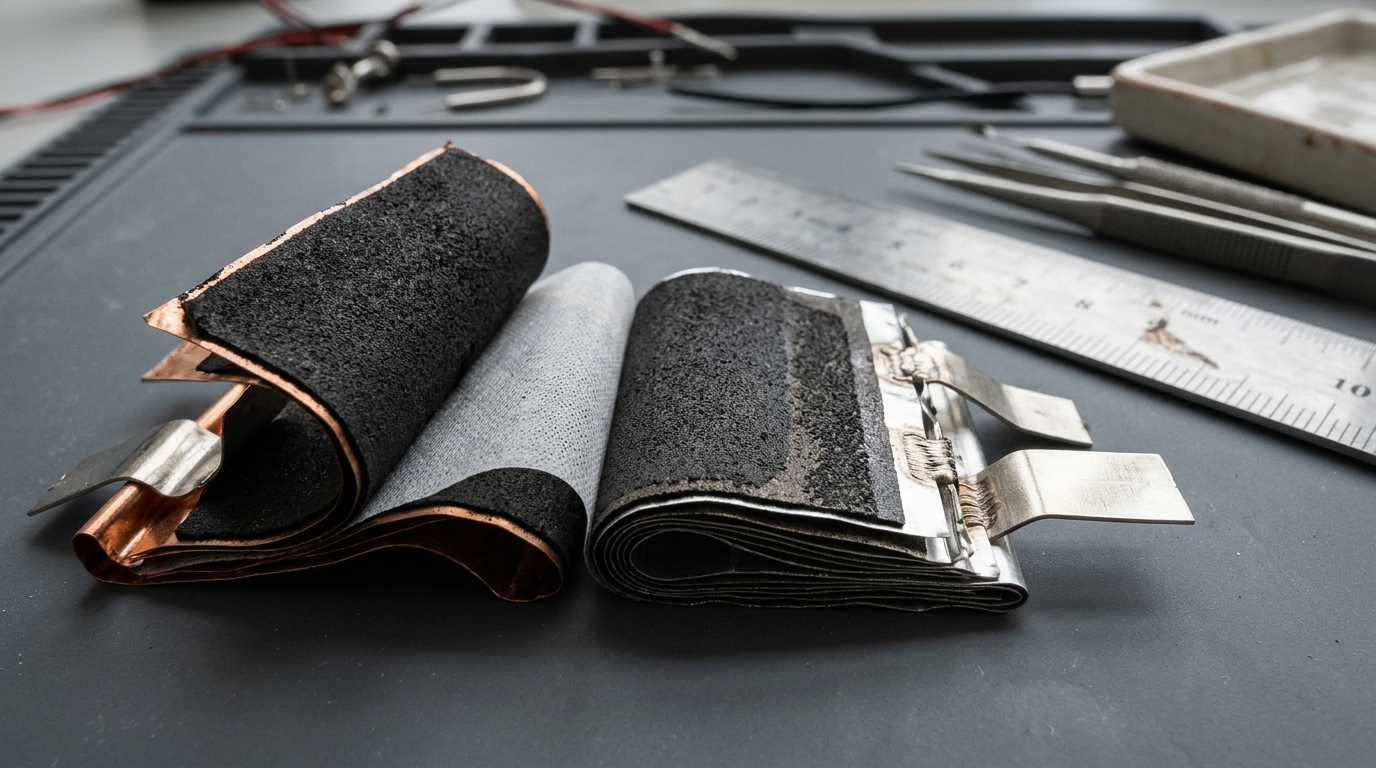
Lithium-ion batteries and lithium-ion capacitors are no longer competing technologies but complementary ones, according to a comprehensive new review that maps how electrode materials, electrolyte chemistry, and the fragile interfaces between them jointly determine the performance, safety, and sustainability of modern energy storage. The review, published in Discover Electrochemistry, argues that the choice between a battery and a capacitor should follow the application: batteries for energy-dense electric vehicles and grid storage, capacitors for regenerative braking, rail transport, and industrial peak-power leveling where fast charge and discharge cycles matter more than total energy.
The two devices differ fundamentally in how they store charge. A lithium-ion battery relies on reversible intercalation of lithium ions into both electrodes, with layered transition-metal oxide cathodes such as NMC and NCA delivering high specific energy but suffering from limited thermal stability and constrained resource availability. Phosphate cathodes like LiFePO4 trade some energy density for superior thermal and chemical stability, making them a preferred option for grid storage and safety-critical deployments. Lithium-ion capacitors instead pair a lithium-intercalating anode that stores charge through faradaic reactions with a porous carbon cathode that stores charge electrostatically through ion adsorption at the electrode-electrolyte boundary. Because the capacitor cathode does not change structure during operation, these devices achieve extremely high cycling stability and power density, though at lower energy density than batteries.
Carbon remains the backbone of both technologies. Graphite still dominates commercial anodes thanks to its well-understood lithium intercalation chemistry and excellent cycling stability, but its limited capacity constrains further gains in energy density. The review documents how modified carbon architectures address this ceiling. Graphene added to activated carbon raised cathode capacity to 85.9 mAh g−1, while incorporating graphene into soft carbon lifted anode capacity from 247.9 to 286.6 mAh g−1; an LIC built with 10 percent modified graphene in both electrodes reached a peak energy density of 106.3 Wh kg−1 at a high-power operation of 4.4 kW kg−1. A pouch-type LIC with 1100 F capacitance and 30.8 Wh kg−1 energy density has also been demonstrated, suggesting a path toward practical application.
Hybrid carbon scaffolds appear to hold a distinct advantage in long-cycling stability. Across nine systems cycled between 50 and 35,000 cycles, carbon-scaffolded architectures—including CNT/rGOR composites, hollow-carbon-sphere paired with activated-carbon dual-carbon cells, and graphene-modified soft-carbon pouch cells—retained more than 87 percent capacity at their maximum cycle counts. By contrast, a NiO-rGO composite paired with activated carbon retained only 72.1 percent after 10,000 cycles. A dual-carbon design using a hollow carbon sphere anode and superactivated carbon cathode at a 2:1 mass ratio achieved 68 Wh kg−1 at 30 kW kg−1 with greater than 92 percent capacity retention after 35,000 cycles. Metal-oxide-containing electrodes still hold an edge in specific capacity at a given cycle number, but the review concludes that carbon scaffolds currently lead in durability.
Beyond carbon, transition-metal oxides, phosphates, and layered chalcogenides extend the achievable capacity range. TiO2, MnO2, Fe3O4, and V2O5 all undergo lithium insertion or conversion reactions that deliver higher capacities than carbon, though low electronic conductivity and sluggish ion diffusion limit practical performance unless the materials are nanostructured or hybridized with conductive carbon. Conversion-type oxides such as Fe3O4 and Co3O4 offer very high theoretical capacities but swell significantly during cycling; dispersing their nanoparticles in a conductive carbon matrix accommodates the volume change and preserves electrical connections. Layered sulfides like MoS2 and WS2 provide two-dimensional channels for lithium diffusion, and a MoS2/expanded graphite composite anode reported roughly 796 mAh g−1 at 0.5 A g−1 with strong high-rate performance.
Silicon and lithium metal represent the most aggressive anode frontiers. Silicon offers extremely high capacity but suffers from volume expansion, low conductivity, and unstable solid-electrolyte interphase formation; a Si/activated carbon composite containing 10 to 30 weight percent silicon delivered an initial capacity of 1634 mAh g−1 and a stable 935 mAh g−1 after 400 cycles at C/10. Lithium metal carries an ultrahigh theoretical capacity of 3860 mAh g−1 and a low electrochemical potential of −3.04 V versus SHE, but repeated plating and stripping cause effectively infinite volume change, cracking the SEI and promoting dendrite growth that can pierce the separator and trigger internal short circuits. Surface modification of the separator through alloying with silver and silicon, forming Li-Ag and Li-Si alloys at the separator surface, has been proposed as a route to a new lithium metal-lithium alloy anode that mitigates these failure modes.
Electrolyte chemistry emerges as the decisive factor for cycle life and safety. Aqueous electrolytes offer inherent safety, nonflammability, low cost, and ionic conductivity of 10 to 100 mS cm−1, far exceeding the 1 to 10 mS cm−1 typical of organic carbonate systems, but their electrochemical stability window is constrained to roughly 1.23 V by water splitting. Water-in-salt electrolytes based on highly concentrated LiTFSI push that window to nearly 3 V by binding almost all water molecules into coordination shells around lithium ions, enabling a 2.3 V aqueous lithium-ion battery with stable cycling and high coulombic efficiency. Non-aqueous carbonate electrolytes, by contrast, enable operating voltages up to 4.2 to 4.5 V and remain the commercial standard, though their flammability and the thermal and hydrolytic decomposition of LiPF6 into reactive species remain persistent hazards. Additives such as fluoroethylene carbonate and vinylene carbonate, used below 5 weight percent, control interphase formation and have been shown to strengthen the SEI on silicon anodes.
The review places particular weight on the solid-electrolyte interphase and cathode-electrolyte interphase under high-voltage and high-rate conditions. Aging tests of commercial lithium-ion capacitors showed that after 80,000 cycles at 2.0 to 4.0 V a cell retained 73.8 percent capacity, whereas 200,000 cycles were required to reach 94.5 percent retention at the reduced voltage window of 2.2 to 3.8 V—a difference of 2.5 times the cycle count for similar retention, driven solely by the depth-of-discharge and voltage-window parameter. Electrode mass balancing also matters: an activated carbon/Li4Ti5O12 system with a cathode-to-anode mass ratio of 0.72 delivered 31 Wh L−1 at 2.3 kW L−1, nearly ten times higher than an unbalanced baseline, and improved cycling stability by a factor of 4.8 after 1,000 cycles. In an Sn-Ni alloy anode study, a cathode-to-anode ratio of 4/1 proved optimal among ratios of 16/1, 8/1, and 4/1, corresponding to roughly 60 percent anode depth of discharge.
Sustainability threads run through the entire analysis. Pyrometallurgical recycling of end-of-life lithium-ion batteries smelts shredded cells at 800 to 1200 °C to recover cobalt, nickel, copper, and iron as an alloy but is energy-intensive, produces toxic fumes, and loses lithium and aluminum to slag. Hydrometallurgical routes dissolve cathode material through acid leaching followed by solvent extraction or selective precipitation, recovering metals at higher purity and lower temperatures but generating large volumes of acidic waste. Direct recycling aims to preserve the cathode crystal structure for relithiation with reduced energy input, though it is constrained by the diversity of cell chemistries and the difficulty of delaminating cathode powder from binders and current collectors. Because lithium-ion capacitor cathodes are predominantly activated carbon and lack valuable transition metals, the hydrometallurgical processes needed for battery cathodes are unnecessary for LICs, though anode, current collector, and electrolyte recycling challenges remain, and dedicated LIC recycling methods have been less intensively studied.
Green synthesis offers a complementary upstream strategy. Biomass-derived carbon routes using agricultural residues, cellulose, and lignin—a pulp-and-paper by-product with roughly 60 percent intrinsic carbon content—can produce hard carbons, porous carbons, and heteroatom-doped carbon microspheres with competitive reversible capacities and cycling stability across lithium, sodium, and potassium-ion systems while valorizing an industrial waste stream. The review identifies prelithiated hard carbon paired with activated carbon, using a LiPF6-based EC/DEC or EC/DMC electrolyte with LiDFOB and LiFSI additives, as the most promising LIC system examined, and points to Ti3C2-based MXenes as particularly interesting emerging anodes due to their fast lithium-ion transport and tunable interlayer spacing. Solid-state and gel-polymer electrolytes—lithium amide-borohydrides reaching 6.4 × 10⁻³ S cm−1 at 40 °C, ALD lithium niobium oxide films, and K2C2O4-doped PVDF gels that enabled 200 stable cycles at 120.3 mAh g−1—round out a materials landscape in which electrode-electrolyte compatibility, scalable manufacturing, and standardized benchmarking will determine whether laboratory advances translate into commercially viable, safer, and more durable energy storage.
Subject of Research: Electrode materials and interfacial chemistry in lithium-ion batteries and lithium-ion capacitors
Article Title: Advances in electrode materials and interfacial chemistry of lithium-ion-based energy storage devices
Article References: More, S. S., Mendhe, A. B., & Panda, H. S. (2026). Advances in electrode materials and interfacial chemistry of lithium-ion-based energy storage devices. Discover Electrochemistry, 3(1), Article 92. https://doi.org/10.1007/s44373-026-00183-6
Image Credits: AI Generated
DOI: 10.1007/s44373-026-00183-6
Keywords: lithium-ion batteries, lithium-ion capacitors, electrode materials, electrolytes, solid-electrolyte interphase, carbon anodes, transition-metal oxides, water-in-salt electrolytes, battery recycling, green synthesis, energy density, MXenes
News Source: Faith Mcneil. (November 6, 2026). Lithium-Ion Batteries and Capacitors Converge as Electrode and Electrolyte Advances Reshape Energy Storage. Scienmag.