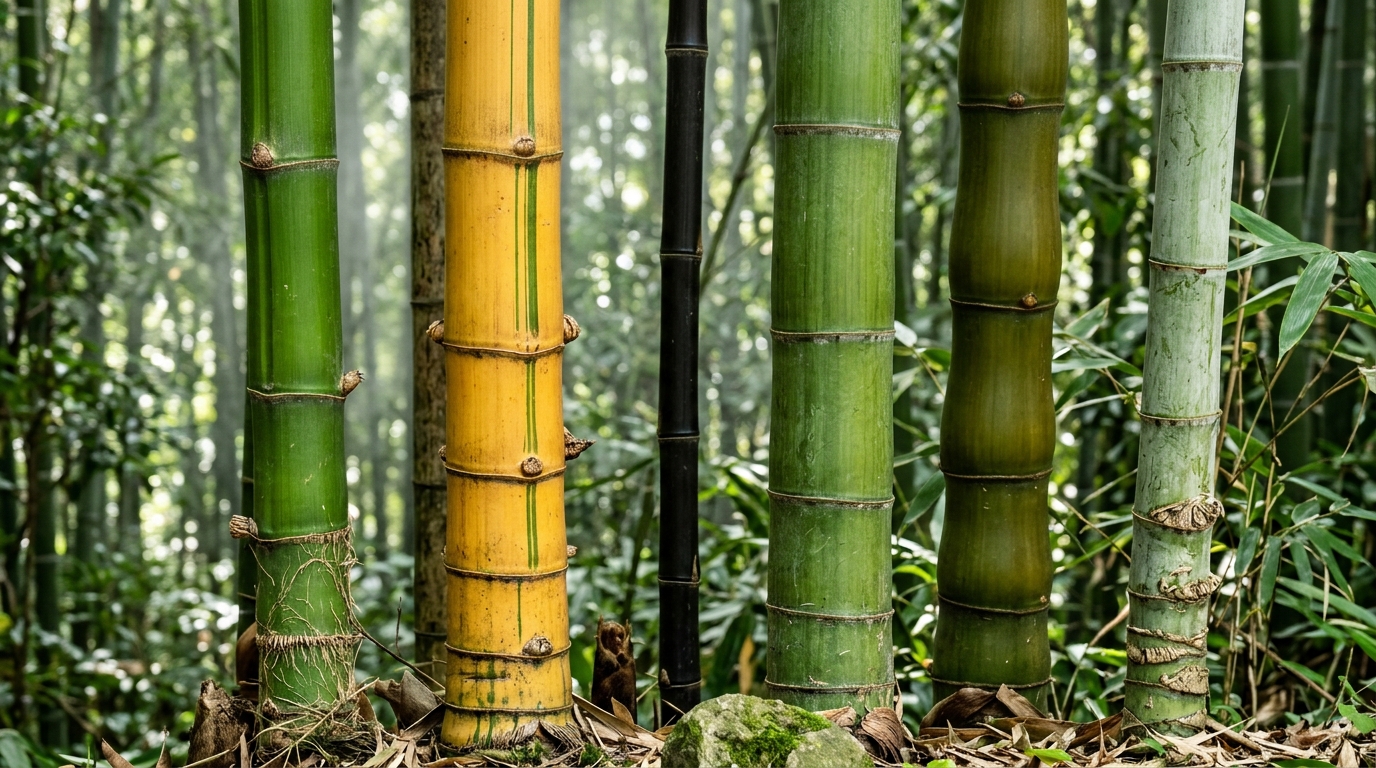
Bamboo is one of the most useful plant groups on Earth, yet identifying which species a nursery tray, a timber shipment, or a seed-bank accession actually contains remains surprisingly difficult. A new review published in Frontiers in Ecology and Evolution argues that the problem is not a lack of molecular tools but the absence of any single tool that works everywhere. After synthesising the literature on bamboo DNA barcoding and molecular identification, the authors conclude that no individual marker, and no combination of markers, currently serves as a universal barcode across the roughly 1,662 bamboo species recorded globally in 2016 estimates. Performance, they find, depends strongly on which marker is used and which bamboo lineage is being tested.
The review, led by Anupam Barh and Jag Mohan Singh Tomar of the ICAR-Indian Institute of Soil and Water Conservation in Dehradun, was framed by a scientometric analysis rather than a systematic review. The team retrieved bibliographic records from OpenAlex on July 29, 2026, using four search strings: bamboo DNA barcoding, bamboo molecular marker, bamboo molecular phylogeny, and bamboo molecular identification. From 592 records, 262 survived screening, and after duplicates were removed again, 201 publications entered the final analysis in VOSviewer. Of 363 unique keywords, 80 met a minimum occurrence threshold of five and grouped into five thematic clusters covering genetic diversity markers, phylogenetics and genomics, DNA barcoding and computational biology, taxonomy and systematics, and population genetic structure.
The reason bamboo resists conventional identification is biological. Most bamboo species flower unpredictably, some only once after decades or even more than a century, and many undergo monocarpic senescence, dying shortly after flowering. Floral characters, which anchor taxonomy in the grass family Poaceae, are therefore rarely available. Taxonomists fall back on vegetative traits such as culm branching, leaf morphology, and rhizome structure, but these show high phenotypic plasticity under environmental conditions and convergent evolution across distantly related lineages. The subfamily Bambusoideae also carries polyploidy, natural hybridisation, and introgression, and nuclear and plastid genomes have shown inconsistencies indicating reticulate rather than tree-like evolution. Major lineages have displayed non-monophyly and uncertain relationships, leaving the taxonomy unstable.
DNA barcoding promises a way around these obstacles because it matches a short, standardised DNA region against a reference database, independent of developmental stage, tissue type, or environment. In bamboo, the commonly employed regions are the nuclear internal transcribed spacer ITS and chloroplast loci such as matK, rbcL, and psbA-trnH. The review reports that ITS generally carries more sequence variation and stronger discriminating power than the plastid markers, but its PCR amplification universality sits around 80 percent, which limits its use as a standalone barcode. In temperate woody bamboos, ITS alone discriminated 66.6 percent in a single-marker system, while matK managed 15.4 percent and rbcL and trnH-psbA each 7.69 percent.
Combinations shift the picture. Adding ITS to plastid markers improved discrimination, with rbcL plus ITS reaching 87.5 percent in temperate woody bamboos and matK plus rbcL plus ITS apparently achieving 100 percent generic identification. Yet the standard core plant barcode combination of matK, rbcL, and trnH-psbA performed poorly in bamboo: one study reported only 5.7 percent tree-based and 2.9 percent distance-based resolution, worse than any single plastid region alone. The authors stress that concatenating conventional barcode regions does not guarantee better species discrimination, and that the nuclear-plus-plastid strategy should be treated as a promising candidate rather than an established universal bamboo barcode until validated across a much broader representation of Bambusoideae.
The plastid markers each carry their own caveats. matK, a roughly 1,500-base-pair gene encoding maturase K within the trnK intron, showed strong performance for genus-level identification and notable discriminatory potential in Himalayan temperate bamboos, but in Bambusa species it failed at the species level because sequences showed 99 to 100 percent similarity across species. rbcL, reported at 868 base pairs for bamboo barcoding, achieved 100 percent accuracy at the genus level but had low discriminating power when used alone. In one comparison across Bambusa, Dinochloa, Gigantochloa, Schizostachyum, and Dendrocalamus, identification efficiencies up to species level reached only 60 percent. The psbA-trnH intergenic spacer captured species-specific nucleotide variation in most examined taxa, yet its reproducible amplification was questioned in a later bamboo-focused study, and rps16-trnQ showed high variability between tribes but insufficient variation within a tribe for species-level discrimination.
Beyond single loci, the review surveys the wider molecular toolkit. RAPD and RFLP markers provided early feasibility demonstrations for bamboo species differentiation, while SSR microsatellites, prized for high polymorphism and codominant inheritance, have supported clonal-fidelity checks in micropropagated plants, population structure analysis, and taxonomy in genera such as Phyllostachys. ISSR markers generate more fragments per primer than RAPD but were found less reliable than functional gene-targeted iPBS, CDBP, and SCoT markers, with reported problems of low polymorphism and primer reproducibility. Applied work illustrates the practical stakes: molecular markers confirmed the hybrid origin of Bambusa changningensis as a cross between B. rigida and Dendrocalamus farinosus, chloroplast markers authenticated micro-propagated plantlets and culm cuttings for planting-stock certification, and multi-locus barcodes enabled rapid biodiversity inventory in tropical forest ecosystems including bamboo-rich habitats.
Next-generation sequencing is reshaping what is possible. Genome skimming, a low-coverage approach below one-fold to five-fold coverage, recovers high-copy regions such as organellar genomes and nuclear ribosomal DNA at low cost, and skimming-based plastome assemblies have yielded super-barcodes with higher species discrimination rates than conventional barcodes. Complete plastomes, generally 130 to 160 kilobases long with roughly 110 to 130 genes, resolved relationships among closely related Fargesia species that standard barcodes failed to separate, and hypervariable plastome regions in Gelidocalamus have been flagged as prospective high-resolution markers. Target capture, used on 412 woody bamboo samples, reduces raw data needs per sample. Whole-genome and long-read sequencing go further: bamboo underwent a whole-genome duplication around 7 to 12 million years ago, and long-read PacBio HiFi sequencing identified three subgenomes in B. tulda, something the cheaper approaches cannot do because they cannot resolve subgenomes in polyploid bamboo.
Machine learning adds another layer. In an image-based study of 2,000 bamboo samples from 10 species with 131 attributes, a support vector machine reached 82.27 percent accuracy, the convolutional neural network VGG16 reached 88.75 percent, and a deep learning algorithm called MajMulVot lifted accuracy to 92.8 percent. On nucleotide data from six bamboo species, roughly 1,000 base pairs of the matK barcode segment across 56 instances were classified by logistic regression, random forest, support vector machine, and gradient boosting machine, with gradient boosting achieving an average accuracy of 95.3 percent. The authors caution, however, that ML for bamboo barcoding remains in a very nascent state: classifiers are usually trained on a small number of commercial or well-known taxa rather than the full species pool, the largest comparative plastome dataset covers less than 10 percent of the subfamily, and shared ancestry, hybridisation, and incomplete lineage sorting mean barcode sequences are not independent samples and can mislead classifiers.
The review closes with a hierarchy of priorities. First, build voucher-linked, taxonomically validated reference libraries tied to expert-identified herbarium or living vouchers, since bamboo sequences are underrepresented in public databases and often derive from few specimens or taxonomically uncertain samples. Second, run multilocus and genome-scale validation across representative lineages rather than single difficult groups. Third, standardise sampling, sequencing, and analytical protocols, including common marker sets, alignment procedures, and distance thresholds, so data can be pooled. Fourth, validate species-specific markers for economically and conservation-important taxa. Fifth, test machine learning classifiers on accessions from outside their training region before operational use. For practitioners, the practical message is blunt: DNA barcode identification will be reliable at the genus level but provisional at the species level unless supported by multilocus data, especially for verifying nursery planting stock, and ML-based screening tools should be adopted only after regional validation.
Subject of Research: Molecular identification and DNA barcoding of bamboo species
Article Title: An insight into molecular identification and DNA barcoding of bamboo: current status, challenges, and future prospects
Article References: Barh, A., Tomar, J. M. S., Kaushal, R., Annepu, S. K., Mariappan, S., Singhal, V., Jayaprakash, J., & Madegowda, M. (2026). An insight into molecular identification and DNA barcoding of bamboo: current status, challenges, and future prospects. Frontiers in Ecology and Evolution, 14, Article 1905281. https://doi.org/10.3389/fevo.2026.1905281
Image Credits: AI Generated
DOI: 10.3389/fevo.2026.1905281
Keywords: bamboo, DNA barcoding, molecular markers, ITS, matK, rbcL, plastome sequencing, genome skimming, machine learning, taxonomy, polyploidy, Bambusoideae
News Source: Drew Townsend. (November 6, 2026). No universal DNA barcode for bamboo: review finds markers work only lineage by lineage. Scienmag.