A South African cicada long thought to be a single species has turned out to be two. A systematic revision of the genus Albanycada, published in African Invertebrates, shows that the type species Albanycada albigera and a second, previously unnamed lineage both live in the Albany Thicket Biome of the Eastern and Western Cape provinces. The new species, Albanycada bellinganorum, is described from specimens collected on a farm near Willowmore, and the paper also resolves a century-old confusion over where the older species was actually found.
The genus Albanycada was created in 1989 for Platypleura albigera, a cicada described by Francis Walker in 1850, because the species did not match the revised concept of the genus Platypleura and did not fit any other established genus. Later phylogenetic work on the tribe Platypleurini confirmed that Albanycada is monophyletic and forms the sister group to Platypleura, and it also hinted that a second species-level lineage existed within the genus. Platypleura membranacea, described by Karsch in 1890, had been treated as a junior synonym of A. albigera since the early twentieth century, so the authors set out to re-evaluate that synonymy and to pin down the identity of the mysterious second lineage.
The resolution came from two directions at once. Phylogenetic analysis of nucleotide sequences of the cytochrome oxidase I gene supported the hypothesis that the genus contains more than one species-level lineage. At the same time, direct comparison of the lectotype of Platypleura albigera in the Natural History Museum in London with the lectotype and paralectotypes of Platypleura membranacea in the Museum für Naturkunde in Berlin confirmed that those type specimens represent the same species. That left the second genetic lineage, previously labelled Albanycada sp. 1 in earlier work, as an undescribed species, which is now named Albanycada bellinganorum in honour of the Bellingan family, who helped the authors obtain specimens and sound recordings around their farm, Rietfontein.
The type specimens themselves carry a misleading geographic story. The albigera lectotype, a female, is labelled only “? Cape”, while the membranacea syntypes are labelled “Cap Bona Spei”, the Cape of Good Hope. The Berlin specimens were supplied by Ludwig Krebs, a Cape naturalist to the King of Prussia who worked as an apothecary in Grahamstown between 1820 and 1828 and shipped fifteen significant collections to the Berlin Museum. Krebs collected in the Sundays River, Albany and Kaffraria regions in 1822 and 1823, and the authors argue the specimens were almost certainly gathered near what is now Makhanda and shipped to Germany via Cape Town, which would explain the Cape of Good Hope labels. Because the two names are synonyms, the paper fixes a site just north of Makhanda, at 33°16’S, 26°28’E, as the restricted type locality for both species, and designates lectotypes for each name to stabilise their interpretation.
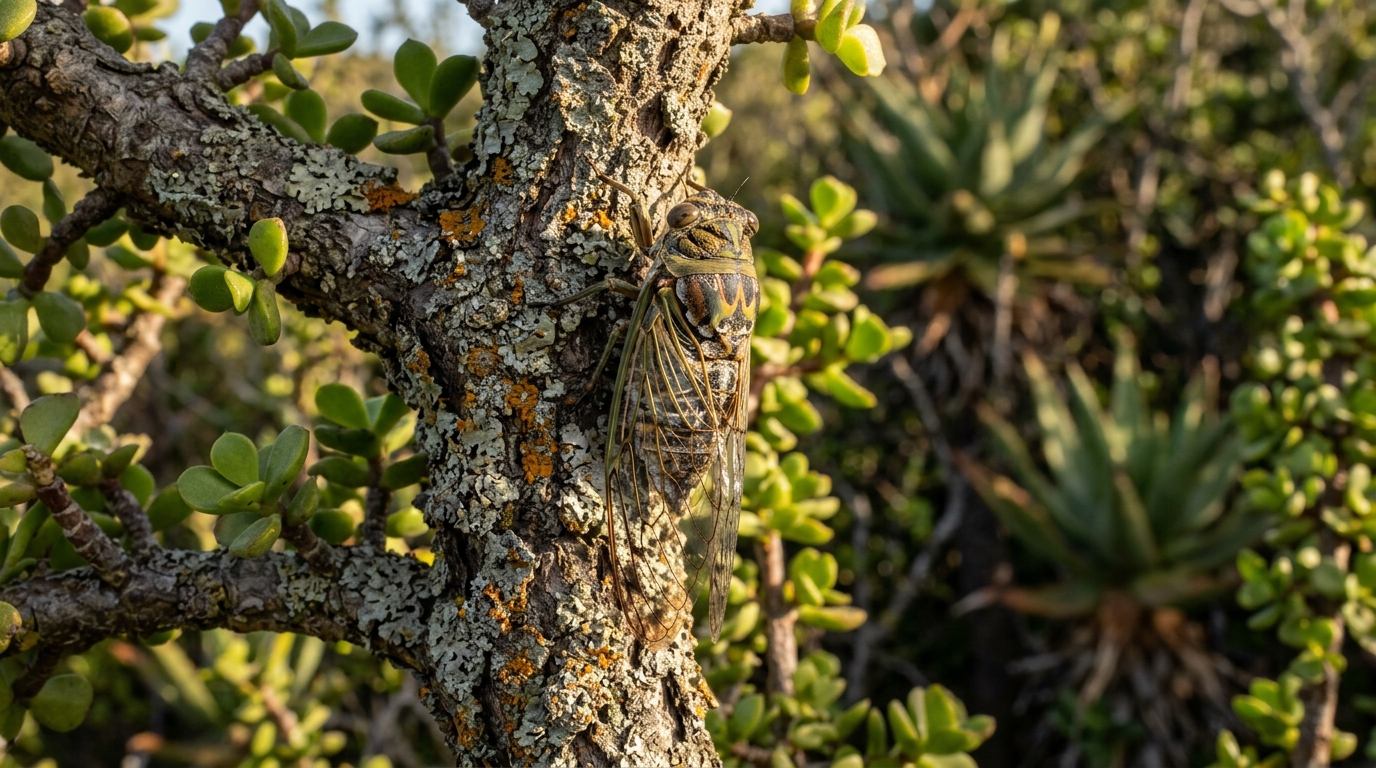
Separating the two species in the hand comes down mainly to wing colour. In A. albigera, the veins in the apical areas of the hind wing lack dark markings and the wing apex is substantially hyaline, or glassy. In A. bellinganorum, the veins in the apical areas of the hind wing are surrounded by dark markings and the apex is substantially pigmented, with the hind wing burnt orange basally in live specimens. Both are small, short-bodied platypleurine cicadas with green heads marked by two black stripes running from eye to eye, fore wings with eight apical cells and hind wings with six, and a male urite whose ventral mediolateral processes turn laterally at their tips but are robust, short, conical and spineless. Albanycada differs from Platypleura in having yellowish rather than distinctly orange hind wings and spineless rather than spiny uncus processes, and its fore wing is more oval than is typical for the tribe.
Measurements place the two species in a similar size range. Male A. albigera have fore wing lengths of 22.4 to 25.3 millimetres and body lengths of 19.0 to 21.6 millimetres, while male A. bellinganorum measure 23.4 to 24.3 millimetres in fore wing length and 19.8 to 20.7 millimetres in body length. The single measured female of the new species has a fore wing length of 22.5 millimetres and a body length of 18.3 millimetres. The paper provides these dimensions, along with head and mesonotum widths, as part of the formal description of the new species.
The calling songs add another layer of distinction. Both species sing a continuous, unmodulated whine that individual males can sustain for minutes at a time, and neither forms choruses during the day or shows crepuscular singing. The song of A. albigera is pitched between 7 and 12 kilohertz, emphasised at about 9.5 kilohertz, with a pulse repetition rate of roughly 250 hertz; it has been characterised as a sibilant “Tseeeeeeeeeeeeeeeeeeeeeeee” sound. The song of A. bellinganorum, recorded in the field with a flat-response handheld recorder and analysed as spectrograms and power spectra, is pitched between 6.5 and 12.75 kilohertz, emphasised around 9.0 kilohertz, with a pulse repetition rate of about 160 hertz, and its pulses are arranged in pairs in a manner similar to those of A. albigera and the related Kongota punctigera. The recordings are publicly available on the Bioacoustica website.
Distribution and ecology separate the species as well. A. albigera is widespread in the Albany Thicket Biome of the southwestern Eastern Cape, from the coast to the Great Escarpment about 200 kilometres inland, occupying Mesic, Valley, Arid and Mosaic Thicket with Grassland types, all of them semi-arid with erratic rainfall. Adults are active from October to February, peaking in January, and perch on plants including Portulacaria afra, several Euphorbia species, Grewia robusta, Euclea undulata and Vachellia karroo, though records on wooden fence posts, from which the insects clearly could not feed, mean plant associations need cautious interpretation. A. bellinganorum is apparently endemic to Arid Thicket and Mosaic Thicket with Fynbos variants in the westernmost Eastern Cape and eastern Western Cape, but its distribution is poorly sampled. Its known biology comes from a patch of Arid Thicket on the farm Rietfontein, where adults are associated with Rhigozum obovatum, and the type locality holds a population of the endemic Aloe comptonii, a possible marker plant for that thicket variant. Adults of the new species are known to be active in January.
The phylogenetic history reconstructed from four genes places the split between the two species at about 5 million years ago, at the start of the Pliocene, while the genus itself is estimated to have diverged from its sister genus Platypleura in the mid-Miocene, around 13.5 million years ago. The authors note that the Albany Thicket Biome may have originated as early as the Eocene, making it reasonable that the Albanycada lineage colonised the biome in the Miocene and has remained endemic to it. They also consider whether recurring climate-driven cycles of allopatry caused the diversification, since the biome’s distribution has apparently responded to past glacial cycles, but they point out that those cycles began only 2.58 to 2.6 million years ago, after the two species had already diverged. Identification of both species is now supported either by four genes, including COI, COII, 16S and EF-1α, or by about 490 nuclear Anchored Hybrid Enrichment loci, with GenBank accession numbers cited for the sequences.
Conservation is where the revision acquires urgency. A. albigera has an Area of Occupation of 228 square kilometres and an Extent of Occurrence of 40,373 square kilometres at altitudes of 15 to 850 metres; it is Not Evaluated on the IUCN Red List but would qualify as Endangered by Area of Occupation criteria and Near Threatened by Extent of Occurrence criteria. A. bellinganorum, known from only two sites about 190 kilometres apart, has an Area of Occupation of 8 square kilometres and an Extent of Occurrence of 0 square kilometres at altitudes of 255 to 935 metres, and the authors write that by criteria linked to those figures and its habitat it may well qualify as Critically Endangered; it is not yet known from any formally conserved area. The threat comes from the biome itself, one of the smallest in South Africa, whose vegetation resists many natural perturbations but is not resilient to degradation, with roughly half already transformed and substantial ongoing losses of about 40 percent of its extent between 2006 and 2018. The authors recommend a formal conservation status analysis for the members of the genus, particularly for the newly named species, whose future, like that of its habitat, they describe as equivocal.
Subject of Research: Systematic revision of the South African cicada genus Albanycada, including the description of a new species
Article Title: The cicada genus Albanycada Villet, 1989 ( Hemiptera , Cicadidae ): systematic revision
Article References: Villet, M. H., Bellingan, T. A., & Price, B. W. (2026). The cicada genus Albanycada Villet, 1989 (Hemiptera, Cicadidae): systematic revision. African Invertebrates, 67(2), 233-252. https://doi.org/10.3897/afrinvertebr.67.208987
Image Credits: AI Generated
DOI: 10.3897/afrinvertebr.67.208987
Keywords: Albanycada, cicadas, taxonomy, new species, Albany Thicket Biome, South Africa, phylogenetics, calling song, type specimens, conservation, Hemiptera, endemism
News Source: Drew Townsend. (November 6, 2026). Hidden cicada species uncovered in South Africa’s thicket biome. Scienmag.