Dairy cows given a sustained-release mineral-vitamin bolus around the start of the breeding period had markedly higher odds of conceiving at their first insemination than untreated herdmates, according to a retrospective matched cohort study conducted on a commercial Lithuanian dairy farm. After adjustment for baseline metabolic status, parity, and days in milk at enrolment, bolus supplementation was associated with roughly three and a half times the odds of first-service conception, with an odds ratio of 3.45 and a 95% confidence interval of 1.07 to 11.11. Supplemented cows also showed higher serum magnesium concentrations and lower lactate dehydrogenase activity than controls over the three-week sampling window. The authors stress that because allocation was not randomised, the findings are associative and hypothesis-generating rather than proof of benefit.
The study, published in Frontiers in Veterinary Science, drew on routine herd records from a family-owned farm in Kazlų Rūda municipality that keeps about 2,400 Holstein × Lithuanian Black-and-White cattle, including 1,100 lactating cows averaging roughly 11,000 kg of milk per year. Farm staff enrolled 100 clinically healthy cows in 50 matched pairs based on calving date and lactation number, giving one cow in each pair the bolus and leaving the other as a control. Twelve cows were later excluded because of missing blood samples, clinical disease, death, or culling, leaving 88 animals in the final analysis: 45 supplemented cows and 43 controls. The investigators obtained the records and laboratory results only after the observation period had ended, and the research question and analysis plan were defined at that point.
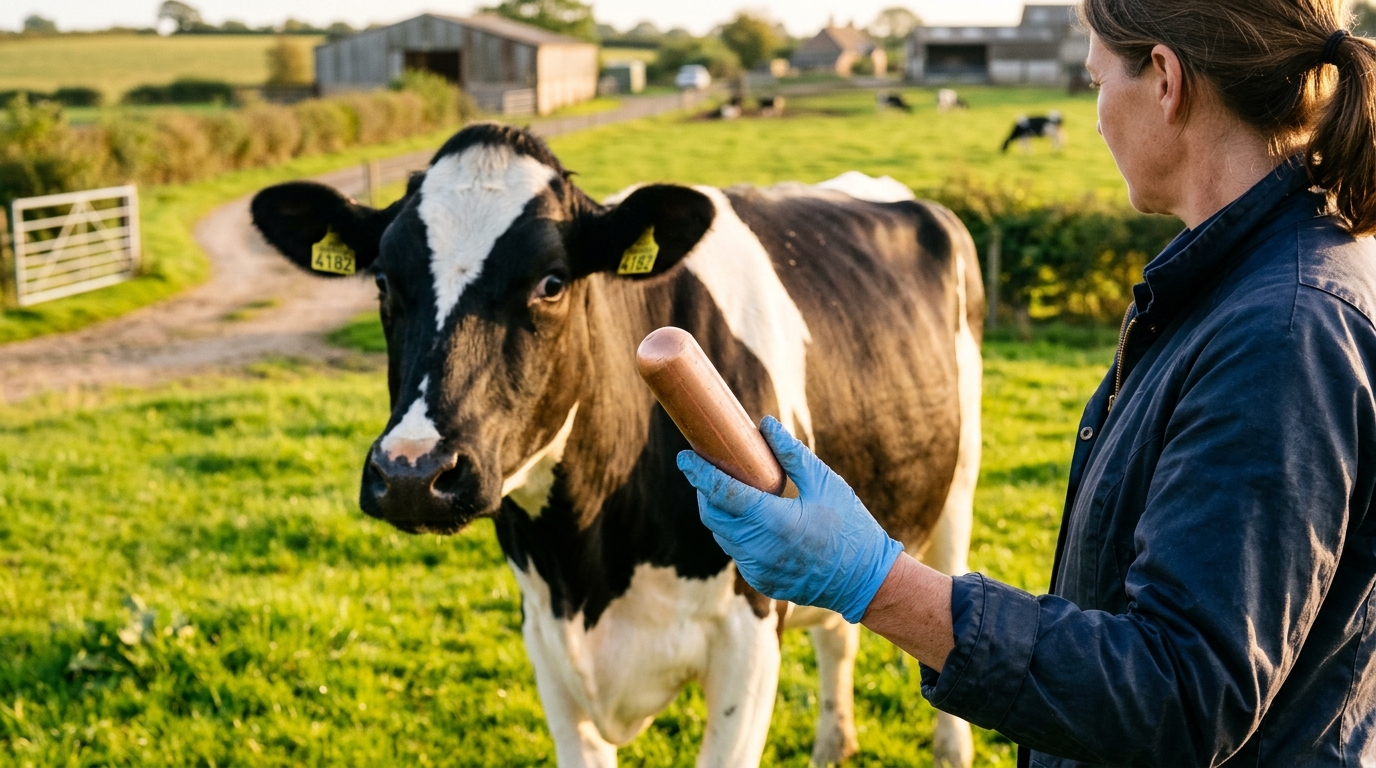
Each supplemented cow received two boluses at 51.13 ± 3.15 days in milk, followed by two more 14 days later. According to the manufacturer, each two-bolus dose releases 2.4 g of magnesium, 130 mg of zinc, 36 mg of copper, 1.5 mg of selenium, 132,000 IU of vitamin A, 500 IU of vitamin E, and 300 mg of β-carotene daily over a 10-day period. The bolus is registered as a dietetic mineral feed and is marketed as a nutritional supplement intended to support oestrus expression and reproductive performance. The first administration was timed roughly 10 days before the end of the farm’s 60-day voluntary waiting period, in line with the manufacturer’s recommendation for use during the breeding window.
Reproductive outcomes were tracked through the herd’s automated management system, which monitors milk progesterone from 45 days in milk onwards, alongside visual oestrus checks and veterinary examination before insemination. Pregnancy was initially suggested by milk progesterone changes about 20 days after insemination and then confirmed by ultrasonography at 60 days; only ultrasonographically confirmed pregnancies counted as outcome events. In total, 37.8% of supplemented cows conceived at their first insemination compared with 18.6% of controls, a difference that was significant in the unadjusted analysis and remained significant after adjustment. The Firth-penalised estimate for the same model was comparable at an odds ratio of 3.08.
Not every reproductive measure moved in the same direction. The proportion of cows pregnant by 150 days in milk was almost identical between groups, at 57.8% versus 55.8%, and time to confirmed pregnancy did not differ significantly; the adjusted hazard ratio was 1.29 with a confidence interval spanning 0.77 to 2.15. Supplementation was also not associated with days to first oestrus overall or with days to first insemination, which averaged 80.8 days in supplemented cows and 87.1 days in controls after adjustment for parity. Breeding exposure was comparable as well, with similar numbers of inseminations per cow and services per conception in both groups.
The clearest separation appeared in cumulative pregnancy by 300 days in milk, where 82.2% of supplemented cows were confirmed pregnant compared with 62.8% of controls, giving an adjusted odds ratio of 3.80. The authors treat this endpoint as exploratory because the groups were nearly identical at 150 days in milk and diverged only later in the breeding period, with the difference emerging after 180 days in milk, more than 100 days after supplementation had ended. They note that a direct effect of the bolus at that stage is biologically implausible and that the pattern may reflect chance in a small sample or unmeasured differences between groups. An exploratory subgroup analysis also suggested that multiparous supplemented cows reached first detected oestrus about 13.6 days earlier than multiparous controls, while no such difference appeared among primiparous cows, though this interaction was not adjusted for multiple comparisons.
Blood samples collected at enrolment and again 14 and 21 days later revealed distinct biochemical shifts. Serum magnesium rose in supplemented cows and fell in controls, producing a significant group-by-time interaction and a mean difference of 0.048 mmol/L averaged across all sampling points. By the final sampling point, supplemented cows had serum magnesium concentrations 0.124 mmol/L higher than controls. Lactate dehydrogenase activity, a marker associated with tissue turnover and metabolic strain, declined in supplemented cows while rising in controls, with a significant group-by-time interaction and a between-group ratio of 1.94 at day 21. Phosphorus, calcium, sodium, albumin, and total protein showed no significant group-by-time interaction.
The authors interpret the magnesium shift as evidence that supplementation altered mineral status, since serum magnesium in ruminants depends mainly on absorption and renal excretion rather than tight endocrine control. The forage-based ration supplied roughly 35 g of magnesium and 312 g of potassium per cow daily, a potassium-to-magnesium ratio of about 9:1 that is known to inhibit ruminal magnesium absorption. The bolus increment of about 2.4 g daily represents roughly 7% of the magnesium provided by the forage portion alone. However, because circulating trace element and vitamin concentrations were not measured, the contribution of zinc, copper, selenium, vitamin E, or β-carotene to the reproductive associations remains hypothetical, and the study cannot determine whether magnesium itself mediated the outcomes.
Several limitations temper the findings. Cows were not randomly allocated, and the groups differed at baseline in milk fat, milk protein, and milk β-hydroxybutyrate, although these variables were included as covariates in all reproductive models and residual confounding cannot be excluded. Baseline lactate dehydrogenase activity was also numerically higher in control cows. No a priori power calculation was performed, and the moderate sample size is reflected in wide confidence intervals. Twelve cows were excluded after enrolment, and attrition bias cannot be excluded, though the exclusions related to disease, death, or culling occurred mostly in the control group, potentially biasing results against rather than in favour of the reported association. In a matched-pair sensitivity analysis restricted to the 39 complete pairs, the estimates were attenuated but remained in the same direction.
The study was conducted on a single farm, and all cows calved between February and May, which constrains generalisability to other herds, breeds, management systems, and calving seasons. No hormonal, ovarian, or uterine measurements were available, and the mineral content of the compound concentrate and premix was not determined, so total dietary mineral supply could not be quantified. The authors conclude that the results are best treated as hypothesis-generating and call for adequately powered, randomised, multi-herd studies that include measurement of circulating trace element and vitamin status, ovarian activity, and reproductive hormone profiles to establish whether targeted mineral-vitamin supplementation during the breeding period genuinely improves fertility in dairy cows.
Subject of Research: Association between sustained-release mineral-vitamin bolus supplementation during the breeding period and reproductive outcomes in dairy cows
Article Title: Association between mineral-vitamin bolus supplementation during the breeding period and reproductive outcomes in dairy cows
Article References: Kačiulytė, K., Urbonas, S., Stoškus, R., Sorkytė, Š., Vaičiulienė, G., Sutkevičienė, N., Vilkonienė, T., & Rekešiūtė, A. (2026). Association between mineral-vitamin bolus supplementation during the breeding period and reproductive outcomes in dairy cows. Frontiers in Veterinary Science, 13, Article 2004069. https://doi.org/10.3389/fvets.2026.2004069
Image Credits: AI Generated
DOI: 10.3389/fvets.2026.2004069
Keywords: dairy cows, mineral-vitamin bolus, reproductive performance, conception at first AI, serum magnesium, lactate dehydrogenase, matched cohort study, pregnancy by 300 DIM, trace elements, sustained-release supplementation, Association, between
News Source: Drew Townsend. (November 6, 2026). Mineral bolus tied to higher conception odds in dairy cows. Scienmag.