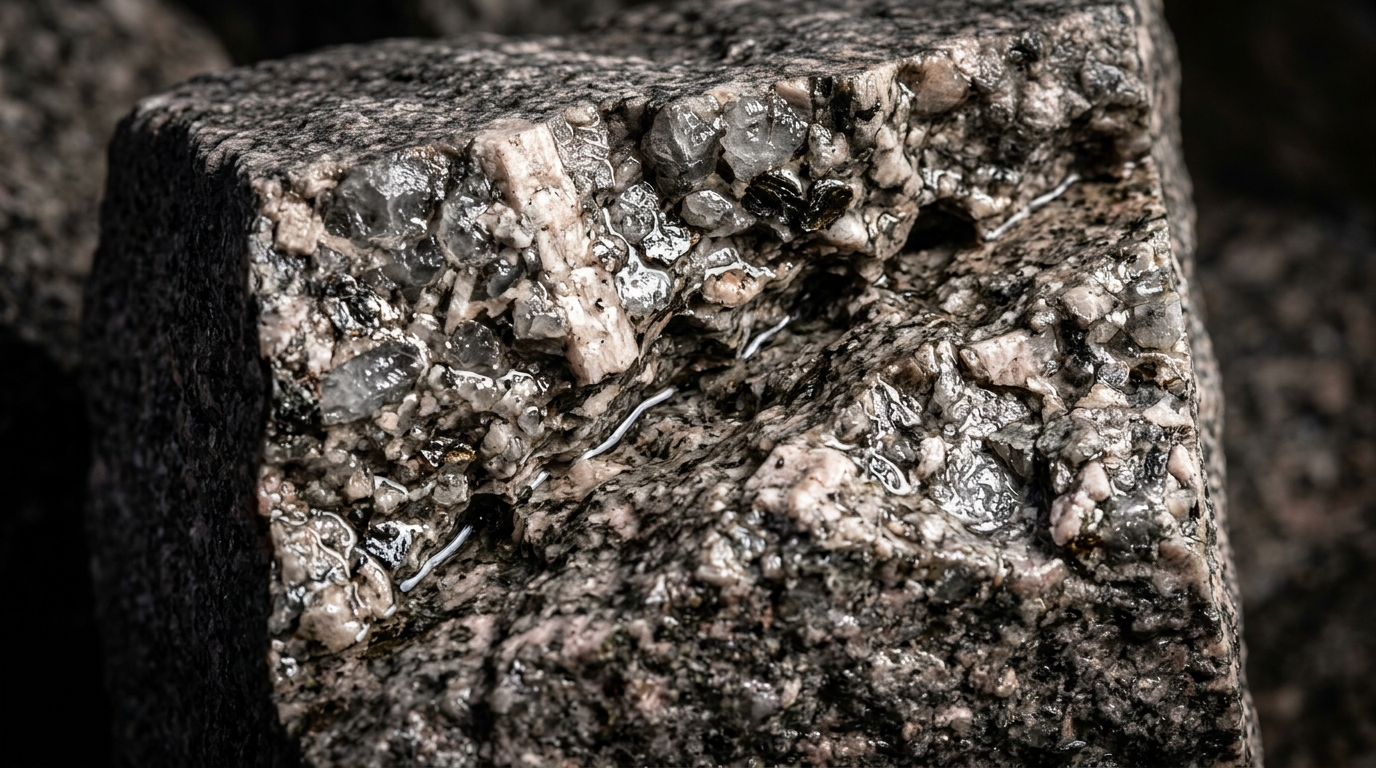
Deep geothermal reservoirs in crystalline rock depend on how fluids move through natural fractures, and a new study argues that the fine-scale shape of those fracture surfaces matters far more than conventional models assume. Researchers measured the topography of granite fracture samples collected from three locations near the geothermal anomaly of the Rhine Graben and then modeled how laminar flow responds to the resulting geometry. Their central finding is that local fluctuations in the roughness height gradient, rather than global surface statistics, dominate how fracture apertures evolve during shear, with consequences for hydraulic conductivity that standard parallel-plate approaches miss.
The work addresses a specific setting: the wider pressure-stimulated zones of geothermal reservoirs, where high fluid pressures drive low effective normal stress conditions. Under these conditions, fractures can undergo normal opening or shear displacement with minimal abrasion, so the original roughness of the rock surfaces is largely preserved. That makes the geometry of natural, unaltered fracture surfaces a controlling factor in how fluids circulate, and therefore in how much heat a reservoir can deliver.
The team used high-resolution topography measurements of the granite fracture samples to quantify surface roughness. Their analysis showed that local fluctuations in the roughness height gradient control the evolution of the fracture aperture during shear. The fracture voids that result exhibit mean apertures up to 2 millimeters larger than conventional models suggest, and the normalized local aperture distribution widens with shear distance. In practical terms, shearing a rough granite fracture opens channels that are wider, on average, than a model built on smooth or statistically averaged surfaces would predict.
To translate these geometric shifts into fluid dynamics, the researchers applied a dual-modeling approach under laminar flow at low Reynolds numbers. A one-dimensional model isolated how the width of the aperture distribution affects fracture hydraulics, while a three-dimensional model examined how the overall aperture increase governs the flow direction. This separation allowed them to distinguish two distinct effects: a broadening of the aperture distribution, which impedes flow, and an increase in mean aperture, which enhances it.
The results cut both ways. On the one hand, the local height gradients of natural fracture surfaces significantly increase hydraulic conductivity by expanding the mean aperture. On the other hand, an aperture distribution width of 18 percent, a condition the authors note can be introduced by fracture shearing, leads to a pressure increase of more than 25 percent compared with a parallel plate assumption. In other words, even as shearing opens the fracture overall, the unevenness of the opening imposes an additional hydraulic penalty that uniform models do not capture.
The three-dimensional simulations added a further nuance: the increased aperture in sheared fractures was found to reduce spatial flow non-uniformity. Wider, sheared fractures therefore channel fluid more evenly across the fracture plane, a property that could influence how uniformly heat is extracted from the rock surrounding a geothermal well.
The authors draw a clear modeling conclusion from these observations. Conventional fracture models, they argue, should be expanded beyond global surface statistics to integrate the geometrical effects of natural, extreme local height gradients, primarily by increasing the fracture mean aperture. Because the study focused on laminar flow at low Reynolds numbers, its conclusions apply to the slow, viscous flow regime typical of many deep reservoir conditions rather than to turbulent flow, and the samples came from granite fractures adjacent to the Rhine Graben geothermal anomaly, so the quantitative values reflect that setting.
For reservoir engineers, the implications are concrete. Predictions of fluid pressure, flow rate and heat extraction in stimulated crystalline reservoirs currently rely on fracture characterization schemes that emphasize global roughness statistics. This study indicates that such schemes can underestimate mean apertures in sheared fractures by up to 2 millimeters and misjudge the pressure penalty associated with aperture variability by more than 25 percent in the case examined. Incorporating local height-gradient information into aperture models could therefore sharpen forecasts of how stimulated fractures conduct fluid, without requiring any change to the underlying laminar flow physics.
The research, published open access in the journal Geothermal Energy, positions local roughness gradients as a measurable, modelable input for deep geothermal reservoir management. As enhanced and stimulated geothermal systems push deeper into crystalline basement rock, the difference between a parallel-plate idealization and a roughness-aware fracture model may determine whether predicted flow rates and pressures match what the reservoir actually delivers.
Subject of Research: How local roughness gradients on granite fracture surfaces affect laminar flow and hydraulic conductivity in deep geothermal reservoirs.
Article Title: Impact of local roughness gradients on laminar flow within granite fractures
Article References: Buness, C. M., Nitschke, F., & Kohl, T. (2026). Impact of local roughness gradients on laminar flow within granite fractures. Geothermal Energy. https://doi.org/10.1186/s40517-026-00417-1
Image Credits: AI Generated
DOI: 10.1186/s40517-026-00417-1
Keywords: geothermal energy, granite fractures, fracture roughness, laminar flow, hydraulic conductivity, fracture aperture, shear displacement, Rhine Graben, crystalline rock, reservoir modeling, aperture distribution, deep geothermal
News Source: Violet Maxwell. (November 6, 2026). Rough granite fracture surfaces reshape geothermal fluid flow predictions. Scienmag.