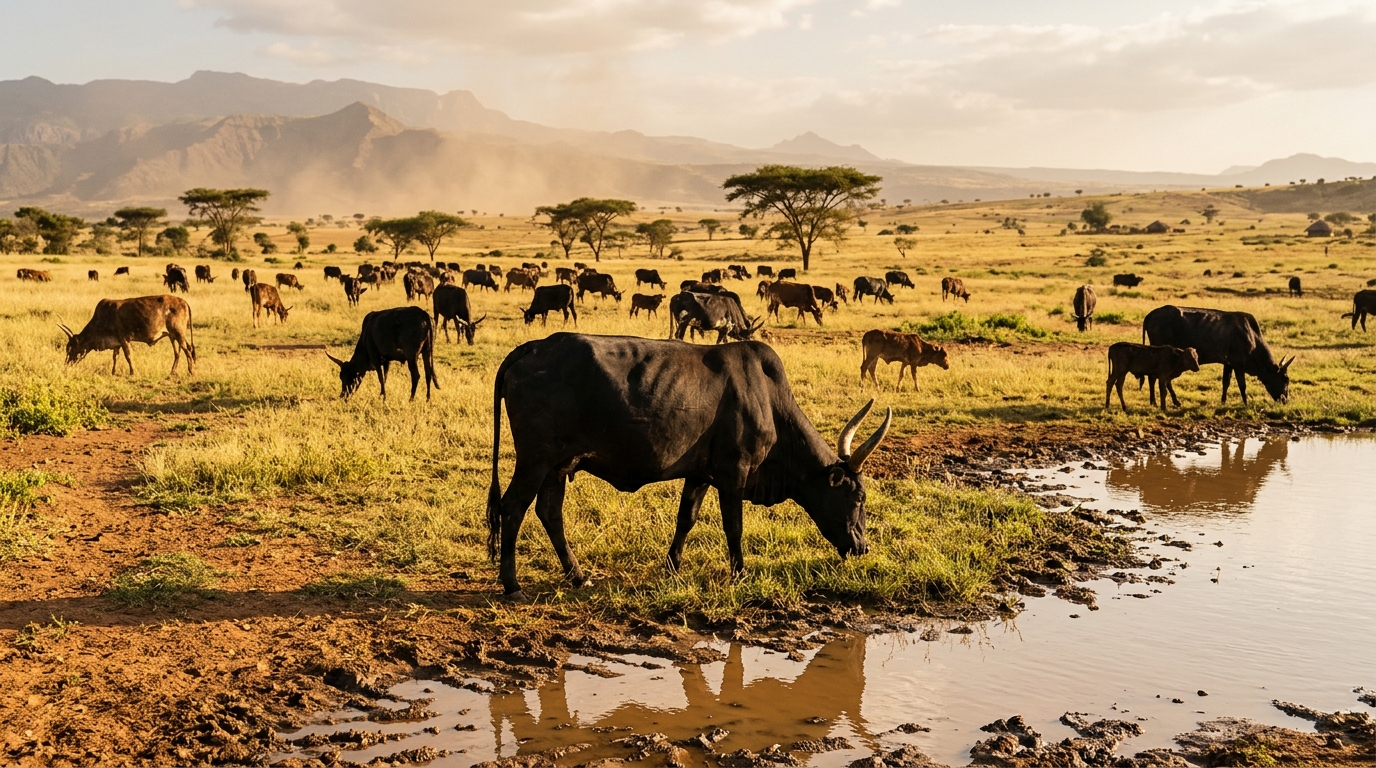
A cross-sectional investigation of 384 free-ranging cattle across Buno Bedele Zone in Southwestern Ethiopia has identified high rates of gastrointestinal parasite carriage, dominated by gastrointestinal strongyles and liver flukes belonging to the genus Fasciola. The research, conducted by Ashenafi Miresa Kenea and Ashenafi Timotiwos Erkalo and published in BMC Veterinary Research, evaluated the prevalence and egg-shedding intensity of gastrointestinal helminth infections across distinct agroecological settings. In the surveyed population, gastrointestinal strongyles represented the most widespread infection, detected in 41.67 percent of the animals, while Fasciola species were identified in 19.53 percent of the cattle. In contrast, tapeworms of the genus Moniezia demonstrated a low prevalence among the sampled herds. The authors noted that gastrointestinal helminthiasis represents a persistent operational challenge to smallholder cattle production within free-ranging grazing systems, where designing targeted control interventions requires an understanding of how host characteristics and local agroecological factors shape parasite distribution.
To assess parasite burdens across different environments, the cross-sectional study sampled cattle situated in midland and lowland agroecological zones. The investigators evaluated faecal samples using a combination of diagnostic parasitological procedures, comprising flotation, sedimentation, and McMaster egg-counting techniques. To achieve precise differentiation of gastrointestinal strongyles, coproculture and Baermann recovery techniques were employed to isolate and identify third-stage larvae (L3). The research team analyzed associations between infection status and potential explanatory variables through initial univariable assessments, followed by multivariable generalized linear mixed-effects models (GLMMs). In these multivariable models, fixed effects included the animal’s body condition score, age category, sex, and altitude classification. To account for geographical and administrative clustering within the study area, the models incorporated peasant associations nested within districts as random intercepts.
Coproculture differentiation of the recovered gastrointestinal strongyle third-stage larvae revealed a specific composition dominated by Bunostomum species, which accounted for 28.42 percent of the larval profile, followed by Trichostrongylus species at 21.62 percent. When evaluating risk factors through multivariable modeling, the researchers identified a statistically significant interaction between an animal’s body condition and its altitude category for gastrointestinal strongyles, yielding an interaction adjusted odds ratio (aOR) of 7.05 (p < 0.001). This interaction demonstrated that the relationship between body condition and parasite detection depended directly on the agroecological setting. Specifically, among cattle managed in midland environments, animals in poor body condition exhibited substantially higher odds of gastrointestinal strongyle detection compared to individuals in good body condition (aOR = 8.40, 95% confidence interval [CI]: 3.25–21.67, p < 0.001). However, this association between poor body condition and elevated strongyle detection was not observed among cattle sampled in lowland settings.
In the multivariable generalized linear mixed-effects model for Fasciola species, both physical condition and altitude demonstrated independent associations with parasite detection. Cattle assessed in poor body condition had significantly higher odds of Fasciola detection than those in good condition (aOR = 3.58, 95% CI: 1.71–7.49). Similarly, cattle residing at midland altitudes had higher odds of testing positive for Fasciola compared to those in lowland areas (aOR = 4.23, 95% CI: 2.32–7.69). Host demographic factors also exhibited notable associations with Fasciola detection. Age-stratified analyses revealed that young cattle and adult cattle faced higher odds of infection than calves, with adjusted odds ratios of 4.02 and 5.50, respectively. Furthermore, animal sex was associated with infection status, as male cattle showed significantly lower odds of Fasciola detection compared to female cattle (aOR = 0.50, 95% CI: 0.29–0.87).
By contrast, Moniezia species exhibited a low prevalence across the sampled herds and showed no statistically significant associations with any of the evaluated host or agroecological risk factors. A critical methodological finding of the study was the presence of pronounced parasite clustering within individual households, evidenced by design effects of 3.7 and 6.7. This substantial household clustering prompted the investigators to perform sensitivity analyses that specifically adjusted for household-level clustering. When these household-clustered sensitivity analyses were executed, the statistically significant associations previously identified for Fasciola species—including those linked to body condition, altitude, age, and sex—were not retained.
In their conclusions, the authors emphasized that gastrointestinal helminth infections remain common among free-ranging cattle in Buno Bedele Zone, with strongyles and Fasciola species constituting the primary parasite burdens. Because the relationship between body condition and gastrointestinal strongyle infection varied according to agroecological setting, while midland altitude and body condition showed independent associations with Fasciola detection in primary models, the authors highlighted the need for locally adapted parasite management strategies. They concluded that these empirical findings support the implementation of targeted interventions tailored to specific agroecological settings alongside ongoing parasitological surveillance in smallholder grazing communities.
Subject of Research: Gastrointestinal parasite prevalence and risk factors in free-ranging cattle
Article Title: Gastrointestinal parasite burdens and associated factors in free-ranging cattle in Buno Bedele Zone, Southwestern Ethiopia: a cross-sectional study
Article References: Kenea, A. M., & Erkalo, A. T. (2026). Gastrointestinal parasite burdens and associated factors in free-ranging cattle in Buno Bedele Zone, Southwestern Ethiopia: a cross-sectional study. BMC Veterinary Research. https://doi.org/10.1186/s12917-026-06073-8
Image Credits: AI Generated
DOI: 10.1186/s12917-026-06073-8
Keywords: gastrointestinal helminths, cattle parasites, Ethiopia, Buno Bedele Zone, Fasciola, strongyles, agroecology, veterinary parasitology, Gastrointestinal, parasite, burdens, associated
News Source: William Thompson. (November 6, 2026). Gastrointestinal Parasites and Infection Factors Identified in Free-Ranging Ethiopian Cattle. Scienmag.