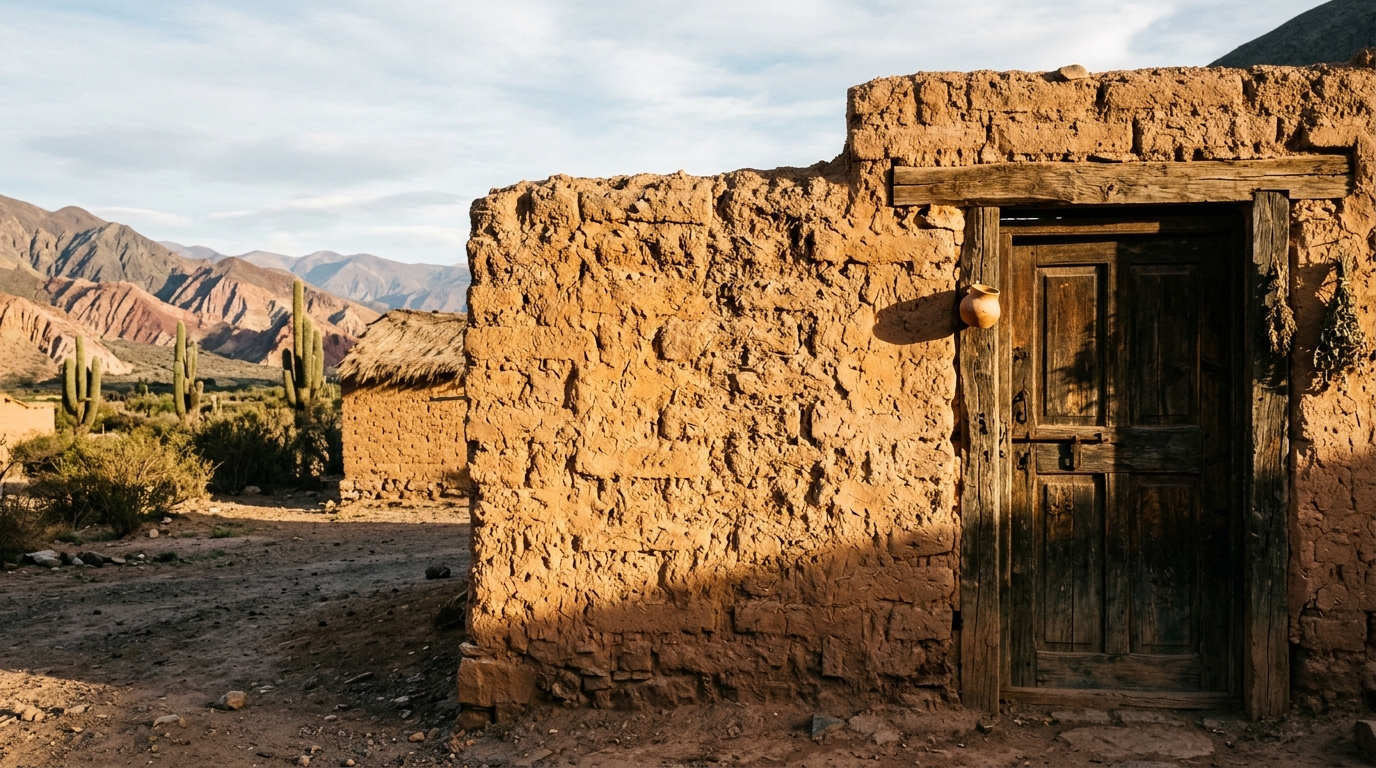
Quebrada de Humahuaca, a high-altitude valley in northern Argentina, has been defined for more than a century by dense earthen building cultures that persist in present-day construction. An article published in Built Heritage on 20 August 2026 argues that the label “vernacular” attached to those architectures is not a neutral description but an invention produced by disciplinary classification, and proposes “vernacularities” in the plural as a better way to understand how local and external actors build, contest and reinterpret the region’s earthen architecture.
The author, Jorge Tomasi, grounds the argument in twenty years of work at the Laboratorio de Arquitecturas Andinas y Construcción con Tierra in the region, combining ethnographic research on construction practices, systematic recording of historical and contemporary architectures, and laboratory and field characterisation of materials. The article traces how earthen building cultures, predominant in the region, were named, described, classified and judged within politically situated narratives that appealed to senses of the vernacular, beginning in the early twentieth century and intensifying after the region’s inscription on the World Heritage List in 2003 as a cultural landscape.
The conceptual core is a distinction between vernacular as a classificatory category and vernacularities as plural political processes. The vernacular, in this account, is a label associated with stereotyped and static reductions, a decoding and fixing of otherness that emerged within colonial structures of understanding the world. Vernacularities, by contrast, refer to the diversity of existences of these architectures within processes of delimitation, appropriation, stigmatisation, resistance and reivindication by diverse actors, involving active positionings within relations of power.
The article situates this classification within the history of European imperial expansion from the nineteenth century onwards, when architectures from distant places attracted researchers, travellers and officials, and their accounts fuelled imaginaries at home. Drawing on Edward Said’s Orientalism, the author argues that narratives of otherness functioned in the interests of the centres of power from which they emanated, favouring exploitation and self-legitimation. Evolutionist theory, especially as embodied by Lewis Morgan in 1877, made material culture an indicator of progress, and architecture was used for social classification through a comparative method that ran from savagery to barbarism to civilisation, such that the use of adobe or stone corresponded literally to a status of barbarism.
A double movement of romantic valorisation and civilisational critique underpinned architectural vernacularisation. The figure of the primitive hut, in Laugier and Viollet-Le-Duc, synthesised essential and harmonious values of architecture alongside the backwardness of societies alien to Western progress. These architectures were objects of desire while simultaneously requiring disciplinary intervention. Later, so-called vernacular architectures served as a source of inspiration for architectural modernity in the first half of the twentieth century, and decades later were taken up again in critiques of modernity’s universalism, including Kenneth Frampton’s critical regionalism and the Latin American idea of modernidad apropiada, or appropriate modernity, coined by Fernández Cox.
To analyse appropriation, the article uses the Brazilian anthropologist Eduardo Menezes’s 1989 framework of three operations: an ideological-repressive operation of open rejection, which in architecture can involve the eradication or forced replacement of constructions and the prohibition of techniques such as earthen building; an ideological-scientific operation of domestication through interpretation and classification by the scientific apparatus; and an ideological-economic operation of recovery, in which rejected and studied productions are assimilated by hegemonic devices and incorporated into consumption through heritagisation and tourist commodification. These operations are treated not as successive stages but as simultaneous processes, and the social groups subjected to them are not passive actors but deploy their own tactics, in De Certeau’s sense.
Quebrada de Humahuaca itself is a gorge forming a high-altitude valley organised by the Río Grande, roughly 120 kilometres long, with altitudes between 3,400 and 1,600 metres above sea level. It became singularised as a region through the descriptions of travellers and scholars across the nineteenth and twentieth centuries, and although it is not an administrative area, it forms part of the institutional regionalisation of Jujuy into Valles, Quebrada and Puna. The World Heritage inscription in 2003 established a rigid delimitation of around 170,000 hectares and reinforced the emphasis on the north-south corridor over transversal relations.
The region’s transformation accelerated with tourism. Visitor numbers rose from around 7,000 in 1994 to 109,000 in 2006, three years after the inscription, according to information gathered by Bergesio and colleagues. At the provincial scale, lodging establishments doubled between 2001 and 2011, and in 2012 the town of Purmamarca had twenty-four hotel buildings compared with only one in 2001. The total population rose from 31,700 to 41,000 inhabitants between 2001 and 2022, while rurality fell from 27.8 per cent to 16.4 per cent, with rapid growth in the main towns including 134 per cent in Maimará and 86 per cent in Humahuaca. Between 2001 and 2022, the Tilcara-Maimará conurbation recorded a 212 per cent increase in dwellings, rising from 1,407 to 4,398, the same percentage as in Humahuaca, where dwellings rose from 1,728 to 5,402, while Huacalera grew 219 per cent and Purmamarca 88 per cent, amounting to more than 7,000 new dwellings across the five towns in just over twenty years.
Against this backdrop, the article identifies three intertwined trajectories of vernacularisation. The first is invention: early twentieth-century heritage studies and anthropogeography established a field of meaning about the local, with heritage designation of colonial churches valued in historical and aesthetic terms while their adobe masonry and earthen roofs were rendered invisible or framed negatively, and with surveys of rural housing resting on strong environmental determinism that predicted these architectures were destined to disappear. The second is disciplinary appropriation: new architectures for tourism adopt material expressions that appeal to the vernacular through volumetric operations, textures that evoke the rustic, and earth-toned colours regardless of the materials used, corresponding to Menezes’s operation of recovery through disciplinary purification and commodification. The third is recreation: new architectures produced largely without disciplinary intervention, conceived within an incremental logic of continuous construction, often as large-scale multi-storey buildings that maximise space under urban densification and rising land values, and that openly challenge heritage-derived regulations through contrasting colours, reinterpreted cornices and an accentuated expression of adobe masonry bonding.
The persistence of earthen building is itself striking. According to 2001 census data, adobe masonry was the predominant solution in almost 90 per cent of dwellings in Tilcara, with even higher percentages elsewhere, and more recent research shows a decline in incidence although it remains above 80 per cent, increasingly associated with reinforced concrete. The article concludes that vernacular architecture does not exist as such outside the intellectual processes that classify it, and that the architectures of Quebrada de Humahuaca are not vernacular architectures per se but vernacularities constructed as such. This plural conception, the author argues, offers a field for rethinking management policies for World Heritage sites, replacing the statism of external classification with recognition of the dynamism of making, through collaborative practices that expose power asymmetries and rupture the marginalisation emerging from a persistent coloniality.
Subject of Research: Vernacularisation and the multiple vernacularities of earthen architecture in Quebrada de Humahuaca, Argentina
Article Title: Looking with (not so) foreign eyes: the multiple existences of vernacular in earthen architectures of Quebrada de Humahuaca (province of Jujuy, Argentina)
Article References: Tomasi, J. (2026). Looking with (not so) foreign eyes: the multiple existences of vernacular in earthen architectures of Quebrada de Humahuaca (province of Jujuy, Argentina). Built Heritage, 10(1), Article 52. https://doi.org/10.1186/s43238-026-00295-3
Image Credits: AI Generated
DOI: 10.1186/s43238-026-00295-3
Keywords: vernacular architecture, earthen construction, adobe, Quebrada de Humahuaca, World Heritage, heritagisation, touristification, Argentina, critical regionalism, building cultures, patrimonialisation, coloniality
News Source: Denise Maddox. (November 5, 2026). Vernacular architecture is an invention, argues 20-year study of earthen building in Argentina. Scienmag.