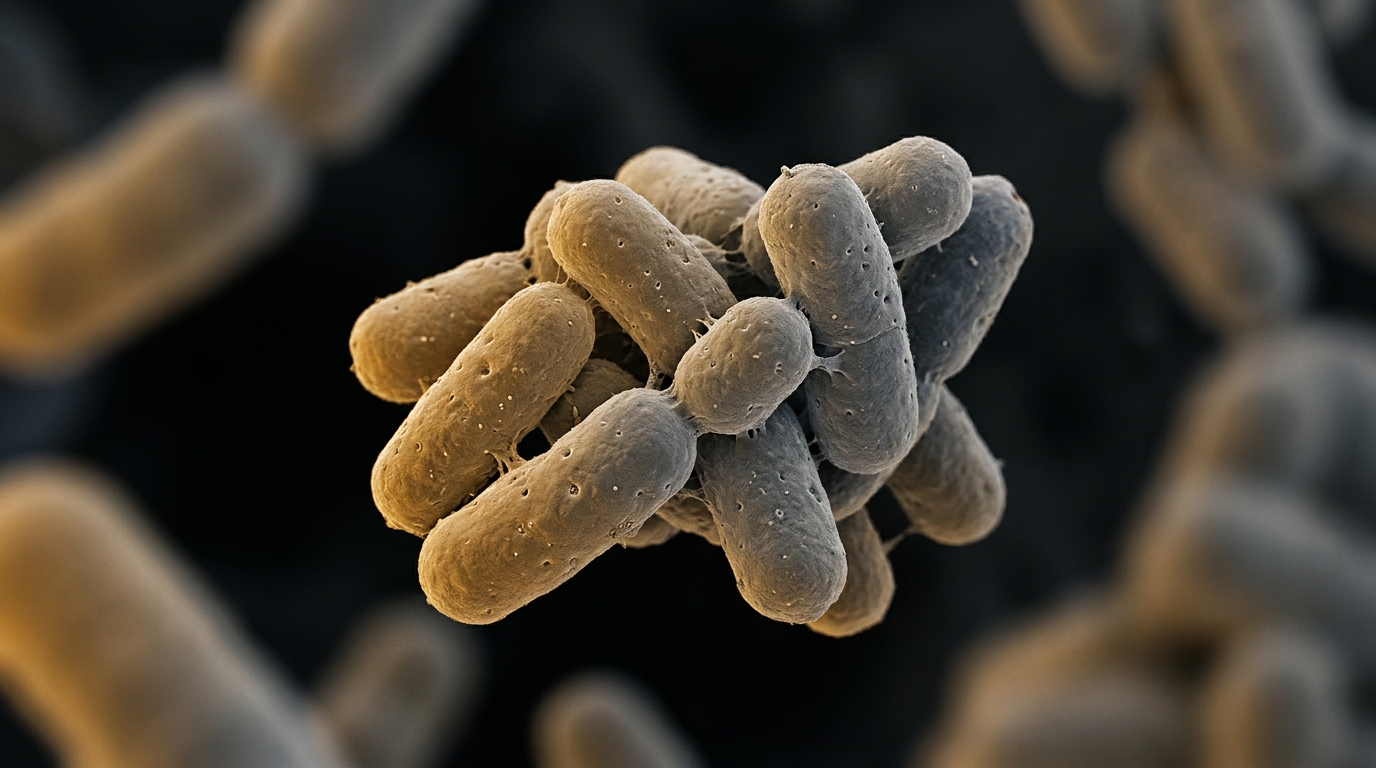
Non-ribosomal peptide synthetases, the giant assembly-line enzymes that bacteria use to build peptide natural products without the help of the ribosome, have turned up in an unexpected corner of the microbial world. A new computational study reports that these enzymes, long studied in antibiotic-producing Actinobacteria and Pseudomonas, are widespread across the Lactobacillaceae family, the group that includes the lactic acid bacteria familiar from fermented foods and probiotics. By mining genomes across the family’s newly expanded taxonomy, the researchers identified NRPS sequences in 26 of 31 genera and catalogued their domain architecture, conserved motifs and predicted substrate preferences in unprecedented detail.
The work, published in Discover Bacteria, arrives at a moment when the taxonomy of this family has been thoroughly reshuffled. The traditional Lactobacillus genus was split into multiple new genera, and the merger of the Lactobacillaceae and Leuconostocaceae families produced a classification of 31 genera and 336 species. The authors note that the family has also diversified ecologically, with species adapted to vertebrate and insect hosts, nomadic lifestyles, environmental niches, or hosts that remain unassigned. Against this backdrop, the presence, diversity and structural organization of NRPS enzymes in the family had remained poorly characterized, leaving a gap in understanding of the secondary metabolic potential of this phylogenetically varied group.
To close that gap, the team turned to in silico tools rather than laboratory experiments. NRPS sequences were retrieved from the JGI Secondary Metabolism Collaboratory and analyzed with SeMPI 2.0, which detects biosynthetic gene clusters responsible for producing non-ribosomal peptides and type I polyketides. Genomes were selected according to their NCBI GenBank assembly accessions, and each strain was downloaded into the corresponding GCF files. From 118 species, the researchers retrieved 159 NRPS sequences, with 41 species carrying multiple NRPS sequences and 31 species showing variations among their NRPS sequences, a phenomenon the authors attribute to genetic diversity within bacterial populations.
Phylogenetic analysis placed these sequences in an evolutionary framework. Using Clustal Omega alignments and a bootstrap analysis with 1,000 repetitions, the researchers built trees that separated the lactic acid bacterial sequences from outgroup taxa such as Corynebacterium diphtheriae, while Bacillus subtilis, Flavobacterium johnsoniae, Agrobacterium vitis and Anabaena sp. 90 formed a closely related cluster. Within Lactobacillaceae, the team classified genera by fermentation mode, finding at least 17 genera with homofermentative metabolism and 14 with heterofermentative metabolism. From species of different origins, 114 homofermentative and 45 heterofermentative NRPS sequences were retrieved, and separate trees were constructed for each metabolic group.
The homofermentative tree revealed three clades with distinct ecological signatures. Clade 1 held 10 sequences from nomadic, environmental and unassigned hosts; clade 2 contained 26 sequences from nine genera, dominated by 21 unassigned-host sequences; and clade 3 included 78 sequences, with 21 from vertebrate hosts and 54 from unassigned hosts. Vertebrate and unassigned hosts showed a co-evolutionary relationship in clade 3, and species such as L. intestinalis, L. acidophilus, L. crispatus, L. ultunensis and L. amylovorus formed a well-supported clade suggesting shared ancestry within vertebrate hosts. In the heterofermentative group, 12 of 14 genera possessed NRPS sequences, with Acetilactobacillus and Convivina as the exceptions, and clade 3 again held the greatest diversity, mixing sequences from unassigned, vertebrate, environmental and insect origins.
Sequence conservation analysis added a layer of functional detail. Across all 159 sequences, glycine emerged as the most conserved amino acid at 54 percent, followed by threonine at 46 percent, a notable contrast with earlier literature reporting aspartic acid and glycine as the most conserved residues in bacterial NRPSs. Isoleucine showed the highest conservation in insect hosts at 67 percent, while in nomadic hosts eight amino acids, including lysine, glutamic acid, proline and alanine, reached 100 percent conservation. Negatively charged residues such as aspartate and glutamate aligned consistently with positively charged arginine and lysine, a pattern the authors link to electrostatic interactions that stabilize protein folding and function across different host adaptations.
Motif mining with the MEME suite identified thirteen unique conserved motifs ranging from three to thirteen amino acids. Most striking were three motifs, TSGTTG, FCGEEL and RLPIG, that appeared in every genus and every host group, marking them as evolutionarily conserved across the bacterial domain. Other motifs showed narrower distributions: DFQ and ELE were exclusive to insect, nomadic and environmental hosts, while NGK and GPTE spanned insects, nomads, vertebrates and environmental sources. The researchers suggest that the transition from a free-living style to a symbiotic lifestyle drives significant motif variation, even as the universal motifs persist.
Domain architecture analysis confirmed that Lactobacillaceae NRPSs follow the conventional NRPS framework seen in other bacteria. The amino acid adenylation domain, the AMP-dependent synthetase/ligase domain, the AMP-binding C-terminal domain and the phosphopantetheine binding domain were prevalent across the 26 NRPS-positive genera, with only Weissella and Leuconostoc lacking identifiable domains. The adenylation domain, which activates amino acids and acts as the gatekeeper of substrate selection, was particularly widespread in Lacticaseibacillus and Bombilactobacillus. The PCP domain, which shuttles growing peptide chains between catalytic centers, appeared broadly in vertebrate-associated organisms.
The study also tackled the substrate specificity code of the adenylation domains, sometimes called NRPS codons. Three-dimensional models of 159 adenylation domains were built with SWISS-MODEL and validated with Ramachandran plots, with selected structures showing over 96 percent of residues in allowed and favored regions. Thirty-six structures were chosen for deeper analysis, revealing eight distinct amino acids, Asp, Leu, Cys, Gly, Gly, Pro, Thr and Val, conserved across all host-adapted groups at the binding pocket site, located between residues 180 and 286. The first four residues sit within the binding pocket flanked by core motifs A3 to A5, while the remaining four lie outside it, and the pocket’s position shifts between host groups, sitting between A4 and A5 in environmental and vertebrate hosts but between A3 and A5 in nomadic and insect hosts.
Substrate prediction with the NRPS predictor showed that alanine and phenylalanine are the most widely recognized substrates across the family, though preferences vary sharply by ecology. In vertebrate-associated species, alanine dominates at 90.47 percent, while phenylalanine and 2-aminoadipic acid each appear in only 4.71 percent. Nomadic hosts favor alanine at 62.5 percent with dihydroxybenzoic acid at 25 percent, insect hosts split between phenylalanine at 50 percent and alanine at 37.5 percent, and environmental species recognize alanine at 53.84 percent alongside glutamic acid at 23.08 percent. Secondary structure predictions indicated that random coils dominate all host groups, at roughly 44.5 to 46.5 percent, with alpha helices and extended strands making up the remainder. The authors emphasize that these computational predictions now require functional validation through mass spectrometry and bioassays, and that understanding the regulatory networks controlling NRPS expression remains a key next step before the biosynthetic potential of Lactobacillaceae can be harnessed for metabolic engineering, probiotic innovation or industrial biotechnology.
Subject of Research: In silico analysis of non-ribosomal peptide synthetase diversity and substrate specificity across the Lactobacillaceae family
Article Title: Unveiling the structural diversity of non-ribosomal peptide synthetases in the Lactobacillaceae family through in silico approaches
Article References: Kumari, M., Pandey, K., Khuman, A., Chaudhary, B., & Singhal, B. (2026). Unveiling the structural diversity of non-ribosomal peptide synthetases in the Lactobacillaceae family through in silico approaches. Discover Bacteria, 3(1), Article 3. https://doi.org/10.1007/s44351-025-00039-1
Image Credits: AI Generated
DOI: 10.1007/s44351-025-00039-1
Keywords: non-ribosomal peptide synthetases, Lactobacillaceae, lactic acid bacteria, genome mining, biosynthetic gene clusters, secondary metabolites, substrate specificity, phylogenetics, conserved motifs, adenylation domains, probiotics, biotechnology
News Source: Juliet Wilcox. (November 5, 2026). Computational survey maps hidden peptide-making machinery across Lactobacillaceae. Scienmag.