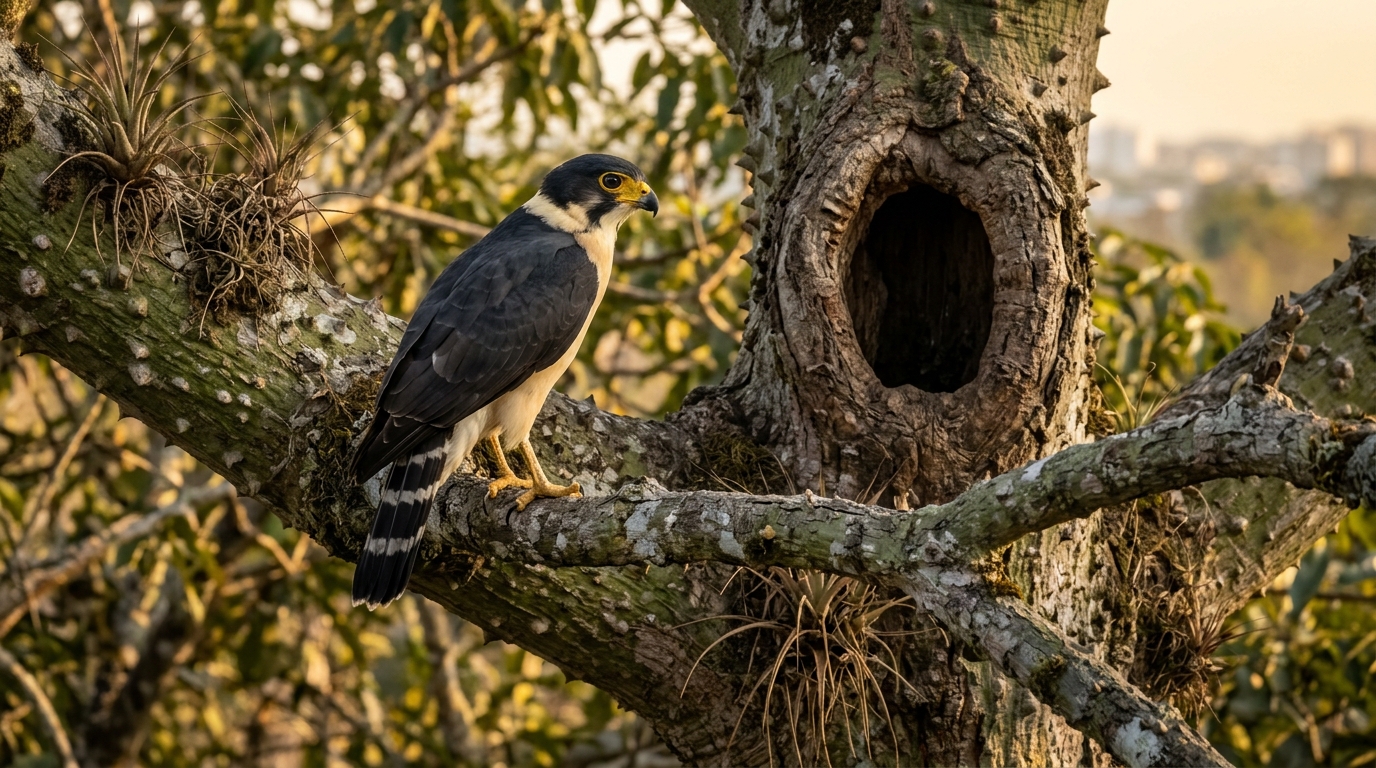
A Collared Forest Falcon (Micrastur semitorquatus), the largest of the six neotropical falcons in its genus, has been documented using a deep cavity in a mature Ceiba trichistandra tree as a nest site within an urban remnant of dry deciduous forest in Guayaquil, southwestern Ecuador. The observations, carried out at the Bosque y Vegetación Protector La Prosperina between January and February 2020 and revisited incidentally in 2023, 2024 and 2025, add a new nest tree species to the known repertoire of this wide-ranging raptor and underline the ecological value of large cavity-bearing trees in one of the Neotropics’ most threatened ecosystems.
The discovery was incidental. While unrelated research activities were underway, an individual falcon was seen perched on a C. trichistandra beside a trail used for recreation and research, at coordinates 2°9.164’S, 79°57.821’W and 155 meters above sea level. Over the following weeks the team returned five times. On 13 January 2020 the bird was inside the cavity; on 17 January it remained inside while two Red-masked Parakeets (Psittacara erythrogenys) perched at the entrance with no interaction between the species; on 24 January it left the cavity and perched 15 meters away; on 30 January it sat on the tree 30 meters from the nest; and on 4 February it was again inside before exiting to a nearby tree. A bird was heard flying roughly 40 meters from the cavity tree during a December 2023 visit, and an individual was seen about 60 meters away in June 2024.
The tree itself is a giant of the dry forest. It stands 16.45 meters tall with a diameter at breast height of 226 centimeters. Its cavity entrance sits 3.98 meters above the ground and has an estimated perimeter of 319 centimeters, with an entrance width that varied between 90 and 45 centimeters. Most striking is the cavity depth: 3.22 meters, deeper than any cavity previously reported for nesting M. semitorquatus. Measurements and cavity inspections were conducted after the breeding period to minimize disturbance, without handling birds or modifying the nest structure, and a Dewalt DCT410S1 inspection camera was used to photograph and video the cavity interior.
During the initial visits the occupant was an adult of the pale morph, repeatedly recorded inside the cavity, leaving the entrance and perching in nearby trees between 15 and 60 meters from the nest tree. Based on consistent plumage coloration and apparent body size, the researchers considered it the same individual throughout. The cavity tree was identified as C. trichistandra (Malvaceae) from its morphology, trunk and leaves. Surrounding vegetation included shrubs, vines and trees of Sorocea sprucei, Simira ecuadoriensis and Diospyros inconstans, within a habitat where C. trichistandra is structurally prominent alongside species such as Machaerium millei, Centrolobium ochroxylum, Cochlospermum vitifolium, Gustavia angustifolia, Chloroleucon mangense and Morisonia heterophylla.
Direct evidence of nesting came only later. During the last inspection in February 2025, observers found feathers and eggshell fragments at the bottom of the cavity, which the authors interpret as supporting evidence of nesting activity and possible recurrent use of the cavity through time. The 2020 observations alone are consistent with nesting but do not encompass the complete breeding cycle, a limitation the researchers state explicitly. Camera inspection of the interior nonetheless suggested repeated use of the cavity by the species.
Micrastur falcons are small to medium-sized neotropical falconids with short wings, long tails and crepuscular hunting habits. The Collared Forest Falcon spans 72 to 86 centimeters in wingspan, measures 46 to 58 centimeters in body length and weighs 560 to 940 grams, and its distribution runs from Mexico through South America, excluding Chile and Uruguay. Prior nesting records span trees, caves and human-built structures. In Ecuador, a pair was previously documented usurping a cavity used by a Great Green Macaw, and in Mexico the species has been reported taking over a Military Macaw nest. Tree species recorded for nests include Cedrela odorata, Swietenia macrophylla, Spondias mombin and Sterculia apetala, with cavity depths in earlier studies far shallower than the 3.22 meters measured here; comparable figures include a 50-centimeter nest depth in Venezuela, mean cavity depth of 37.4 centimeters in Guatemala and a 20-centimeter depth in Mexico.
Why would a falcon favor such a deep cavity? The authors suggest the greater depth may offer increased protection from predators and environmental fluctuations. In Guayaquil, where temperatures can exceed 30 °C, tree cavities may provide a more stable microclimate, helping birds regulate body temperature and reduce the risk of hyperthermia. The irregular trunk structure and large diameter of the ceiba may also favor the long-term persistence of cavity systems suitable for nesting birds. These are mechanistic interpretations grounded in prior literature rather than direct measurements from this study, and the observations did not test them experimentally.
The setting matters as much as the bird. Dry deciduous forests are among the most threatened ecosystems in the Neotropics, squeezed by deforestation, agricultural expansion, urbanization and habitat fragmentation. In Ecuador, the Tumbes-Guayaquil Seasonal Dry Forest is classified as Critically Endangered, with fragmentation rates exceeding 70 percent. Bosque y Vegetación Protector La Prosperina, owned and managed by Escuela Superior Politécnica del Litoral, is one of the remaining patches of this forest embedded in Guayaquil’s urban matrix, lying above 100 meters elevation with mean annual temperatures of 21 to 26 °C, maxima reaching 33.2 °C and rainfall concentrated between January and May. C. trichistandra, characteristic of dry forests in Ecuador and Peru, faces pressures from deforestation and climate change, and mature individuals frequently develop natural cavities through fungal decay and the activity of insects and cavity-excavating birds.
Because raptors occupy upper trophic levels and depend on prey availability and suitable habitat structure, they are considered indicators of ecosystem integrity. The presence and apparent nesting activity of M. semitorquatus in such an urbanized and fragmented setting may therefore suggest that urban remnants of dry deciduous forest can still retain ecological conditions capable of supporting specialized forest predators, and may play a role in maintaining ecological functionality and biodiversity within highly modified landscapes. In fragmented forests, the loss of mature trees reduces the availability of natural cavities used by cavity-dependent birds, so retaining large, cavity-bearing trees within dry forest remnants may be particularly important for maintaining breeding habitat. C. trichistandra has also been reported hosting other raptors, such as a Laughing Falcon that used a depression on the side of the trunk.
The researchers caution that their observations do not cover the full breeding cycle, and that direct evidence of nesting rests on the 2025 discovery of eggshell fragments and feathers. Even so, the record expands the known nest-site choices of a poorly studied raptor in a dry deciduous forest ecosystem where reproductive data remain scarce, and reinforces the case for conserving mature cavity-bearing ceibas. The authors call for additional studies on nesting ecology and cavity use by raptors in fragmented Neotropical ecosystems, noting that urban dry forest remnants like La Prosperina may hold more ecological value than their size suggests.
Subject of Research: Nesting site use of the Collared Forest Falcon in a Ceiba trichistandra cavity within an urban dry deciduous forest remnant in Ecuador
Article Title: Notes on the nesting behavior of the Collared Forest Falcon ( Micrastur semitorquatus ) in Ceiba trichistandra within a dry deciduous forest of Guayaquil, Ecuador
Article References: Ramón Salcedo, A., Castillo-Orellana, K., Pibaque, P., & Piedrahita, P. (2026). Notes on the nesting behavior of the Collared Forest Falcon (Micrastur semitorquatus) in Ceiba trichistandra within a dry deciduous forest of Guayaquil, Ecuador. Neotropical Biology and Conservation, 21(4), 355-363. https://doi.org/10.3897/neotropical.21.e205501
Image Credits: AI Generated
DOI: 10.3897/neotropical.21.e205501
Keywords: Collared Forest Falcon, Micrastur semitorquatus, Ceiba trichistandra, dry deciduous forest, nest cavity, Ecuador, Guayaquil, urban forest remnant, raptor ecology, cavity-nesting birds, habitat fragmentation, Tumbes-Guayaquil dry forest
News Source: Drew Townsend. (November 5, 2026). Collared Forest Falcon Found Nesting in Giant Ceiba Tree in Ecuador’s Urban Dry Forest. Scienmag.