Adults having elective surgery under general anesthesia developed perioperative hypothermia far less often when operating room nurses applied a combined warming protocol instead of routine passive insulation, according to a retrospective study published in BMC Anesthesiology. Among 142 patients treated between July 2024 and February 2026, 13.24% of those who received the multimodal strategy became hypothermic, compared with 32.43% of those given conventional care, a difference the authors report as statistically significant at P = 0.007.
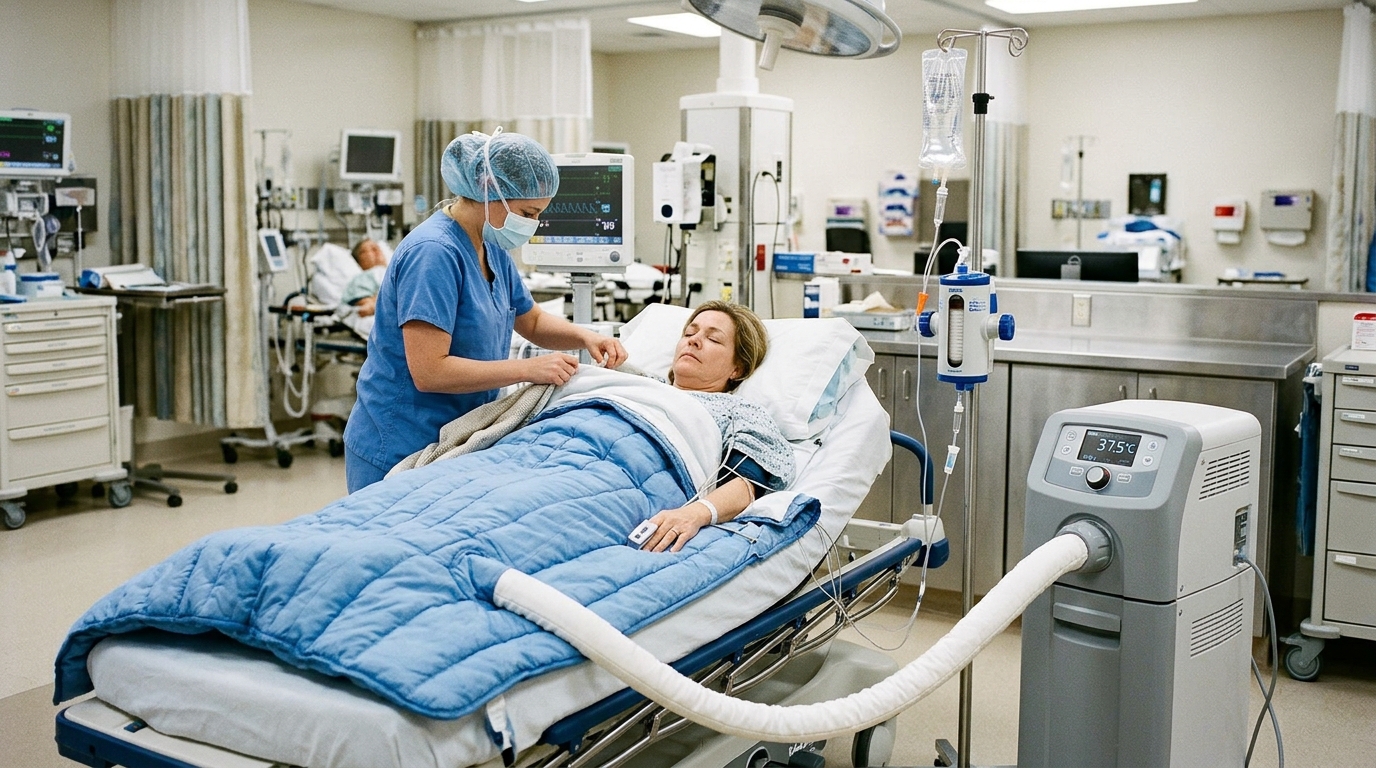
The multimodal approach layered several warming measures across the surgical timeline. Patients were prewarmed before anesthesia, kept warm with forced-air devices during surgery, received warmed intravenous fluids, and the operating room’s ambient temperature was actively controlled. The conventional group received passive insulation alone, such as blankets, without active warming. The study compared these two real-world care patterns by reviewing records of patients who had already been treated, rather than randomly assigning them to a protocol.
Body temperature measurements told a consistent story. The multimodal group recorded higher lowest intraoperative temperatures, higher temperatures at the end of surgery, and higher temperatures on admission to the post-anesthesia care unit, with all three comparisons reaching P < 0.05. Patients in this group also left the PACU at a higher temperature (P = 0.005). Perioperative hypothermia matters because even mild drops in core temperature can affect how patients wake from anesthesia and how quickly they recover.
Recovery markers favored the multimodal group as well. Emergence time, the interval from the end of anesthesia until the patient wakes, was shorter, and so was the length of stay in the post-anesthesia care unit, with both differences reported at P < 0.001. Patients rated their recovery higher on the Quality of Recovery-15 scale, a validated questionnaire covering physical and psychological recovery after surgery, also with P < 0.001 for the total score.
Surgical and hospital outcomes tracked the same direction. Intraoperative blood loss was lower in the multimodal group (P = 0.003), and total hospital stay was shorter (P < 0.001). The study also tracked complications as a secondary outcome, alongside these recovery measures, though the abstract reports the significant differences primarily in temperature, recovery speed, blood loss, and stay length.
To account for other factors that could influence hypothermia risk, the researchers used multivariate logistic regression. In that analysis, multimodal warming remained independently associated with lower odds of perioperative hypothermia, with an odds ratio of 0.308 and a 95% confidence interval of 0.124 to 0.766 (P = 0.011). In practical terms, patients who received the combined warming strategy had roughly a third of the odds of becoming hypothermic compared with similar patients who received passive insulation, after adjusting for the variables included in the model.
The authors frame these results as associations rather than proof of cause. Because the study was retrospective, patients were not randomly assigned to the two warming approaches, and unmeasured differences between the groups could have influenced the outcomes. The types of surgery, patient characteristics, and anesthetic techniques may have differed between the periods or groups in ways the analysis could not fully capture. The conclusion states that the findings suggest potential clinical value but that prospective studies are needed to confirm the observed associations.
Still, the pattern across multiple independent outcomes strengthens the signal. Temperature trajectories, emergence time, PACU stay, recovery scores, blood loss, and hospital stay all moved in the same direction, and the adjusted analysis preserved the hypothermia benefit. If prospective trials confirm these results, the multimodal strategy, which relies on standard operating room equipment such as forced-air warmers and fluid warmers, could offer a practical template for perioperative warming protocols.
The study appears in BMC Anesthesiology as an open-access article published on 4 November 2026, authored by Lin Ji, Tuan Li, Chao Liang, Yuhao Chen, and Wei Liu, and shared early as a peer-reviewed, accepted version of record pending final edits. For surgical teams weighing warming protocols, the work adds retrospective evidence that layering prewarming, active intraoperative warming, warmed fluids, and room temperature control is associated with fewer hypothermia events and a smoother path through anesthesia recovery.
Subject of Research: The effect of a multimodal hypothermia prevention strategy in operating room nursing on perioperative patient recovery after elective surgery under general anesthesia
Article Title: Effect of operating room nursing based on a multimodal hypothermia prevention strategy on perioperative patient recovery: a retrospective study
Article References: Ji, L., Li, T., Liang, C., Chen, Y., & Liu, W. (2026). Effect of operating room nursing based on a multimodal hypothermia prevention strategy on perioperative patient recovery: a retrospective study. BMC Anesthesiology. https://doi.org/10.1186/s12871-026-04397-4
Image Credits: AI Generated
DOI: 10.1186/s12871-026-04397-4
Keywords: perioperative hypothermia, multimodal warming, operating room nursing, forced-air warming, prewarming, general anesthesia, emergence time, post-anesthesia care unit, Quality of Recovery-15, retrospective study, logistic regression, elective surgery
News Source: Ophelia Keating. (November 5, 2026). Multimodal operating room warming linked to fewer hypothermia cases and smoother anesthesia recovery in retrospective analysis. Scienmag.