Schistosomiasis, a parasitic disease transmitted in 79 countries, still has only one widely deployed drug: praziquantel, developed in the 1970s. A review published in Frontiers in Drug Discovery argues that artificial intelligence and laboratory automation could help break this decades-long therapeutic stalemate, but only if the field invests as heavily in standardized parasite assays as it does in algorithms. The authors, led by Samir Irshaid of the Technical University of Munich, synthesize evidence on how machine learning can accelerate the search for new anti-schistosomal compounds, from target identification through compound screening to regulatory submission.
The scale of the problem is considerable. According to the World Health Organization, at least 253.7 million people required preventive chemotherapy for schistosomiasis in 2024, and roughly 93.9 percent of them lived in Africa. The Global Burden of Disease 2021 study estimated that the disease caused about 1.75 million disability-adjusted life years and 12,858 deaths worldwide that year, with Africa accounting for 87.92 percent of the DALYs and 87.28 percent of the deaths. People aged 15 to 24 years bear the greatest burden, the review notes.
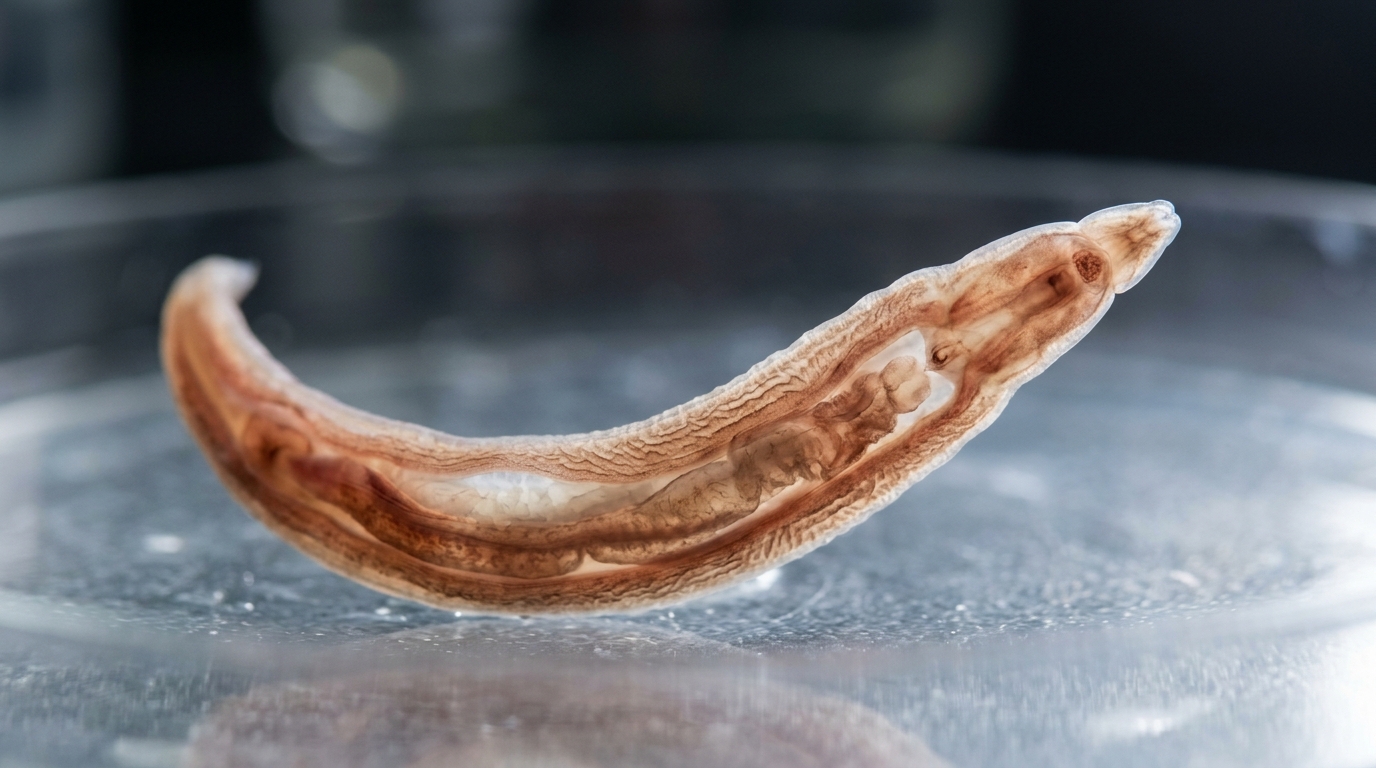
Praziquantel’s limitations drive the urgency. The drug works primarily against adult worms but has limited effectiveness against earlier parasite stages and does not prevent reinfection. Continuous use at the population level could also select for parasites with reduced susceptibility. Because the parasite Schistosoma passes through distinct developmental stages, from skin-penetrating cercariae that transform into schistosomula to sexually mature adults living in the vasculature, a compound active against one stage may show weaker or no activity against another. Stage-specific validation is therefore essential, yet many screening workflows still depend on microscopy-based readouts that limit throughput, reproducibility, and comparability across laboratories.
Current screening relies predominantly on phenotypic assays, in which compound effects are measured directly on parasites. Motility scoring under light microscopy is a common reference method, but it is subjective and labor-intensive, introducing inter-operator variability. Structured scoring systems grade motility, morphology, and granularity on a scale from 0 for dead parasites to 3 for highly viable ones. Alternative readouts exist: dual-fluorescence staining with fluorescein diacetate and propidium iodide distinguishes viable parasites from those with compromised membranes, metabolic assays using resazurin, ATP, or XTT offer quantitative signals compatible with higher-throughput screening, and high-content imaging or impedance platforms provide scalable, objective metrics. Each carries trade-offs, and most cited assay-validation studies used Schistosoma mansoni, so applicability to other species requires independent validation.
The review identifies two machine-learning applications most clearly demonstrated in schistosomiasis. The first is predictive modeling to prioritize compounds before wet-lab testing. Zorn and colleagues trained eight Bayesian models on 3,898 historical phenotypic data points from prior Schistosoma screening experiments, then applied them to 56 commercial compounds evaluated experimentally against S. mansoni. The reported hit rates were 48 percent against schistosomula and 34 percent against adult worms, indicating substantial enrichment for active compounds, though the authors caution that direct comparison with generic high-throughput screening baselines is inappropriate because library composition and confirmation criteria differ between studies.
Later work extended this strategy. Moreira-Filho and colleagues built classification and regression models to predict schistosomicidal activity and experimentally confirmed four compounds active against schistosomula, with half-maximal effective concentration values between 9.8 and 32.5 micromolar and no toxicity in the mammalian cell lines evaluated. Deep learning has entered the field as well: Zeng and colleagues developed GNN-DDAS, a graph neural network integrating molecular sequence and structural features, which outperformed benchmark methods in the authors’ evaluations and used GNNExplainer to identify predictive molecular substructures. However, that validation was purely computational, with no prospective parasite-based confirmation. Similarly, de Angelo and colleagues achieved random-forest R-squared values of 0.93 internally and 0.89 on a held-out set for predicting natural-product activity, but the held-out data came from the same curated ChEMBL-derived dataset rather than independently generated experiments.
The second demonstrated application is automated image analysis. Paveley and colleagues introduced a label-free high-content screening platform using brightfield imaging and Bayesian classification on 10,041 compounds, correctly detecting 99.8 percent of visually identified hits with a 1.1 percent false-positive rate. More recently, Villamizar-Monsalve and colleagues trained a YOLOv5 object-detection model on 4,390 images of S. mansoni schistosomula, achieving a mean average precision of 0.966 and identifying 28 candidate compounds in a small-scale screen. Liu and colleagues went further, combining automated segmentation and tracking with a VideoMAE model to assess viability from video. On a praziquantel dataset of 325 videos, the model reached a Pearson correlation coefficient of 0.937 for concentration regression and outperformed handcrafted feature methods; on 13 additional compounds it retained a correlation of 0.712, and predicted scores agreed strongly with expert assessments.
Complementary automated technologies broaden the toolkit. Ravaynia and colleagues built an impedance-based platform that continuously monitored schistosomula viability over 72 hours and screened 57 repurposed compounds, five of which reduced viability by more than 70 percent. Girod and colleagues developed a self-purifying microfluidic device in which drug-induced detachment of adult worms served as a rapid readout, validated with praziquantel and artemisinin and detecting active compounds within one hour. Ryan and colleagues combined automated imaging of worm movement with lactate measurements in a multiplexed assay of 21 macrocyclic lactones against adult S. mansoni; several compounds caused contractile paralysis with reduced lactate production, but when prioritized compounds were tested in infected mice, no reduction in worm burden was observed, a stark reminder that strong in vitro activity does not guarantee in vivo efficacy.
The review is candid about the field’s structural constraints. Drug development typically requires more than a decade and cumulative investment exceeding 2 billion dollars, with roughly 90 percent of clinical candidates failing, and commercial incentives for neglected diseases are minimal. AI-discovered molecules still represent only a small share of clinical pipelines, and late-stage outcomes remain limited. Data fragmentation poses a particular problem: compound-activity datasets vary across parasite stages, exposure times, concentrations, assay formats, and endpoints, complicating model training. A 2025 systematic review of 21 East African studies found extreme between-study heterogeneity in praziquantel efficacy estimates, with an I-squared of 94.8 percent, and a 2026 review of AI diagnostic studies reported an I-squared of 100 percent across 15 datasets, underscoring limited generalizability across AI applications in schistosomiasis.
The authors’ central argument is that algorithmic innovation alone will not suffice. They call for harmonized assay protocols, common metadata standards, repositories containing both active and inactive compound results, prospective experimental confirmation of computationally prioritized candidates, and reproducibility testing across laboratories, imaging systems, parasite stages, and compound libraries. They also flag ethical concerns: datasets generated primarily in well-resourced settings may reduce the local relevance of predictive models for endemic regions, requiring equitable partnerships and investment in local data infrastructure. Recent long-read sequencing of five S. mansoni populations has revealed structural variation within loci linked to drug resistance, expanding molecular resources, but integrating these omics data with standardized compound-response phenotypes remains incomplete. The review concludes that meaningful progress demands equal investment in standardized, high-throughput phenotypic platforms capable of generating the data-rich training inputs that machine-learning systems need.
Subject of Research: How automation and machine learning can accelerate drug discovery for schistosomiasis, a neglected tropical disease treated with a single decades-old drug.
Article Title: Automation and machine learning in schistosomiasis drug discovery
Article References: Irshaid, S., Hamway, Y., Geoui, T., Chaltikyan, G., Prazeres da Costa, C., & Hayden, O. (2026). Automation and machine learning in schistosomiasis drug discovery. Frontiers in Drug Discovery, 6, Article 1906539. https://doi.org/10.3389/fddsv.2026.1906539
Image Credits: AI Generated
DOI: 10.3389/fddsv.2026.1906539
Keywords: schistosomiasis, machine learning, drug discovery, neglected tropical diseases, praziquantel, high-content screening, phenotypic screening, artificial intelligence, Schistosoma mansoni, drug repurposing, automated imaging, Automation
News Source: Blake Davidson. (November 5, 2026). Machines Join the Hunt for New Schistosomiasis Drugs. Scienmag.