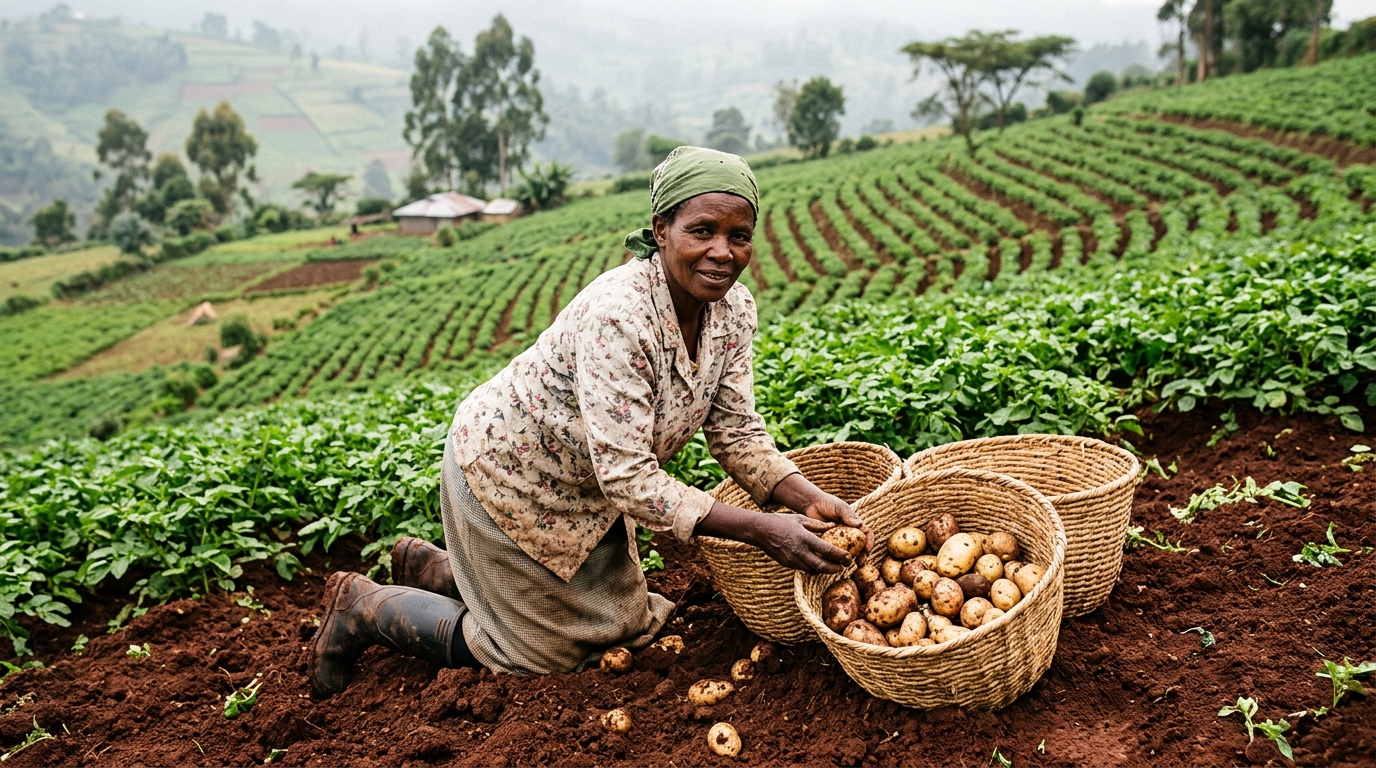
Female potato farmers in central Kenya produce substantially less per plot than their male counterparts, and a new study argues that the gap stems less from capability than from the structure of the seed systems meant to serve them. The research, a secondary gender analysis of survey data from 1,061 plots across 34 villages in six districts, found that women who manage plots independently cultivate smaller, less fertile land, have limited access to certified seed, and face a 71% gender gap in potato productivity after accounting for observable differences between plots.
The study, published in BMC Agriculture, draws on data originally collected from smallholder potato farmers by earlier research at the International Potato Centre. Potatoes are a major crop in Kenya, cultivated by approximately 800,000 smallholder farmers and supporting 2.5 million jobs, yet national yields stagnate at roughly 8 to 10 tonnes per hectare, below the sub-Saharan African average of 13 tonnes. Limited access to certified seeds is a key constraint, and formal seed system interventions have historically lacked gender responsiveness, leaving female farmers reliant on recycling saved seed from season to season.
The researchers, led by Janet Mwende Mutiso with Nozomi Kawarazuka and Julius Juma Okello, applied a multivariate probit model to examine four seed-related behaviours: purchasing, replacing, currently using, and selling certified seed from Kisima Farm, a private seed multiplier in Kenya. They then used an exogenous switching treatment effects regression (ESTER) model to estimate the causal effect of plot manager gender on productivity by constructing a counterfactual: what female-managed plots would produce if they retained their observed characteristics but received the same returns to those characteristics as male-managed plots.
The counterfactual analysis showed that average observed productivity for female plot managers was 7.867, while their predicted productivity under the male return structure would have been 8.581. The difference, an average treatment effect on the treated of -0.714, was statistically significant. Descriptive results reinforced the pattern: female plot managers operated an average of 0.43 acres, significantly smaller than plots managed by men or jointly controlled plots, and only 6.7% of female farmers sourced quality seed from Kisima Farm compared with 8.5% of male farmers. Men sold an average of 201.4 kilograms of potatoes per plot against 67.8 kilograms for women.
Robustness checks tested the finding against alternative methods. A reweighted recentered influence function decomposition indicated that male plot decision-makers were 54% more productive, with a total endowment effect of 0.14 and a structural effect of 0.609, pointing to structural disadvantage rather than pure resource differences. Propensity score matching confirmed a 54.2% gap, while inverse probability weighted regression adjustment estimated a more conservative but statistically significant 36.7%. Mixed-effects models with village-level clustering showed a 34.0% gap with a village variance of 0.192, and ridge regression with village fixed effects produced 30.3%. The authors noted that perfect causal identification remains challenging because plot manager gender is not randomly assigned.
The structural disadvantage, according to the decomposition, is driven by several identifiable factors: the need to replace seeds at least every three seasons, difficulty finding certified seeds, small plot size, late blight disease, price barriers, education, and household food insecurity. Late blight, caused by Phytophthora infestans, is a serious threat to potato farming worldwide, and the study found that male plot managers showed increased productivity when facing the disease because they are mainly in charge of pest and disease control, while female farmers tend to depend on men for these decisions.
Gender divisions of labour shaped every stage of production. Men mostly undertook mechanised, input-intensive tasks such as ploughing and applying fertiliser, pesticides, and fungicides, whereas women were responsible for planting and weeding, with harvesting and bagging carried out jointly. Women were significantly involved in almost all activities related to potato production and postharvest work. In the multivariate probit model, female plot managers were more likely than male counterparts to replace Kisima seeds, continue their use, and sell seed stock, behaviours the authors linked to women’s traditional roles in saving, storing, and managing diverse seed varieties within local networks.
Other factors behaved differently by gender. Older farmers were more likely to purchase and sell seed stock, and education was positively associated with purchase and sale but negatively related to replacement after three seasons. Farmers who demanded credit were more likely to purchase Kisima seeds. Male labour availability positively influenced purchase, replacement, and current use, while female labour availability was positively associated only with current use. Access to public extension services by male household members was negatively associated with seed replacement, a counterintuitive finding the authors suggested may reflect male farmers’ perception that certified seed carries lower risk of degradation. Distance to Kisima Farm reduced productivity only for female farmers, consistent with women’s limited mobility due to domestic responsibilities and cultural norms.
The authors conclude that commercialised potato seed systems are male-oriented, requiring input costs such as fertiliser and certified seed that may not fit female farm managers whose plots tend to be smaller, less fertile, and oriented toward household consumption. They recommend gender-responsive interventions grounded in the targeted needs and capacities of women, including recognising women’s roles in jointly managed farms and supporting agroecological approaches for resource-constrained women who grow potatoes primarily for subsistence. The study is based on cross-sectional secondary data from six districts in Kenya, which limits causal inference and generalisability to other agro-ecological or socioeconomic contexts, and the authors call for future qualitative research to illuminate the cultural, social, and economic contexts shaping farming decisions for male and female farmers alike.
Subject of Research: Gender-based constraints on certified potato seed access and productivity among smallholder farmers in central Kenya
Article Title: Understanding gender-based constraints among potato farmers for benefiting from quality seeds
Article References: Mutiso, J. M., Kawarazuka, N., & Okello, J. J. (2026). Understanding gender-based constraints among potato farmers for benefiting from quality seeds. BMC Agriculture, 2(1), Article 33. https://doi.org/10.1186/s44399-026-00054-w
Image Credits: AI Generated
DOI: 10.1186/s44399-026-00054-w
Keywords: potato farming, Kenya, gender gap, certified seed, smallholder farmers, seed systems, productivity, agricultural extension, ESTER model, food security, sub-Saharan Africa, women farmers
News Source: Alan Morgan. (November 5, 2026). Kenyan potato study finds 71% productivity gap between women and men. Scienmag.