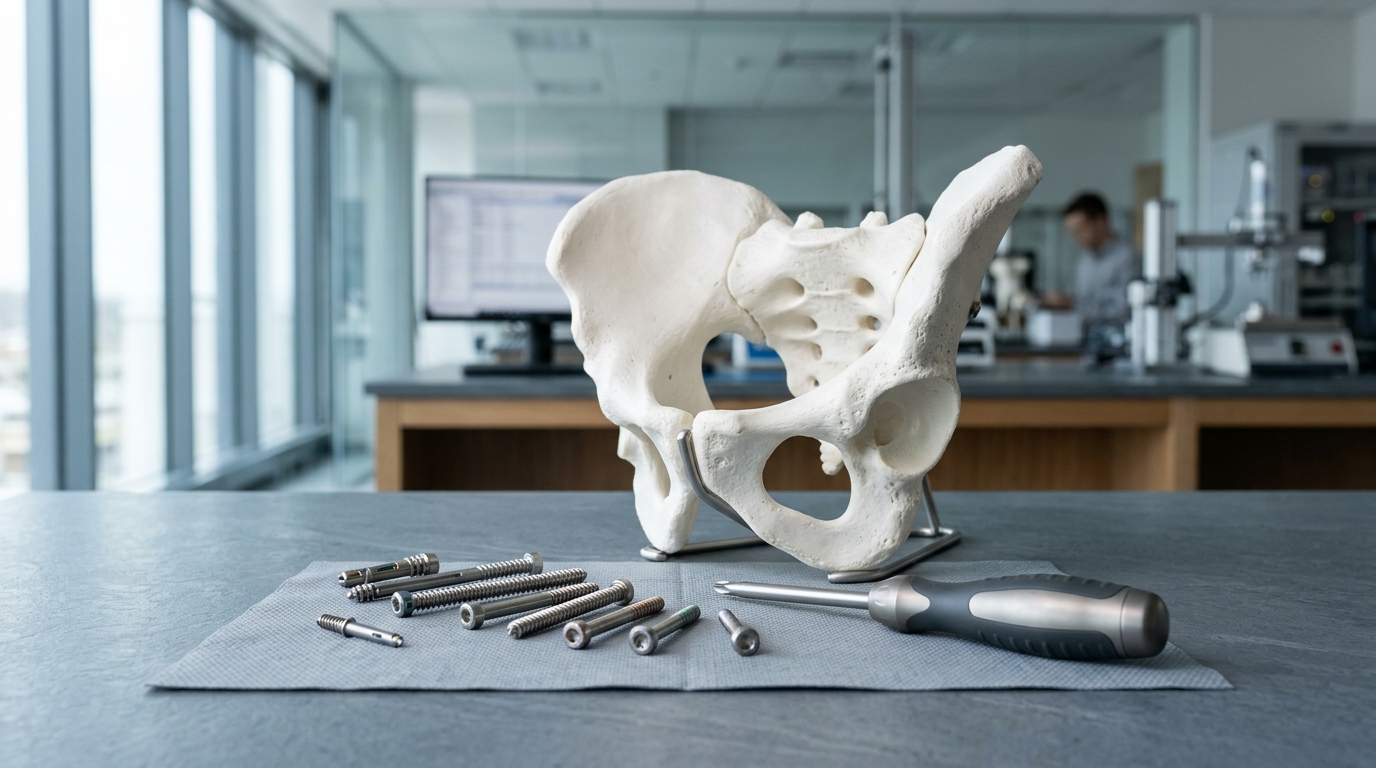
Research on technology-assisted percutaneous pelvic-ring fixation has grown steadily over three decades, but the much-discussed artificial intelligence revolution has barely reached the operating table, according to a bibliometric and science-mapping analysis published in Archives of Orthopaedic and Trauma Surgery. The study, led by Giovanni Vicenti and colleagues, mapped the literature from 1996 to 2026 and found that navigation, fluoroscopy and screw insertion form the conceptual backbone of the field, while explicit AI terminology appeared in only 1 of 271 documents at the author-keyword level.
Percutaneous pelvic-ring fixation demands that implants be placed within narrow, three-dimensionally complex osseous corridors surrounded by neurovascular structures, leaving little margin for error. Conventional fluoroscopy exposes both patient and surgical team to substantial ionising radiation and struggles with the interpretation of two-dimensional projections of a curved corridor. These limitations have driven successive waves of technological assistance, from fluoroscopy-based and computed-tomography-based navigation to intra-operative three-dimensional imaging, robotic guidance, augmented reality and, most recently, artificial intelligence.
The researchers searched the Web of Science Core Collection as the primary dataset and Scopus as a robustness comparison, both interrogated on 8 June 2026 with identical conceptual logic and adapted syntax. The searches combined a pelvic-fixation-technique block covering iliosacral, sacroiliac, trans-sacral, trans-iliac, percutaneous pelvic, pelvic ring fixation or injury, posterior pelvic ring, LC2 corridor, pubic rami and anterior-column screws and sacropelvic fixation with a technology block spanning artificial intelligence, machine or deep learning, neural networks, navigation, computer-assisted surgery, robotics, augmented reality, 3D fluoroscopy and intra-operative imaging. Degenerative-spine, deformity, arthroplasty and isolated acetabular records were excluded. Results were limited to articles, reviews and conference papers.
The primary corpus comprised 271 documents from 97 sources, written by 1311 authors, with a mean of 16.3 citations per document. Of these records, 230 were indexed as articles and 19 as reviews, 12 as proceedings papers or as articles and proceedings papers, and the remaining 10 under adjacent document categories. The Scopus corpus contained 762 documents from 206 sources, and the deduplicated merged corpus 831 documents from 238 sources, differences the authors attribute to broader indexing rather than a different field. Annual output was low and irregular before 2010, typically 1 to 6 documents per year, reached 12 to 13 documents in 2013 and 2016, and accelerated after 2018, with 17 documents in 2019, 21 in 2021, 25 in 2022 and a peak of 29 in 2023.
An exploratory logistic life-cycle model, fitted to the annual output with an R² of 0.80, indicated that the field remains in its rapid-growth phase, below half of the projected cumulative total, with the model-estimated inflection point near 2028 not yet reached. The authors caution that the estimated saturation level, roughly 587 cumulative documents, is highly sensitive to model specification and to inclusion of the partial final year, and is reported only as an illustrative model parameter rather than a firm forecast. The robust, specification-independent conclusion is simply that output remains in accelerating growth, so substantial further output is expected over the coming years.
Publication output followed a classic Bradford distribution. In the Web of Science corpus the core zone comprised six journals: Injury with 32 documents, Der Unfallchirurg with 17, Journal of Orthopaedic Trauma with 14, International Orthopaedics and Orthopaedic Surgery with 10 each, and Archives of Orthopaedic and Trauma Surgery with 9. The Journal of Robotic Surgery appeared in the second Bradford zone, consistent with robotics as an emerging peripheral theme. By source impact, the Journal of Orthopaedic Trauma was the strongest single journal, with an h-index of 29, a g-index of 58, an m-index of 0.9 and 3421 citations, and it was the single most-cited source in the reference base with 993 citing references, ahead of Injury with 696 and Clinical Orthopaedics and Related Research with 598.
Corresponding-author analysis identified Germany as the leading producing country with 73 documents, or 26.9 percent, followed by China with 69 documents, or 25.5 percent, the United States with 30 documents, or 11.1 percent, and Switzerland with 23 documents, or 8.5 percent. The citation profile was distinctly geographical: Germany accumulated by far the most citations, 1848 in total, with a mean of 25.3 per article, reflecting the German-speaking origins of computer-assisted orthopaedic surgery. International collaboration was highly uneven. Multi-country publication rates were high for Switzerland at 34.8 percent and Austria at 40 percent, but very low for China at 4.3 percent, indicating a largely domestic Chinese output and an opportunity for cross-border consortia, particularly relevant for navigation and AI applications that are sensitive to population, equipment and workflow context.
The intellectual base of the field was reconstructed through co-citation, local-citation and historical-reference analyses, which converged on the same structure. The most globally cited documents were the navigation-outcome studies of Zwingmann from 2009 with 135 citations, 2013 with 125 and 2010 with 80, and Gras from 2010 with 101, together with Hinsche from 2002 with 94, Smith from 2006 with 91 and the robot-assisted series of Wang JQ from 2017 with 90. The locally most-cited references, which define the intellectual base, were the foundational percutaneous-fixation papers of Routt from 1995, 1997 and 1996, the Zwingmann navigation study, and the classic internal-fixation and outcome studies of Matta from 1989, Templeman from 1996 and van den Bosch from 2002. Reference-publication-year spectroscopy revealed a sequence of citation peaks: a 1980 cluster of classification work, a 1989 cluster on internal fixation and outcome scoring, a dominant 1995 to 1996 peak marking the codification of the percutaneous technique, and a sustained 2000 to 2013 plateau corresponding to the navigation era.
After stop-term removal from the combined author-keyword and Keywords-Plus field, the leading topical terms were navigation with 99 occurrences, fixation with 91, placement with 85, fluoroscopy with 58, insertion with 57, iliosacral screws with 54, accuracy with 38, internal fixation with 38 and complications with 32. Callon thematic mapping positioned surgical navigation, fluoroscopy and screw insertion as a large, highly central but only moderately developed cluster, the transversal, basic backbone of the field. Fracture-fixation outcomes formed the most internally developed motor theme, while complications, the posterior pelvic ring and sacroiliac-screw technique occupied specialised niche positions. Trend-topic analysis traced a clear technological evolution: an early phase of computer-assisted surgery and pedicle-screw work around 2002 to 2010, a middle phase of CT-based and fluoroscopic navigation, image guidance and radiation-exposure concerns around 2013 to 2016, and a recent phase dominated by iliosacral-screw placement, fluoroscopy, navigation, reduction and complications around 2018 to 2021. The most recent emergent terms, with median year of 2023 or later, were intra-operative 3D imaging with the O-arm, fragility fractures of the pelvis and sacropelvic fixation.
The emerging frontier deserves careful framing, the authors argue. Navigation and computer-assisted surgery are the established, evidence-bearing core of the field, while robotics and augmented reality appear as genuine but still peripheral emerging terms, and explicit AI or machine-learning terminology is currently sparse in this specific domain. Artificial-intelligence, machine-learning or deep-learning terms appeared in only 1 of 271 documents, or 0.4 percent, at the author-keyword level and in 5 documents, or 1.8 percent, across titles, abstracts and keywords, against 114 documents, or 42 percent, carrying navigation or computer-assisted-surgery terminology and 40 documents, or 15 percent, carrying robotics. This distribution argues against overstating an AI revolution in percutaneous pelvic fixation: the accurate description is of a mature navigation paradigm onto which robotics, mixed reality and, prospectively, AI are beginning to be layered. The authors note that bibliometric indicators are descriptive signals of attention and diffusion, not measures of methodological quality, and are sensitive to database coverage, indexing practices and the citation window, with the partial year 2026 under-representing recent output and citations. They conclude that the findings can support research prioritisation, cross-border collaboration and transparent reporting of new technologies in trauma orthopaedics, with future studies urged to converge on consistent reporting of screw-placement accuracy against an explicit breach definition, revision and hardware-failure rates, radiation dose to patient and surgical team, set-up and workflow time, the learning curve and incremental cost, and to provide prospective external validation rather than single-centre development data for AI- and robotic-guidance systems.
Subject of Research: Bibliometric and science-mapping analysis of navigation, robotics and artificial intelligence in percutaneous pelvic-ring fixation research from 1996 to 2026
Article Title: From fluoroscopy to artificial intelligence: three decades of percutaneous pelvic ring fixation—a bibliometric and science-mapping analysis (1996–2026)
Article References: Vicenti, G., Ferorelli, D., Loiodice, M., Sirago, G., Solarino, G., & Dell’Erba, A. (2026). From fluoroscopy to artificial intelligence: three decades of percutaneous pelvic ring fixation—a bibliometric and science-mapping analysis (1996–2026). Archives of Orthopaedic and Trauma Surgery, 146(1), Article 396. https://doi.org/10.1007/s00402-026-06562-3
Image Credits: AI Generated
DOI: 10.1007/s00402-026-06562-3
Keywords: pelvic ring fixation, bibliometrics, science mapping, surgical navigation, robotics, artificial intelligence, iliosacral screws, fluoroscopy, Web of Science, fragility fractures, augmented reality, orthopaedic trauma
News Source: Ophelia Keating. (November 5, 2026). Three decades of pelvic screw fixation research mapped, with AI still rare. Scienmag.