Surgeons in China have reported that a minimally invasive form of lumbar spinal fusion, performed through two small endoscopic portals, produced markedly less blood loss and shorter hospital stays than conventional open posterior fusion in a retrospective comparison of 67 patients with single-level degenerative lumbar disease. The study, conducted at Jincheng People’s Hospital in Shanxi Province and published in Frontiers in Radiology, compared unilateral biportal endoscopic lumbar interbody fusion, known as ULIF, with conventional posterior lumbar interbody fusion, or PLIF, and found that both techniques delivered substantial relief of back pain, leg pain, and disability over twelve months.
The research team reviewed consecutive patients who underwent lumbar interbody fusion for degenerative lumbar disease between January 2020 and December 2023. Twenty-nine patients received the endoscopic ULIF procedure and thirty-eight received conventional PLIF. The choice of surgical approach was not randomized; it was determined by the surgeon’s clinical judgment after weighing symptoms, radiological findings, anatomical characteristics, and patient preference, with the final strategy settled through shared decision-making between surgeon and patient. All operations were carried out by the same experienced spine surgeon, which reduced variability between operators but also means the results reflect the practice of a single team.
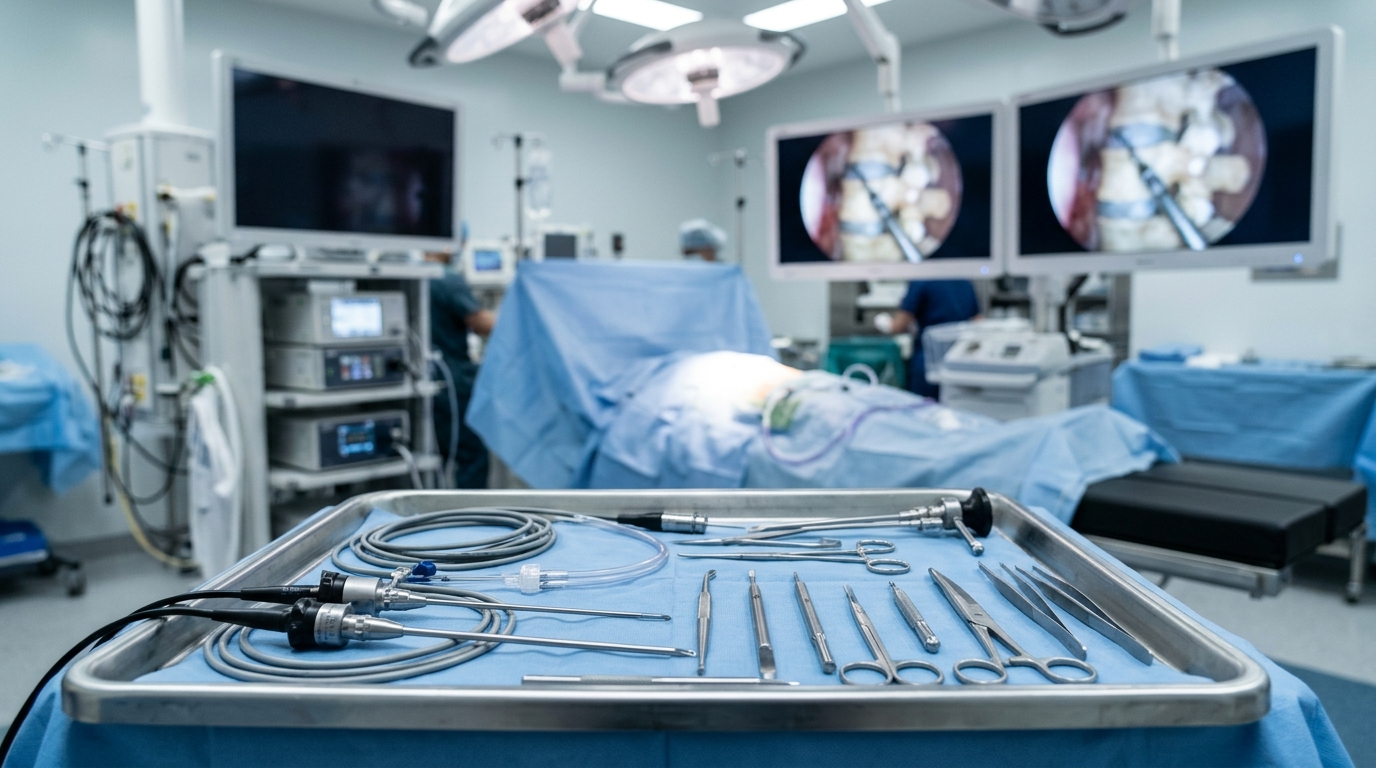
Conventional PLIF is performed through a midline posterior approach that requires extensive subperiosteal dissection of the paraspinal muscles, bilateral laminectomy, partial medial facetectomy, discectomy, insertion of an interbody cage, and bilateral pedicle screw fixation. This extensive exposure achieves reliable decompression and stabilization but can cause substantial blood loss, postoperative pain, and prolonged recovery. ULIF takes a different route: two separate portals at the interlaminar space provide a viewing channel and a working channel, with continuous saline irrigation keeping the field clear. After unilateral laminotomy and foraminotomy, the surgeon completes endoscopic discectomy and endplate preparation, inserts a single cage under endoscopic guidance, and applies percutaneous pedicle screw fixation.
The perioperative numbers favored the endoscopic technique in several respects. Operative time was significantly longer in the ULIF group, averaging 226.5 minutes against 184.1 minutes for PLIF, a difference the authors attribute to the technical complexity and learning curve of biportal endoscopic fusion. But estimated blood loss was far lower with ULIF, 87.6 milliliters versus 251.2 milliliters, and the postoperative hospital stay was 4.1 days compared with 8.5 days for the open procedure. Total hospital stay was also shorter in the ULIF group, 11.7 days against 14.6 days. The authors note that total stay can be inflated by preoperative waiting time and institutional factors, so the postoperative figure more directly reflects the pace of recovery.
Clinical outcomes were tracked with the visual analogue scale for back and leg pain and the Oswestry Disability Index, a standard measure of how back problems limit daily life, assessed before surgery and at three, six, and twelve months afterward. Improvements in both back and leg pain scores were comparable between the two operations, with no statistically significant differences. The reduction in ODI from baseline to twelve months was actually greater in the PLIF group, 47.97 points versus 45.59 points, a statistically significant gap. Yet the absolute ODI values at the final follow-up were nearly identical, 15.87 for PLIF and 16.00 for ULIF, indicating that patients in both groups reached a similar functional status by the end of the year.
The radiological results added a wrinkle. Using axial T2-weighted magnetic resonance imaging taken before surgery and on the third day after it, two blinded assessors measured the cross-sectional area of the spinal canal and its anteroposterior diameter at the operated disc level. Both groups showed substantial decompression, but the ULIF group’s gains were statistically larger: an increase in canal cross-sectional area of 79.76 square millimeters versus 77.82 square millimeters for PLIF, and an increase in canal diameter of 5.37 millimeters versus 4.97 millimeters. The authors urge caution here. The absolute between-group differences, roughly 2 square millimeters and 0.4 millimeters, are small, and because pain improvements were equivalent between groups, these radiographic differences may not translate into any clinically meaningful advantage. The measurements themselves were highly reliable, with interobserver correlation coefficients of 0.90 for canal area and 0.92 for diameter.
Fusion, the ultimate structural goal of the operation, was similar in both groups. At twelve months, continuous trabecular bone bridging without radiolucent lines around the cage was seen in 93.1 percent of ULIF patients and 92.1 percent of PLIF patients, a difference that was not statistically significant. Complications were also numerically similar and statistically indistinguishable: dural tear occurred in one ULIF patient and two PLIF patients, postoperative infection in none and one, cage subsidence in one and four, and fusion failure in two and three respectively. The authors are explicit that with such a small cohort and low event rates, the absence of significant differences should not be read as proof that the two procedures are equally safe.
Across all patients, the improvement in the Oswestry Disability Index correlated strongly with improvement in leg pain scores, with a correlation coefficient of 0.72, reinforcing that functional recovery tracked pain relief in this cohort. The study’s baseline characteristics were well matched: age, sex, body mass index, operated level, preoperative pain scores, and disability scores were comparable between groups, and the mix of diagnoses, including lumbar disc herniation, spinal stenosis, and Meyerding grade I to II spondylolisthesis, was similar as well. Most operations targeted the L4-5 level, though the PLIF group included more cases at higher lumbar levels.
The investigators are candid about the limits of their evidence. Because treatment allocation was not randomized and depended on surgeon judgment, patient preference, and the timing of ULIF’s introduction at the institution, treatment-selection bias and calendar-time effects cannot be excluded, and the retrospective design and modest sample size precluded robust adjustment for temporal effects. There was no a priori sample-size calculation, all procedures came from a single senior surgeon and team, and estimating blood loss during an endoscopic procedure is inherently less precise because continuous saline irrigation must be subtracted from the suction canister volume, even though the irrigation volume was recorded. The twelve-month follow-up was sufficient for early clinical recovery and preliminary fusion status but cannot speak to long-term fusion durability, adjacent segment degeneration, or late implant-related complications.
What the study does establish is a real-world signal worth pursuing. In this cohort, the endoscopic biportal approach achieved similar twelve-month pain relief, similar functional status, and similar preliminary fusion rates to conventional open fusion, while cutting blood loss by roughly two-thirds and trimming the postoperative hospital stay by more than four days, at the cost of about forty extra minutes in the operating room. The authors conclude that larger prospective studies with longer follow-up are needed to determine whether ULIF and PLIF truly share the same fusion and complication profiles, and whether the modest radiological differences seen here matter for patients over the long term. For now, the findings add to a growing body of literature suggesting that endoscopic spine surgery can deliver the structural goals of fusion with considerably less tissue disruption.
Subject of Research: Comparing endoscopic unilateral biportal lumbar interbody fusion with conventional posterior lumbar interbody fusion for degenerative lumbar disease
Article Title: Radiological decompression and clinical outcomes following endoscopic unilateral biportal lumbar interbody fusion vs. conventional posterior lumbar interbody fusion
Article References: Zhang, J., Duan, Y., Wei, S., & Yin, L. (2026). Radiological decompression and clinical outcomes following endoscopic unilateral biportal lumbar interbody fusion vs. conventional posterior lumbar interbody fusion. Frontiers in Radiology, 6, Article 1910633. https://doi.org/10.3389/fradi.2026.1910633
Image Credits: AI Generated
DOI: 10.3389/fradi.2026.1910633
Keywords: lumbar fusion, biportal endoscopy, ULIF, PLIF, spinal stenosis, spondylolisthesis, blood loss, hospital stay, spinal canal decompression, Oswestry Disability Index, minimally invasive spine surgery, retrospective study
News Source: Ophelia Keating. (November 4, 2026). Endoscopic Spine Fusion Cuts Blood Loss and Hospital Stay in Back Surgery Study. Scienmag.