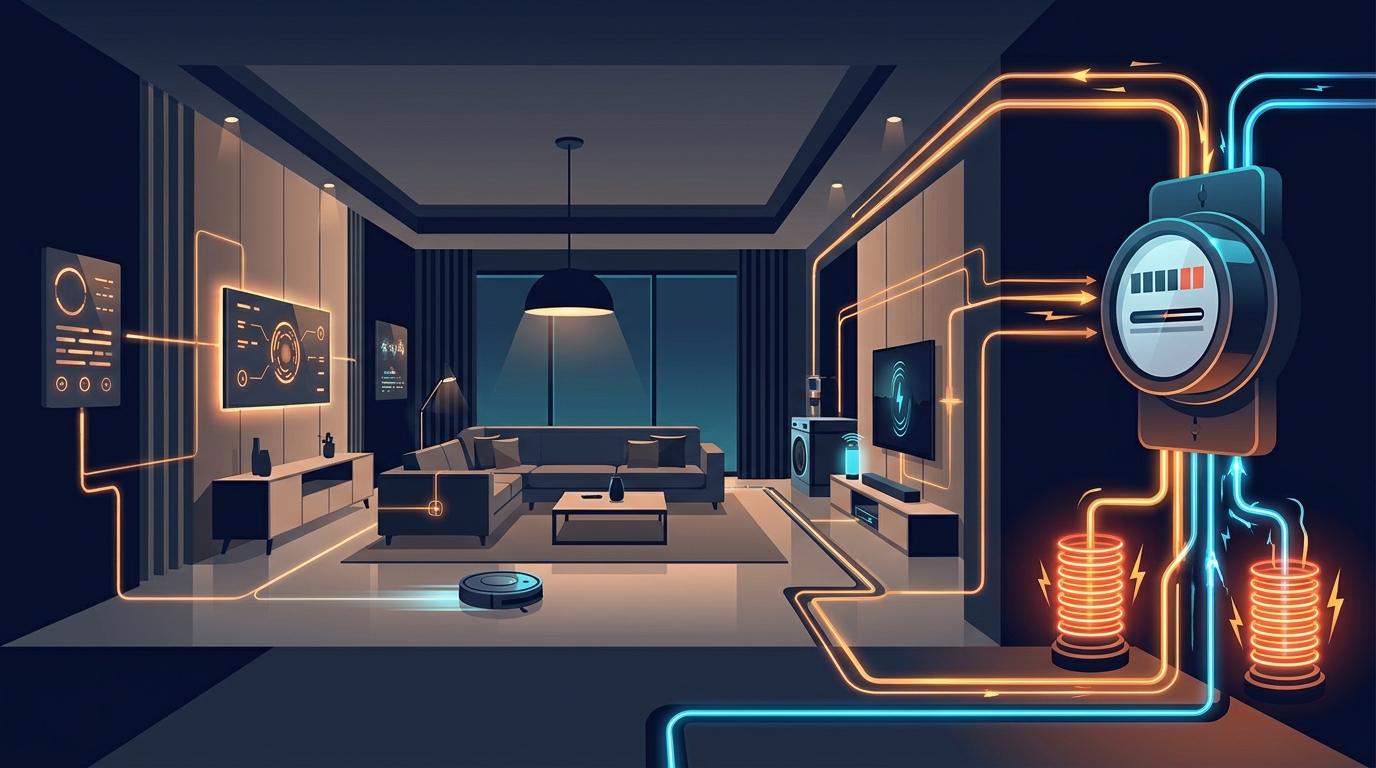
Digital automation is quietly spreading through everyday life, from robot vacuum cleaners and smart thermostats to AI writing assistants and self-driving cars, and a new conceptual study warns that the time these technologies save may come at a hidden energy cost. Researchers Jan Bieser of the University of Zurich and Emilie Vrain of the University of Oxford, publishing in Cleaner Engineering and Technology, systematically mapped how digitally enabled automation reshapes the way people spend their time and, through that, how much energy their lifestyles consume. Their central finding is counterintuitive: time savings do not automatically translate into energy savings, and in some cases they may actually increase overall energy use.
The study arrives at a moment when automation is expanding far beyond factories and offices. The researchers identified 36 activities in private life that currently have market-available execution-stage automation, spanning three domains: chores, leisure, and mobility. In the home, these range from automated bill payment, robotic lawnmowers, and automated pet feeders to smart lighting, meal delivery subscriptions, and automated cooking appliances. In leisure, AI-based tools such as image generators, automated video editors, and smart playlists that select songs based on listening habits are proliferating. In mobility, self-driving technology and AI-powered trip planners are moving toward the mainstream. Most of these applications are framed by manufacturers in terms of convenience and time savings, yet the energy consequences of freeing up human hours have rarely been examined.
To build their framework, the authors adopted a deliberately conceptual approach. Because empirical evidence on the time and energy effects of such a wide and rapidly evolving range of applications remains scarce, they used an expert coding procedure rather than experiments. Two researchers with complementary expertise in digital technology assessment and everyday practices independently classified the applications according to clearly defined criteria and decision rules, achieving an average Cohen’s Kappa of 0.68, which indicates substantial agreement, with no criterion falling below 0.46. The authors stress that this coding does not constitute an external validation of their classifications against observed user behaviour or measured energy outcomes, and that the study should be read as an exploratory conceptual analysis of broader patterns rather than a detailed empirical assessment of individual devices.
The framework distinguishes nine distinct modes of automation based on the roles of humans and machines, whether human presence is required during task execution, and the resulting potential to reallocate saved time. At one extreme lies full replacement, where a machine takes over an entire activity, as with an automated watering system, allowing the whole activity time to be redirected elsewhere. At the other lies fully manual execution, with no time savings by definition. Between these sit assist modes, in which machines take over parts of an activity or enhance it with additional automated features, and coordinate modes, in which a digital application delegates the task to a service provider, as with grocery delivery apps or ride-hailing services. Crucially, even fully autonomous machines may require human preparation, follow-up, or continuous attention, which narrows what the freed time can actually be used for.
When the researchers coded the 36 applications against this framework, clear domain-specific patterns emerged. In chores, replacement applications dominate, and many are explicitly designed to save time, from robot vacuum cleaners to automated payments, with human attention or presence usually not required. In leisure, by contrast, human-machine collaboration is central rather than task replacement. This aligns with the third-person criterion in leisure research, which holds that leisure activities cannot be delegated to others without loss of utility. Smart playlists may speed up track selection, but they are not intended to reduce time spent consuming media, and AI-powered creative tools tend to encourage longer engagement and experimentation. In mobility, time-saving replacement applications that still require human presence, such as level 4 self-driving cars, coexist with collaborative applications in trip planning.
The energy picture proved equally differentiated. In chores, the researchers identified applications that both increase and decrease direct energy intensity, defined as energy use per unit of time. Intelligent heating and lighting systems are often designed to reduce consumption, while robotic cleaning devices typically operate on limited battery capacities with lower power demands. Yet increases also occur, because many activities become electrified only through automation, such as automated pet food dispensing, plant watering, or door locking. In mobility, energy-saving applications dominate, since self-driving technology and trip planners can improve fuel efficiency or suggest efficient routes. In leisure, most applications tend to increase direct energy intensity, because automation there is designed to enhance functionality and user experience, increasingly through AI, which adds to energy use. The researchers found only one leisure application that likely saves energy: health trackers, and only if the data were previously collected with conventional health monitoring devices.
To demonstrate how these effects combine, the authors ran an illustrative case study of robot vacuum cleaners. They estimated that an average manual vacuum cleaner draws between 200 and 1200 watts, with a median of 700 watts, and is used for about 35 minutes per week, resulting in roughly 0.41 kilowatt-hours of electricity weekly. Robot vacuum cleaners typically draw far less, around 20 to 50 watts with a median of 35 watts, but are used for longer periods. Following manufacturer recommendations of two to four sessions per week at approximately 30 minutes per room, a three-room apartment would see about 270 minutes of weekly cleaning and 0.16 kilowatt-hours of electricity. The robot thus saves about 0.25 kilowatt-hours per week despite running longer, though the researchers note its lower suction power may require extended runtime to match manual cleanliness.
The rebound risk emerges when the roughly 35 minutes of weekly time saved, minus preparation and follow-up, is redirected. Drawing on activity-specific energy intensity data from a French time-use study conducted between 2009 and 2011, the researchers calculated how quickly the vacuum’s energy savings could be erased. If just one minute of the saved time is spent driving a car, for example for extra shopping or leisure trips, the savings are effectively negated. Additional meal preparation offsets the savings in about two minutes, personal care such as showering in around three minutes, additional ICT use such as watching television or using a computer in eleven minutes, and reading or other hobbies in sixteen minutes. The authors caution that these figures rest on context-dependent results from studies in different countries and time horizons with partially different system boundaries, and that the underlying data are dated, so they illustrate broad differences across activities rather than current empirical thresholds. Nevertheless, they conclude that a time rebound effect of over 100 percent is possible, meaning overall energy consumption could rise, because vacuum cleaning is less energy-intensive than many substitute activities. This supports earlier findings by Mizobuchi and colleagues, who showed that robot vacuum cleaners can shift time toward other activities that offset the device’s energy savings.
Beyond individual devices, the study identifies broader mechanisms through which automation could raise energy demand. Automation removes constraints that once limited energy consumption linked to time use, because multiple activities can now run simultaneously without human attention, allowing energy use to accumulate across devices in ways previously restricted by human presence. The researchers also highlight a materialization and electrification of everyday life, as growing numbers of connected devices, sensors, and supporting infrastructure require energy for material extraction, manufacture, transport, and end-of-life treatment. These embodied energy requirements were outside the scope of their assessment, but they note that additional devices can increase total energy use even when the devices themselves are efficient during use, particularly when automation adds equipment rather than replacing existing products. At the same time, the identified opportunities are real: more efficient device design, algorithmic control that outperforms human operation, and shifting time toward lower-energy activities could all reduce energy intensity.
The authors are explicit about their study’s limitations. They did not assess indirect energy impacts linked to increased device purchases and production, did not address systemic changes in time-use patterns when multiple applications interact, and their expert coding reflects the researchers’ prior knowledge without external validation against observed behaviour. The impacts they identify are context dependent and shaped by functionalities and user practices that continue to evolve rapidly. Still, their recommendations are concrete: policy and design should steer automation toward energy-efficient device design, low-energy defaults, and limits on unnecessary device proliferation and standby consumption, while assessments should account for rebound risks such as more frequent use and simultaneous operation of multiple devices. For leisure tools that increase energy use, energy-intensive features could be made optional and engagement-maximizing defaults avoided. As the researchers conclude, the energy implications of automation depend not only on technical efficiency but on how technologies reshape practices, routines, and expectations in daily life, and strategies are needed now to ensure automation supports rather than undermines sustainable lifestyles.
Subject of Research: The energy and time-use impacts of digitally enabled automation in everyday private life
Article Title: Time, Technology, and Energy: The energy impacts of digitally-enabled automation in everyday life
Article References: Bieser, J., & Vrain, E. (2026). Time, Technology, and Energy: The energy impacts of digitally-enabled automation in everyday life. Cleaner Engineering and Technology, 35, Article 101346. https://doi.org/10.1016/j.clet.2026.101346
Image Credits: AI Generated
DOI: 10.1016/j.clet.2026.101346
Keywords: automation, energy use, time use, rebound effect, robot vacuum cleaners, smart home, digital technology, sustainability, ICT, household chores, leisure, mobility
News Source: Denise Maddox. (November 4, 2026). Automation at Home May Save Time but Raise Your Energy Bills. Scienmag.