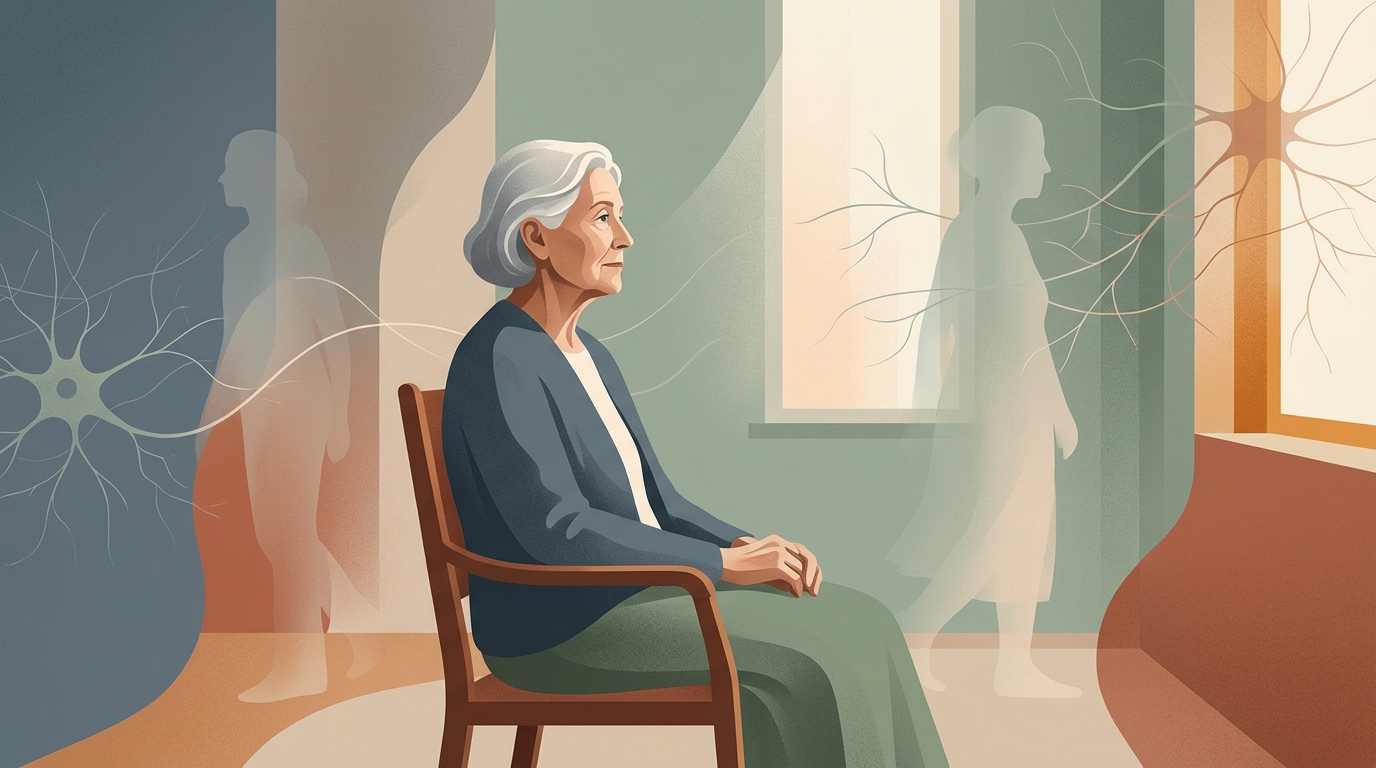
People with Parkinson’s disease sometimes feel that someone is standing beside them when nobody is there. These presence hallucinations belong to a group of minor hallucinations that often precede more elaborate visual disturbances and full-blown Parkinson’s psychosis. A new study now suggests that the identity patients assign to the phantom presence may carry clinical meaning: those who recognize the figure as a familiar person, such as a partner, appear to have a more advanced form of the disease than those who cannot say who the presence might be.
The research, published in npj Parkinson’s Disease, examined 77 people with Parkinson’s disease, of whom 27 reported presence hallucinations. The researchers split this group into two subtypes: 12 patients whose hallucinated presence was identified, and 15 patients whose presence remained unidentified. Across the two groups they compared disease progression measured with the UPDRS and Hoehn and Yahr scales, cognitive performance on the Parkinson’s Disease Cognitive Rating Scale, sensitivity to experimentally induced presence hallucinations, and resting-state functional connectivity of the brain.
The comparison produced a clear clinical pattern. Patients with identified presence hallucinations were at a more advanced stage of Parkinson’s disease and reported more motor impairments in daily life than patients whose hallucinated presence was unidentified. They also experienced simple visual illusions more frequently. Both groups, however, showed similar sensitivity when a robot-induced illusion was used to trigger presence hallucinations in the laboratory, indicating that the difference between the subtypes lies less in the raw tendency to feel a presence and more in the broader disease state surrounding it.
The most striking finding came from brain imaging. Resting-state functional connectivity revealed that patients with identified presence hallucinations had a functional disconnection between the right inferior frontal gyrus and the posterior middle temporal gyrus, two regions that sit within a previously defined presence-hallucination network. The strength of this fronto-temporal disconnection correlated with the degree of posterior cognitive impairment, linking the altered communication between these regions to measurable cognitive dysfunction.
The cognitive association reinforces this interpretation. Because the degree of disconnection tracked posterior cognitive impairment, the identified-presence subtype appears tied to a broader decline in brain function rather than an isolated perceptual quirk. The authors describe these patients as possibly occupying an intermediate disease stage, positioned between patients with unidentified presence hallucinations and patients who have progressed to structured visual hallucinations.
Minor hallucinations deserve this attention because of what they predict. Presence hallucinations are frequent in Parkinson’s disease and are known to foreshadow the later appearance of structured visual hallucinations and Parkinson’s psychosis, outcomes that substantially affect quality of life. Until now, however, differences among presence-hallucination subtypes had not been examined.
The clinical variables were analyzed with an exploratory approach that was not corrected for multiple comparisons, and the two patient groups were small, totaling 27 individuals. The authors emphasize that the findings need confirmation in larger samples before they can inform practice. The study also relied on resting-state connectivity, which captures correlations in brain activity rather than direct causal pathways, so the link between fronto-temporal disconnection and hallucination identity remains associative.
Even with these caveats, the work adds a surprising dimension to the study of Parkinson’s hallucinations: not just whether patients sense a presence, but who they sense.
Subject of Research: Differences in disease progression, cognition and brain connectivity between Parkinson's disease patients with identified versus unidentified presence hallucinations.
Article Title: Parkinson’s disease progression and fronto-temporal disconnection relate to identity of minor hallucinations
Article References: Vehar, N., Potheegadoo, J., Meyer, N. H., Kohoutová, L., Duong Phan Thanh, L. F., Stucker, C., Maradan-Gachet, M. E., Dhanis, H., Burget, L., Stampacchia, S., Bernasconi, F., & Blanke, O. (2026). Parkinson’s disease progression and fronto-temporal disconnection relate to identity of minor hallucinations. npj Parkinson's Disease. https://doi.org/10.1038/s41531-026-01556-9
Image Credits: AI Generated
DOI: 10.1038/s41531-026-01556-9
Keywords: Parkinson's disease, presence hallucinations, minor hallucinations, functional connectivity, fronto-temporal disconnection, cognitive impairment, visual illusions, disease progression, robot-induced hallucinations, npj Parkinson's Disease, Parkinson, disease
News Source: Cassandra Pierce. (November 4, 2026). Parkinson’s hallucinations: who patients sense may signal disease stage. Scienmag.