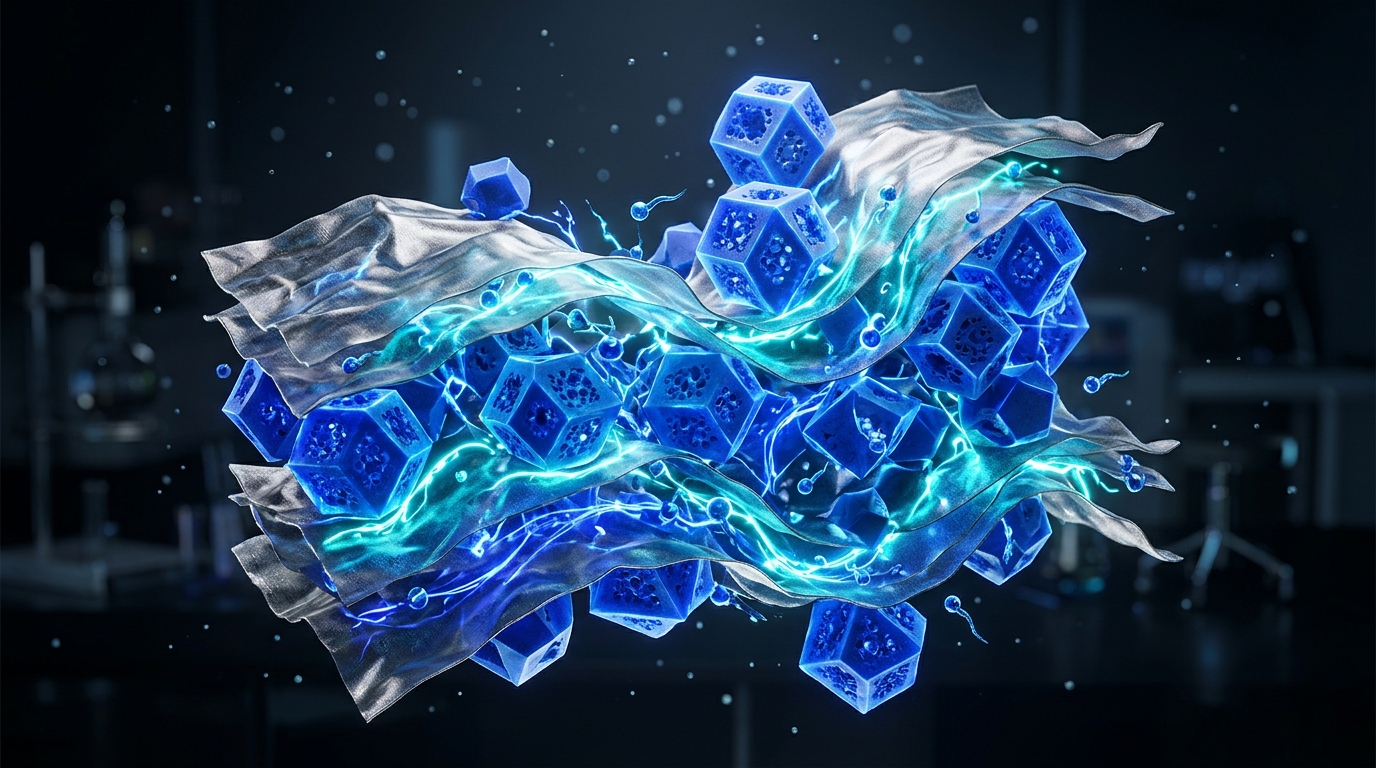
Metal–organic frameworks promise enormous surface area and tunable redox chemistry for supercapacitors, but two stubborn flaws have kept them out of high-performance devices: poor electrical conductivity and sluggish charge transport. A research team led by Tanveer Kaur, Renu Dhahiya, Pargati Vijayrania and Ashok Kumar now reports a composite electrode that tackles both problems at once, by growing a cobalt-based MOF onto a partially etched MXene made through a fluoride-free process. The work, published in Discover Chemical Engineering, describes a [Co(BDC)DMF]n framework synthesized by a solvothermal route and integrated with alkali-etched Ti3C2Tx MXene, where the surface terminations T represent oxygen and hydroxyl groups and x ranges from 1 to 4.
The choice of etching chemistry matters as much as the materials themselves. Conventional MXene synthesis typically relies on hydrofluoric acid, a corrosive and hazardous reagent that demands stringent handling. The team instead used an alkali-assisted partial etching route, which they describe as relatively safer and environmentally benign. Beyond safety, the alkali treatment widens the interlayer spacing of the MXene sheets, and that structural change has practical consequences: wider galleries give ions easier access and strengthen the interfacial interaction between the layered carbide and the MOF particles that decorate it.
Structural and morphological analyses confirmed that the composite formed successfully, while X-ray photoelectron and Raman spectroscopies revealed strong interfacial coupling between the two components and improved electronic properties. That coupling is the heart of the design. The redox-active Co2+ centres of the framework supply faradaic charge storage, while the conductive MXene network provides a continuous pathway for electrons that the insulating MOF alone cannot offer. The result is a synergistic architecture in which each material compensates for the other’s weakness.
The electrochemical numbers bear this out. The composite electrode delivered a specific capacitance of 704 F g−1 at a current density of 1 A g−1, substantially exceeding the 417 F g−1 measured for the pristine [Co(BDC)DMF]n MOF under the same conditions. The composite also showed improved power capability, indicating that it can deliver its stored charge at useful rates rather than only under slow, gentle cycling.
Impedance measurements added a mechanistic explanation for those gains. Electrochemical impedance spectroscopy indicated that the charge transfer resistance fell from 12.58 Ω for the pristine MOF to 8.47 Ω for the composite, confirming enhanced charge transport across the electrode. Lower resistance at the electrode–electrolyte interface means less energy wasted as heat during rapid charging and discharging, and it helps explain both the higher capacitance and the better rate behaviour observed in the composite.
Durability, often the Achilles heel of MOF electrodes, also improved markedly. After 5000 charge–discharge cycles, the composite electrode retained 91% of its capacitance, compared with 79% retention for the [Co(BDC)DMF]n MOF on its own. The conductive MXene scaffold appears to buffer the framework against the structural degradation and loss of active material that typically erode MOF performance over repeated cycling.
To test the material under realistic device conditions, the researchers assembled an asymmetric supercapacitor using the composite. The full cell operated across a 1.6 V voltage window and achieved an energy density of 22.7 W h kg−1. Notably, the device recorded 114% capacitance retention after 5000 cycles, a figure that suggests the cell not only survived extended cycling but, under the reported measurement conditions, performed slightly above its initial capacitance value.
The authors attribute the superior performance to the synergistic effect between the redox-active Co2+ centres and the conductive MXene network. In practical terms, the fluoride-free alkali etching does double duty: it removes the safety and environmental burden of hydrofluoric acid from the synthesis, and it produces a partially etched, expanded-layer MXene whose open structure and surface terminations promote ion accessibility and interfacial bonding with the MOF.
For the energy storage field, the study demonstrates a promising strategy for advanced supercapacitor applications: pairing redox-rich but poorly conducting frameworks with highly conductive two-dimensional carbides, prepared through greener chemistry. If the alkali etching route can be scaled with the same performance benefits it shows at the laboratory electrode level, fluoride-free MXene–MOF composites could become a credible platform for next-generation electrochemical energy storage devices.
Subject of Research: A fluoride-free synthesized partially etched MXene composite with a cobalt metal–organic framework for supercapacitor electrodes.
Article Title: Co-BDC metal organic framework and fluoride free process synthesized partially etched MXene composite for electrochemical energy storage applications
Article References: Kaur, T., Dhahiya, R., Vijayrania, P., & Kumar, A. (2026). Co-BDC metal organic framework and fluoride free process synthesized partially etched MXene composite for electrochemical energy storage applications. Discover Chemical Engineering. https://doi.org/10.1007/s43938-026-00158-4
Image Credits: AI Generated
DOI: 10.1007/s43938-026-00158-4
Keywords: metal–organic framework, MXene, supercapacitor, fluoride-free etching, Ti3C2Tx, specific capacitance, charge transfer resistance, asymmetric supercapacitor, energy density, electrochemical energy storage, Co-BDC, metal
News Source: Bethany Barker. (November 4, 2026). Fluoride-free etched MXene boosts cobalt MOF supercapacitor performance. Scienmag.