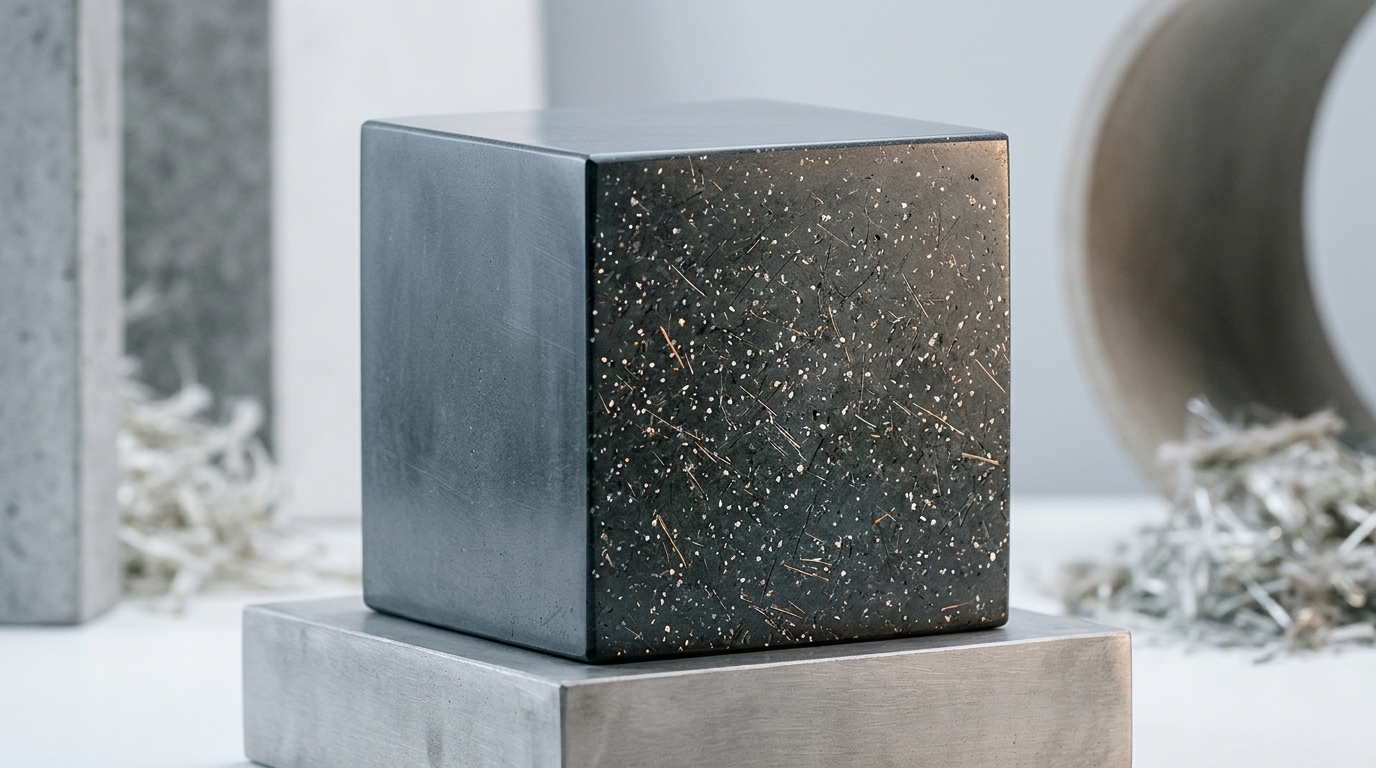
Construction waste that normally clogs landfills has been converted into a high-performance cement alternative that reaches a compressive strength of 85.3 megapascals, according to a study published in Case Studies in Construction Materials. Researchers at Egyptian institutions ground non-biodegradable glass wool insulation into a fine powder, blended it with ground granulated blast furnace slag, and activated the mixture with sodium hydroxide to form an alkali-activated binder. When they added 2 percent zirconia nanoparticles and cured the paste in an autoclave at 120 degrees Celsius for three hours, the material outperformed a reference binder made entirely of slag, which reached 59 megapascals after 28 days of ambient curing. The work was led by M. Ramadan, M.S. Amin, Mona M. Wetwet and Alaa Mohsen, who describe the system as a route toward precast construction materials that combine structural performance with added functions.
The team selected glass wool waste because its predominantly amorphous structure and high silica content, measured at 66.40 weight percent silicon dioxide by X-ray fluorescence, make it reactive under alkaline conditions. Under alkaline activation, part of the glass wool dissolves and contributes to the binding gel, while unreacted particles act as micro-fillers that refine the pore structure. The waste carries a drawback, however: its alumina content is only 3.00 weight percent, which raises the silica-to-alumina ratio of the mixture and can limit the formation of a well-developed geopolymeric framework. The slag compensates for this imbalance, containing 24.50 weight percent calcium oxide, 50.01 weight percent silicon dioxide and 14.11 weight percent aluminum oxide, which support the formation of calcium-rich binding phases such as calcium-silicate-hydrate and calcium-aluminosilicate-hydrate gels.
Particle size analysis showed the ground glass wool was finer than the slag, with a median particle diameter of 0.42 micrometers compared with 1.26 micrometers for the slag, and a maximum particle size of 3.87 micrometers against 11.67 micrometers. Scanning electron microscopy confirmed that grinding broke the long, smooth fibers of the as-received waste into short, irregular, angular fragments, increasing the surface area available for alkaline dissolution. The researchers prepared pastes in which 0, 5, 10 or 20 weight percent of the slag was replaced by glass wool powder, keeping the sodium hydroxide dosage at 6 weight percent of the binder and the water-to-solid ratio fixed at 0.27 for all mixes. Cubic specimens measuring 25 millimeters per side were cast, compacted and held for 24 hours at 98 plus or minus 2 percent relative humidity before demolding and curing.
Compressive strength testing under ASTM C109M-20b, reported as the mean of three replicate specimens, showed that replacing slag with glass wool reduced strength at every curing age. The reference mix reached 32, 41.5 and 59 megapascals at 1, 7 and 28 days of ambient curing, while the 20 percent replacement mix, designated R-20G, fell 22.0 percent below the reference at 28 days but still achieved 46 megapascals. The authors attribute the decline to dilution of the calcium and alumina needed for strength-giving phases, an increase in the silica-to-alumina ratio from 3.5 to 4.5 in the 20 percent mix, and possible coating of slag particles by the high waste fraction, which hinders geopolymerization. They note that the pozzolanic activity of the glass wool, measured at 1877 milligrams of calcium oxide consumed per gram, and its fine particle size helped the 20 percent mix retain strength considered satisfactory for construction applications.
Autoclave curing changed the picture substantially. Specimens cured in saturated steam at 90, 120 and 150 degrees Celsius for three hours, corresponding to pressures of approximately 0.70, 1.99 and 4.76 bar, showed strength gains that peaked at 150 degrees for the reference mix and at 120 degrees for the glass wool mixes. Under these optimum conditions, 1-day strength rose by 92.2 to 168.2 percent relative to ambient curing, and 28-day strength rose by 4.2 to 28.3 percent depending on composition. The 20 percent glass wool mix cured at 120 degrees reached 59 megapascals, matching the 28-day strength of the all-slag reference. X-ray diffraction revealed why: hydrothermal treatment produced zeolitic phases, including hydrogarnet in the reference mix and the zeolites ZZ9 and sodalite in the waste-containing mix, alongside intensified calcium-silicate-hydrate and calcium-aluminosilicate-hydrate peaks.
The zirconia nanoparticles were synthesized by co-precipitation from zirconium oxychloride octahydrate with ammonium hydroxide, using cetyltrimethylammonium bromide as a capping agent, followed by calcination at 550 degrees Celsius for two hours. X-ray diffraction identified phase-pure polycrystalline zirconia with dominant monoclinic and minor tetragonal phases, an average crystallite size of approximately 17.92 nanometers and 80.14 percent crystallinity. Nitrogen adsorption measurements gave a specific surface area of 114.93 square meters per gram and a dominant pore diameter near 5.08 nanometers, while high-resolution transmission electron microscopy showed individual particles of roughly 11 to 18 nanometers with a strong tendency to agglomerate. Energy-dispersive X-ray spectroscopy indicated a purity of about 99.09 percent, with a faint chlorine peak attributed to adsorbed chloride ions from the precursor.
Adding 1 and 2 weight percent zirconia to the 20 percent glass wool mix raised 28-day ambient-cured strength by 17.4 and 32.6 percent respectively, with the 2 percent formulation reaching 61 megapascals and exceeding the all-slag reference. Under autoclave curing at 120 degrees, the 2 percent formulation reached 85.3 megapascals, a 44.6 percent enhancement over the 28-day reference value. The authors explain the gains through two mechanisms: the nanoparticles act as nano-fillers occupying voids, capillary pores and micro-cracks, and they serve as nucleation centers that accelerate precipitation of binding products from unreacted slag and catalyze the participation of the glass wool. X-ray diffraction of the autoclaved zirconia-modified mix additionally detected calcium-zirconium-hexasilicate-hydrate, suggesting a possible chemical interaction between zirconia and the calcium-silicate-hydrate gel that compacts the binding phase. Pore structure analysis by the Brunauer-Emmett-Teller and Barrett-Joyner-Halenda methods showed the dominant pore diameter of the zirconia-modified mix falling from 18.37 nanometers under ambient curing to 12.70 nanometers under autoclave curing, consistent with the reported strength gains.
The composites also showed measurable gamma-ray shielding performance. Using a cesium-137 source at 662 kiloelectronvolts and a sodium iodide scintillation detector, the team measured linear attenuation coefficients from transmitted intensities across specimen thicknesses of 2.5 to 10 centimeters, with correlation coefficients between 0.986 and 0.998 confirming agreement with the Beer-Lambert model. The ambient-cured reference and the 20 percent glass wool mix without zirconia showed nearly identical attenuation coefficients of 0.110 and 0.109 per centimeter, indicating the waste alone did not improve shielding. Adding 2 percent zirconia raised the coefficient to 0.142 per centimeter under ambient curing and 0.160 per centimeter under autoclave curing, while the half-value layer fell from about 6.3 centimeters to 4.33 centimeters. The authors link the improvement to the denser microstructure, the high atomic number of zirconium and the reduced pore size, which increase the probability of photon interactions. They note that a transmission factor reported at a 25-centimeter wall thickness is a calculated extrapolation rather than a directly tested thickness.
Antimicrobial testing by agar diffusion, performed on discs pre-immersed in distilled water to a pH of 8 plus or minus 0.2 to exclude alkalinity effects, showed that the unmodified 20 percent glass wool mix produced no inhibition zone against Bacillus cereus or Fusarium oxysporum, though it moderately inhibited Pseudomonas aeruginosa and Penicillium glabrum. With 2 percent zirconia added, clear inhibition zones appeared against all four tested organisms, reaching 50 plus or minus 1.6 millimeters for Bacillus cereus, 36 plus or minus 1.1 millimeters for Pseudomonas aeruginosa, 60 plus or minus 2.0 millimeters for Fusarium oxysporum and 42 plus or minus 0.8 millimeters for Penicillium glabrum under ambient curing. The autoclaved zirconia-modified specimen performed comparably, with zones of 55, 35, 57 and 48 millimeters respectively. The authors attribute the antimicrobial effect to positively charged zirconium ions disrupting microbial cell envelopes and to reactive oxygen species generated by the nanoparticles, while noting that the Gram-negative Pseudomonas aeruginosa showed the lowest sensitivity, likely due to its layered lipopolysaccharide outer structure.
An environmental and economic assessment standardized to one tonne of precursor estimated that the reference alkali-activated slag mix emits 100.42 kilograms of carbon dioxide per tonne, roughly 89.4 percent below the 944 kilograms attributed to ordinary Portland cement, at a cost of 70.48 dollars per tonne against 90 dollars for cement. Substituting 20 percent glass wool lowered the estimated cost to 61.9 dollars per tonne, about 31.2 percent below cement, while adding 2 percent zirconia raised emissions to 170.22 kilograms per tonne and cost to 115.9 dollars per tonne, still roughly 78 percent below the cement carbon footprint after accounting for autoclave curing energy of 68.03 kilowatt-hours per tonne. The authors caution that the findings rest on 25-millimeter cubic specimens and three-replicate testing, and they identify future work needed on larger specimens, long-term service conditions, water absorption, drying shrinkage, freeze-thaw and chemical resistance, potential zirconium leaching, high-dose multi-energy shielding and quantitative antimicrobial validation before the system can move from laboratory to construction practice.
Subject of Research: Recycling glass wool insulation waste into zirconia-modified alkali-activated slag binders with enhanced strength, radiation shielding and antimicrobial function
Article Title: Circular utilization of glass wool waste in zirconia NPs-grafted alkali-activated binders for advanced construction applications
Article References: Ramadan, M., Amin, M. S., Wetwet, M. M., & Mohsen, A. (2026). Circular utilization of glass wool waste in zirconia NPs-grafted alkali-activated binders for advanced construction applications. Case Studies in Construction Materials, 25, Article e06678. https://doi.org/10.1016/j.cscm.2026.e06678
Image Credits: AI Generated
DOI: 10.1016/j.cscm.2026.e06678
Keywords: glass wool waste, alkali-activated cement, zirconia nanoparticles, autoclave curing, gamma-ray shielding, antimicrobial materials, ground granulated blast furnace slag, compressive strength, geopolymer, construction waste recycling, sustainable building materials, precast concrete
News Source: Denise Maddox. (November 4, 2026). Glass Wool Waste Transformed Into Zirconia-Boosted Cement Reaching 85 MPa. Scienmag.