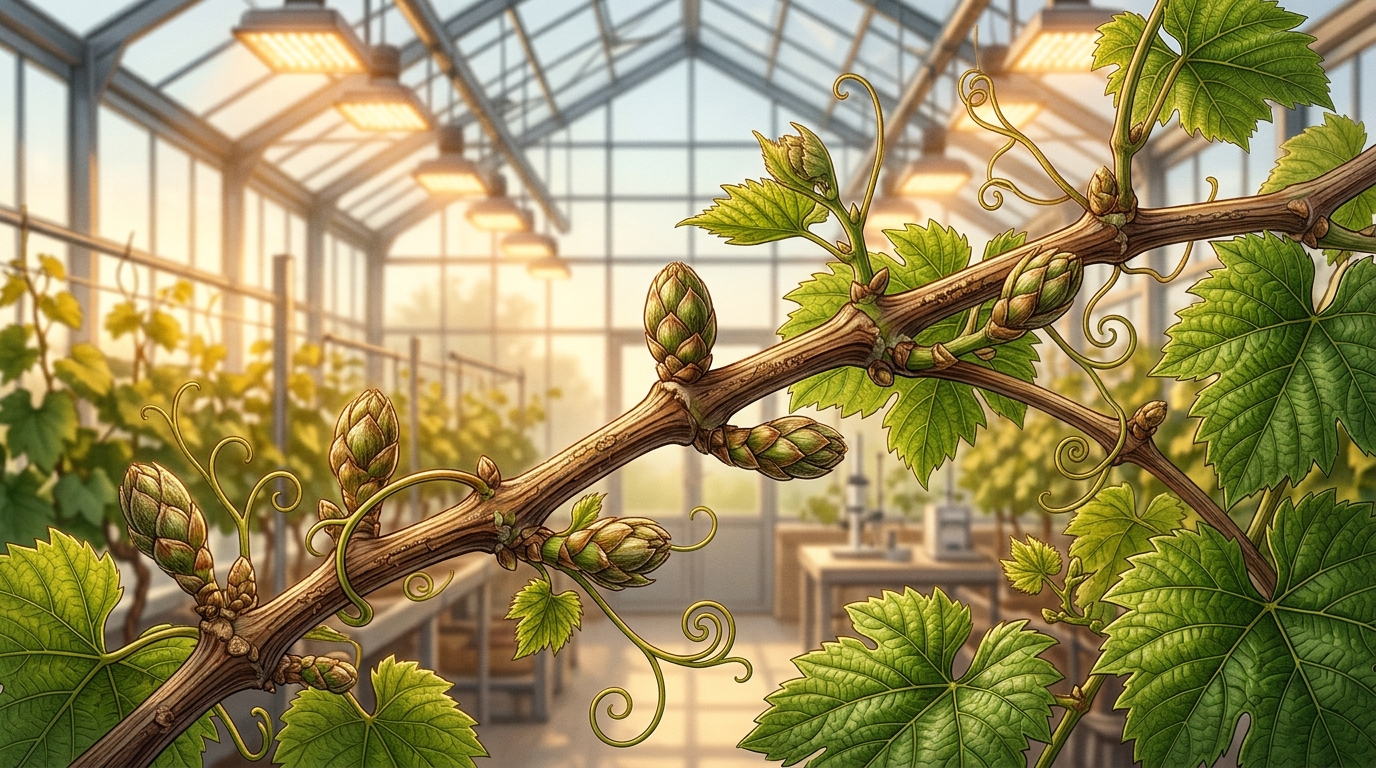
The study aimed to pre-condition grapevine transplants for enhanced reproductive development, in order to be able to produce a crop in the same season of planting. The researchers hypothesized that young potted grape transplants could be pre-conditioned to enhance reproductive development using supplemental light in a controlled environment greenhouse before being planted in the vineyard. The study, published in Frontiers in Horticulture, examined two contrasting cultivars, the French-American hybrid Traminette and the own-rooted Concord (Vitis labrusca), and tracked how different light doses shaped bud fruitfulness, vine physiology and early yield components.
The experiment began with one-year-old bare-root transplants grown in 37-liter grow bags inside a controlled-environment greenhouse for 101 days. Four replicates of each cultivar were assigned to one of three light intensity levels. A control group received no supplemental light and accumulated a cumulative daily light integral of 887 plus or minus 113 mol per square meter, labeled NSL. A medium supplemental light treatment, MSL, delivered a cumulative DLI of 2895 plus or minus 173 mol per square meter, while the high supplemental light treatment, HSL, reached 4928 plus or minus 302 mol per square meter. The light treatments were defined by cumulative daily light integral (DLI): the control received 887 plus or minus 113 mol per square meter, the medium treatment 2895 plus or minus 173 mol per square meter, and the high treatment 4928 plus or minus 302 mol per square meter.
The central hypothesis was straightforward: if the greenhouse environment could push young vines toward enhanced reproductive development, the pre-conditioned transplants might produce at least a partial crop in the same season they were planted. Potential fruitfulness was evaluated through bud dissections. The researchers hypothesized that young potted grape transplants can be pre-conditioned to enhance reproductive development using supplemental light in a controlled environment greenhouse.
Bud dissections were used to assess potential fruitfulness in the greenhouse-grown vines. In Traminette, potential fruitfulness was significantly higher under the high supplemental light treatment, specifically in the secondary and tertiary buds. In Traminette, the significantly higher potential fruitfulness under the high supplemental light treatment was observed specifically in the secondary and tertiary buds. Concord responded very differently. Concord showed extensive bud necrosis in all treatments, and its fruitfulness remained low across the light gradient.
After the greenhouse phase, the pre-conditioned vines were transplanted into a commercial vineyard, where fruitfulness and components of yield were measured for two consecutive years. In the field, total observed bud fruitfulness was significantly higher in both the medium and high supplemental light groups of Traminette compared with vines that had received no supplemental light. After transplanting into a commercial vineyard, total observed bud fruitfulness was significantly higher in the medium and high supplemental light treatments in Traminette compared to vines grown without supplemental light.
The yield results, however, told a more cautious story. The enhanced observed bud fruitfulness in Traminette did not translate into higher yields in the year of planting. The study measured fruitfulness and components of yield (COY) for two consecutive years after the pre-conditioned vines were planted in a commercial vineyard. The authors suggest a potential need for optimized management methods for conditioned vines in commercial vineyards, since the observed enhanced bud fruitfulness in Traminette did not translate into higher yields.
The cultivar contrast carries practical weight, because the study suggests that a potential technology to condition grapevines for fruiting under greenhouse conditions needs to be adjusted to specific cultivars. Traminette, a hybrid of Joannes Seyve 23.416 and Gewurztraminer on 101-14 rootstock, showed higher potential and observed fruitfulness under supplemental light, while Concord, an own-rooted Vitis labrusca cultivar, showed extensive bud necrosis in all treatments, including the control without supplemental light. The study concludes that a potential technology to condition grapevines for fruiting under greenhouse conditions needs to be adjusted to specific cultivars, meaning a protocol that works for one genetic background cannot simply be transferred to another.
The study was conducted in a controlled environment greenhouse, and the light treatments were delivered as three intensity levels with four replicates per treatment. The measured cumulative DLIs spanned from 887 plus or minus 113 mol per square meter in the control to 4928 plus or minus 302 mol per square meter in the high supplemental light treatment. At the same time, the Concord results illustrate a limit of the approach as tested, since the cultivar showed extensive bud necrosis in all treatments and less fruitfulness across the light gradient.
The overall picture is one of a promising but incomplete technology. Supplemental greenhouse light did increase potential fruitfulness in containerized Traminette and observed fruitfulness in the subsequently planted vines, yet the gain stopped short of a first-year yield benefit. Fruitfulness and components of yield were measured for two consecutive years after transplanting, and the study reports that increased observed fruitfulness did not lead to higher yields in the year of planting. The study suggests that a potential technology to condition grapevines for fruiting under greenhouse conditions needs to be adjusted to specific cultivars.
Subject of Research: Pre-conditioning grapevine transplants with supplemental greenhouse light to enhance bud fruitfulness and early vineyard yield
Article Title: Impact of supplemental light on bud fruitfulness, physiology and vine yield of containerized ‘Traminette’ (French-American hybrid) and ‘Concord’ (Vitis labrusca)
Article References: Freedman, K., Heagy, K., Collado, C., Hernández, R., & Hoffmann, M. (2026). Impact of supplemental light on bud fruitfulness, physiology and vine yield of containerized ‘Traminette’ (French-American hybrid) and ‘Concord’ (Vitis labrusca). Frontiers in Horticulture, 5, Article 1953764. https://doi.org/10.3389/fhort.2026.1953764
Image Credits: AI Generated
DOI: 10.3389/fhort.2026.1953764
Keywords: grapevine, supplemental light, controlled environment agriculture, LED, bud fruitfulness, Traminette, Concord, Vitis labrusca, greenhouse, vineyard, bud necrosis, yield components
News Source: Alan Morgan. (November 4, 2026). Greenhouse Light Boosts Bud Fruitfulness in Traminette Grapevines but Not First-Year Yields. Scienmag.