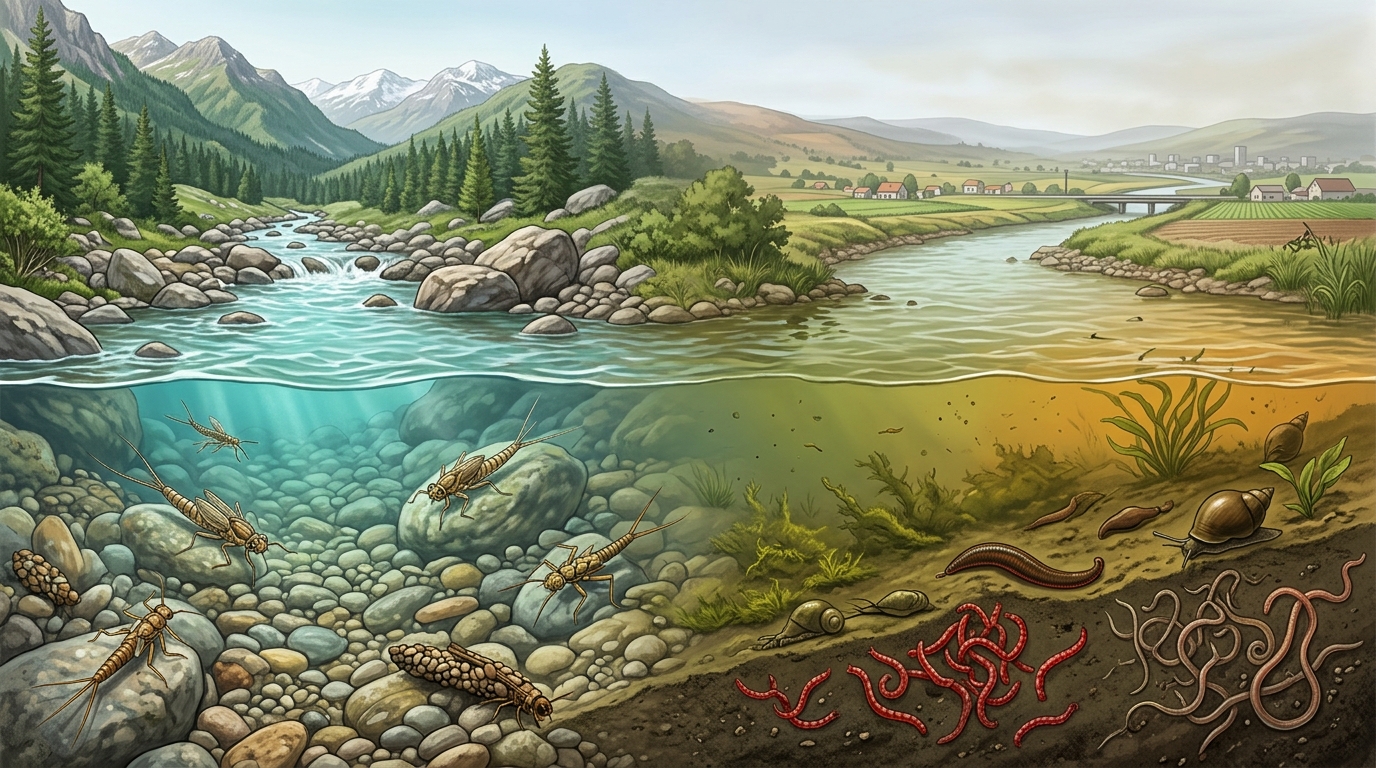
A six-month survey of the Kuliya River at Areka town in southern Ethiopia has traced a clear pollution gradient along the river’s course, using the insects and other bottom-dwelling animals that live in its bed as living gauges of water quality. Between January and June 2023, researchers sampled three sites spaced roughly five kilometres apart and found that the upstream site supported a rich community of pollution-sensitive mayflies, stoneflies and caddisflies, while the downstream site was dominated by tolerant midge larvae and leeches. The study, published in Aquaculture Science and Management, is described by its authors as the first of its kind for this river.
The team counted 1,082 macroinvertebrate individuals belonging to 18 families, 7 orders and 1 class across the three sites. Site 1, the upstream Ukara site, yielded 439 individuals, site 2 at midstream produced 338, and site 3, the downstream Kera site, held 305. Chironomidae, the non-biting midges, were the most abundant family overall at 45.10 percent of the total, followed by Baetidae at 7.86 percent, Gomphidae at 5.26 percent, Leptophlebiidae at 4.44 percent, Heptageniidae at 4.16 percent, Perlidae at 3.97 percent, Naucoridae at 3.88 percent and Nepidae at 3.70 percent. Families such as Aeshnidae, Muscidae, Hydropsychidae, Coenagrionidae, Caenidae, Elmidae, Notonectidae, Gyrinidae, Syrphidae and Hirudinea made up the remainder in smaller proportions.
The composition shifted sharply from one end of the river to the other. At site 1, the orders Ephemeroptera, Plecoptera and Trichoptera, collectively known as EPT, dominated the community, and these three groups accounted for 52.84 percent of individuals there. Their share fell to 12.73 percent at site 2 and collapsed to just 0.98 percent at site 3. Diptera showed the mirror image of this pattern: the order made up 18.00 percent of the community at the upstream site, 62.72 percent at midstream, and 79.34 percent downstream. Because EPT insects are generally sensitive to organic pollution while many dipterans tolerate it, the researchers read this reversal as a direct signal of declining water quality toward the river’s lower reaches.
Two standard indices quantified the pattern. Hilsenhoff’s family biotic index, which scores a community on the pollution tolerance of the families present, came in at 3.80 at site 1, 7.04 at site 2 and 8.18 at site 3, values the authors interpret as possible slight pollution, significant pollution and highly significant organic pollution respectively. The Shannon-Wiener diversity index told the same story, falling from 2.35 at site 1 to 1.72 at site 2 and 0.99 at site 3. On a published scale in which values below 1 indicate heavy pollution, 1 to 2 moderate pollution, 2 to 3 light pollution and values above 3 slight or no pollution, site 1 qualified as lightly polluted, site 2 as moderately polluted and site 3 as heavily polluted. Species richness followed suit, with 14 families recorded upstream against only 8 downstream, and the Simpson diversity index dropped from 0.88 at site 1 to 0.42 at site 3.
The physicochemical measurements reinforced the biological evidence. Mean water temperature rose from 19.27 degrees Celsius at site 1 to 21.7 at site 2 and 23.02 at site 3. Electrical conductivity climbed from 134.77 microsiemens per centimetre upstream to 236.47 downstream, and total dissolved solids rose from 88.90 to 156.02 milligrams per litre, both differences statistically significant. Dissolved oxygen moved in the opposite direction, falling from 7.07 milligrams per litre at site 1 to 4.07 at site 3, a significant decline from upstream to downstream. The pH rose from 7.05 to 8.87 across the same span, exceeding the World Health Organization’s permissible range of 6.5 to 8.5 at the downstream site. Biological oxygen demand increased from 92.5 to 156.87 milligrams per litre and chemical oxygen demand from 185 to 313.75 milligrams per litre, both significantly, while total alkalinity reached a significantly high 292 milligrams per litre at site 3.
Nutrients traced the same downstream intensification. Nitrite concentrations rose from 1.24 milligrams per litre at site 1 to 1.35 at site 2 and 2.21 at site 3, and nitrate rose from 5.22 to 7.47 and then 8.82 milligrams per litre, with both parameters differing significantly among sites. Phosphates likewise increased from upstream to downstream. By contrast, ammonia and ammonium showed no significant differences among sites, ranging from 0.42 to 0.55 milligrams per litre and from 0.45 to 0.60 milligrams per litre respectively. The authors note that the dissolved oxygen level at the downstream site fell below the 5 milligrams per litre threshold they cite as a level below which the functioning and survival of aquatic biological communities may be harmed.
A canonical correspondence analysis linked the community shifts to the measured conditions. The first axis accounted for 93.83 percent of the inertia in the species distribution and correlated positively with dissolved oxygen and temperature, while conductivity, turbidity, total dissolved solids, nitrites, nitrates, phosphates, total alkalinity, biological oxygen demand and chemical oxygen demand correlated negatively with that axis. Dissolved oxygen at the upstream sites aligned with the less tolerant taxa, including Caenidae, Hydropsychidae, Heptageniidae, Baetidae, Gomphidae and Aeshnidae. The tolerant families Coenagrionidae, Notonectidae, Nepidae, Syrphidae, Muscidae, Chironomidae and Hirudinea were associated with the opposite end of the gradient. The authors interpret the negative association between most pollution-sensitive macroinvertebrates and the nutrient and organic load parameters as evidence that water quality shaped the distribution of the community.
The sources of the stress are catalogued in detail in the paper. Chemicals from soaps, pesticides and fertilizers enter the river, along with domestic and non-domestic wastes from Areka town, vehicle washing carried out in the river and in town, laundry water, livestock watering, small-scale irrigation, sand mining and liquid residues from the Kera slaughterhouse, much of it reaching the river through open ditches. Near the study area, the removal of riparian vegetation, excessive grazing, urban runoff, household garbage disposal and other solid pollutants add further pressure. The river rises on Damota Mountain and passes through farmland where artificial fertilizers are released, and the authors attribute the high downstream conductivity to soil erosion, fertilizer-laden runoff and domestic waste dumped in ionized form, and the oxygen decline to organic wastes and household sewage discharged from the town.
The sampling itself followed standard biomonitoring practice. Macroinvertebrates were collected with a D-frame net of 500 micrometre mesh using kick sampling and multi-habitat methods along 100-metre stretches covering both banks at each site, then sieved at 300 micrometres, identified to family level with standard keys and preserved in 70 percent ethanol. Water samples were analysed for a suite of parameters including dissolved oxygen by the Winkler method, pH, temperature, total dissolved solids, conductivity, turbidity, biological and chemical oxygen demand, phosphates, nitrates, nitrites, ammonia, ammonium and total alkalinity, using photometric and titrimetric procedures. Differences among sites were tested with one-way analysis of variance followed by Tukey’s post hoc test.
The authors conclude that the Kuliya River is under anthropogenic stress and call for proper water quality management and continuous monitoring. Their recommendations include routing slaughterhouse, vehicle-washing and municipal wastes through treatment before discharge, controlling solid waste deposits by local communities and small-scale industries, moving domestic and municipal garbage and industrial effluents away from the river, stricter enforcement of environmental protection laws, awareness training for the community, and ongoing monitoring using the parameters applied in this study. Turbidity exceeded the WHO drinking-water guideline at all three sites, and the authors note that the river’s alkaline condition downstream can affect taste, corrosion and toxicity for drinking and for aquatic life. As a first biological assessment of this river, the study provides a baseline against which future recovery or further degradation can be measured.
Subject of Research: Benthic macroinvertebrate communities as bioindicators of water quality along the Kuliya River in southern Ethiopia
Article Title: Abundance and diversity of benthic macroinvertebrates as bioindicators of water quality in Kuliya River at Areka Town Southern Ethiopia
Article References: Minota, L., Deneke, Y., Pattnaik, B. S., Yosef, Z., & Woldesenbet, A. (2026). Abundance and diversity of benthic macroinvertebrates as bioindicators of water quality in Kuliya River at Areka Town Southern Ethiopia. Aquaculture Science and Management, 3(1), Article 21. https://doi.org/10.1186/s44365-026-00047-5
Image Credits: AI Generated
DOI: 10.1186/s44365-026-00047-5
Keywords: benthic macroinvertebrates, bioindicators, water quality, Kuliya River, Ethiopia, freshwater pollution, EPT taxa, Shannon-Wiener diversity index, Hilsenhoff family biotic index, dissolved oxygen, anthropogenic stress, biomonitoring
News Source: Gavin Prescott. (November 3, 2026). Pollution-Tolerant Insects Reveal a Downstream Decline in Kuliya River Water Quality. Scienmag.