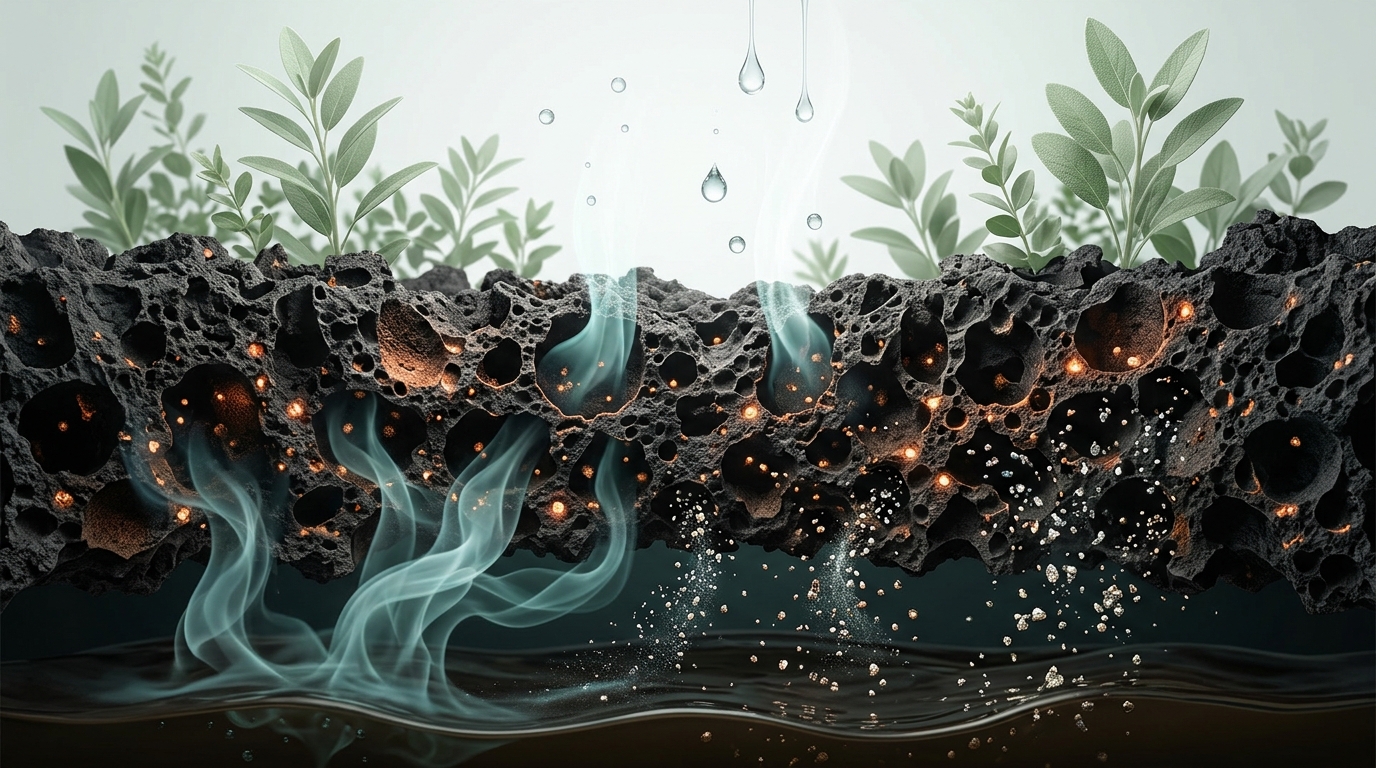
Coal washing leaves behind mountains of fine, largely useless tailings, and a new study shows that a low-temperature catalytic treatment can turn this waste into an adsorbent that simultaneously captures ammonia and immobilizes potentially toxic metals in swine manure. Writing in the journal Carbon Research, researchers in Australia report that heating coal tailings with a silver-on-titanium-dioxide catalyst at 250 °C produced a material that adsorbed 56.80 milligrams of ammonia per gram of tailings, a 16-fold enhancement over the untreated waste. The same material, after ammonia exposure, took up 33.29 milligrams of copper per gram, a threefold increase over its non-ammonia-treated counterpart. In a 14-day incubation with swine manure, adding the treated tailings at 20 percent by weight cut ammonia emissions by 64.89 percent and reduced the DTPA-extractable, bioavailable fractions of copper and zinc by 57.82 percent and 48.50 percent, respectively.
The strategy addresses two persistent problems in livestock agriculture at once. Ammonia from animal manure is both an odor nuisance and a precursor to fine particulate matter formed through reactions with sulfur dioxide and nitrogen oxides, and agricultural activities such as fertilizer application and livestock production account for roughly 90 percent of global ammonia emissions. At the same time, feed additives containing copper, zinc, iron, chromium and manganese pass largely unabsorbed through swine and end up in manure, where their persistence and bioavailability can accumulate in agricultural soils, disrupt soil microbial communities, impair plant growth and promote metal resistance genes that co-select with antibiotic resistance genes. Capturing the ammonia could also pay off twice, since the bound nitrogen can be converted into organic fertilizer during subsequent composting, contributing to a circular economy.
Coal tailings are fine particles smaller than 2 millimeters, composed mainly of fine coal together with clay aluminosilicates and quartz silicates. Their typically alkaline character makes them poor ammonia adsorbents, because ammonia preferentially reacts with acidic surface groups. The labile carbon in the tailings, however, offers a precursor for generating those acidic groups. Conventional routes to such surface modification have drawbacks: thermal pyrolysis is energy-intensive, while chemical reagent treatments raise costs and can produce toxic byproducts that pose secondary pollution risks. The research team instead pursued low-temperature oxidation, which uses atmospheric oxygen as the oxidant, but that reaction faces a kinetic barrier: the labile carbon in coal tailings exists in a singlet state while oxygen is in a doublet state, so direct oxidation is spin-forbidden and slow.
Catalysis overcomes that barrier. The researchers synthesized a 5 percent silver-on-titania catalyst by impregnating p25 titanium dioxide with silver nitrate, drying it at 80 °C and calcining it at 600 °C for 5 hours. Silver serves as the active center because it can activate molecular oxygen through direct dissociative adsorption, while titanium dioxide provides chemical stability and a large surface area for strong metal-support interactions. Silver can transfer thermally activated electrons to adsorbed oxygen molecules, populating their antibonding orbitals, weakening the oxygen-oxygen bond and promoting dissociation. The team mixed raw coal tailing powder with 1 percent of this catalyst and co-heated the mixture across a temperature gradient from 100 to 400 °C for 5 hours in a forced-air oven, comparing it against tailings oxidized without the catalyst.
Thermogravimetric analysis identified the optimal window. Heating in air showed a minor weight loss below 105 °C from moisture evaporation, followed by a weight gain up to 311 °C as oxygen incorporated into the tailings, forming reactive peroxide and hydroperoxide species that mature into stable phenolic, carbonyl and carboxyl groups. Above that temperature the labile carbon ignited and burned rapidly until roughly 730 °C. Under nitrogen, no mass gain occurred, confirming that the weight increase in air arose from oxygen-containing functional group formation rather than thermal decomposition. The differential scanning calorimetry curves showed the modification process was predominantly exothermic, with heat release from mild oxidation and ignition far exceeding the endothermic moisture-evaporation peak, meaning the process could potentially recycle its own heat within the reactor. The catalyst also reduced the energy needed for water evaporation by 38.70 percent, from 141.30 to 86.62 joules per gram, and lowered the combustion heat release by 4.36 percent.
Gas analysis reinforced the emissions advantage. Mass spectrometry showed water and carbon dioxide were the primary gases released during heating, and in the presence of the catalyst the amounts of both were significantly lower than for untreated tailings, suggesting reduced mass loss and carbon emissions during modification. The pH of water extracts served as a proxy for oxidation degree: it declined with temperature, reaching its lowest value between 250 and 300 °C, and the catalytically treated material was consistently more acidic than the non-catalyzed control at the same temperature. The minimum pH of 5.71 occurred at 250 °C for the catalyzed sample, whereas the non-catalyzed sample did not reach its lowest pH of 6.17 until 300 °C, indicating the catalyst achieves superior oxidation with less energy input. Ammonia adsorption capacity tracked the pH decline, peaking at 250 °C and falling above 300 °C as functional groups decomposed and ash formed. All samples retained over 80 percent of adsorbed ammonia during 24-hour desorption tests, indicating a low risk of re-volatilization.
Characterization revealed why the treated tailings performed so well. Nitrogen adsorption showed a slight surface-area increase and a sharp rise in micropores below 2.7 nanometers after oxidation, while mesopores in the 6.4 to 22.7 nanometer range decreased, likely through structural collapse and occupation by bulky functional groups. Carbon dioxide adsorption, which probes ultramicropores inaccessible to nitrogen, showed a substantial increase in surface area and pore volume, with the proportion of ultramicropores below 0.85 nanometers considerably higher in the oxidized materials. Ammonia, with a molecular diameter of 0.26 nanometers, fits these newly formed ultramicropores closely, producing a trapping effect that prolongs residence near active sites. Infrared and X-ray photoelectron spectroscopy showed the catalyst converted alkyl structures into oxygen-containing groups: the methyl and methylene peaks nearly disappeared while hydroxyl and carboxyl signals grew, and the carboxyl carbon fraction rose from 4.08 percent in raw tailings to 6.53 percent after non-catalyzed oxidation and 7.65 percent after catalytic oxidation.
The ammonia adsorption itself proved to be chemistry, not just physical trapping. After ammonia exposure, the carboxyl peak in the infrared spectra decreased while a carboxylate vibration near 1430 per centimeter increased, indicating acid-base neutralization in which carboxyl groups donated protons to ammonia, forming ammonium ions. A new carbonyl stretching band between 1516 and 1670 per centimeter pointed to amide formation through chemical adsorption and dehydration, and the pyridinic and amide nitrogen fraction in the X-ray spectra jumped from 5.54 to 17.3 percent. Copper uptake, which had actually declined after oxidation alone, from 18.45 milligrams per gram in raw tailings to 13.18 and 9.51 milligrams per gram in the oxidized and catalytically oxidized samples, reversed dramatically after ammonia treatment, reaching 27.69 and 33.29 milligrams per gram respectively. The researchers attribute this to several cooperating effects: neutralization of the crowded negatively charged carboxylate surface, charge bridging by ammonium ions, formation of stable copper-ammine complexes, and persistent coordination of copper by the lone-pair electrons of newly formed surface amide groups, whose spectral contribution fell from 17.3 to 8.78 percent after copper binding.
Density functional theory calculations and temperature-programmed experiments explained the catalytic interface. The calculations showed the titanium d-band center shifting downward upon silver loading and a spontaneous electron transfer of about 0.77 electrons from silver to the titanium dioxide substrate, creating an electron-rich interface that favors oxygen adsorption and activation. Hydrogen temperature-programmed reduction showed reduction peaks shifting to lower temperatures with silver, including a distinct peak at 228 °C attributed to oxidized silver species, evidence for reactive surface oxygen. Oxygen desorption peaks likewise shifted downward, with new superoxide and atomic oxygen peaks at 180 °C and 387 °C. The proposed sequence is that molecular oxygen adsorbs onto silver nanoparticles, converts into reactive oxygen species, and these attack aliphatic hydrocarbons on the tailing surface, oxidizing them to carboxyl groups that then capture ammonia.
In the manure incubation, untreated manure emitted 110.08 milligrams of ammonia over 14 days, while raw tailings performed no better, but the oxidized and catalytically oxidized materials cut emissions by 57.45 and 64.89 percent, with the chemical adsorption converting gaseous nitrogen back into quaternary, amine and amide structures that could enable slow nutrient release during composting. All tailing materials reduced copper and zinc bioavailability, with the catalytically oxidized material showing the greatest reductions, attributed to precipitation by native minerals, complexation by the enriched oxygen-containing groups, and the newly identified ammonia-mediated amide pathway. The authors also note an economic case: commercial activated carbon production at 800 to 1000 °C costs 500 to 2000 dollars per ton, whereas their 250 °C process is estimated to save 425 to 1700 dollars per ton compared with commercial activated carbon. Ongoing work is exploring catalysts made from earth-abundant elements and spray-coating techniques to immobilize the catalyst within reactors, preventing catalyst depletion and minimizing any introduction of silver into downstream manure treatment systems.
Subject of Research: Catalytic low-temperature oxidation of coal tailings to create an adsorbent that captures ammonia and stabilizes potentially toxic metals in swine manure.
Article Title: Interface-activated coal tailings for coupled ammonia adsorption and potentially toxic metal complexation via Ag/TiO2 catalysis
Article References: Hu, J., Han, B., Butterly, C., He, J.-Z., & Chen, D. (2026). Interface-activated coal tailings for coupled ammonia adsorption and potentially toxic metal complexation via Ag/TiO2 catalysis. Carbon Research, 5(1), Article 42. https://doi.org/10.1007/s44246-026-00276-2
Image Credits: AI Generated
DOI: 10.1007/s44246-026-00276-2
Keywords: coal tailings, ammonia adsorption, Ag/TiO2 catalysis, swine manure, copper immobilization, zinc bioavailability, oxygen-containing functional groups, ultramicropores, circular agriculture, low-temperature oxidation, nutrient recovery, potentially toxic elements
News Source: Bethany Barker. (November 3, 2026). Catalytically Oxidized Coal Waste Captures Ammonia and Locks Up Toxic Metals in Swine Manure. Scienmag.