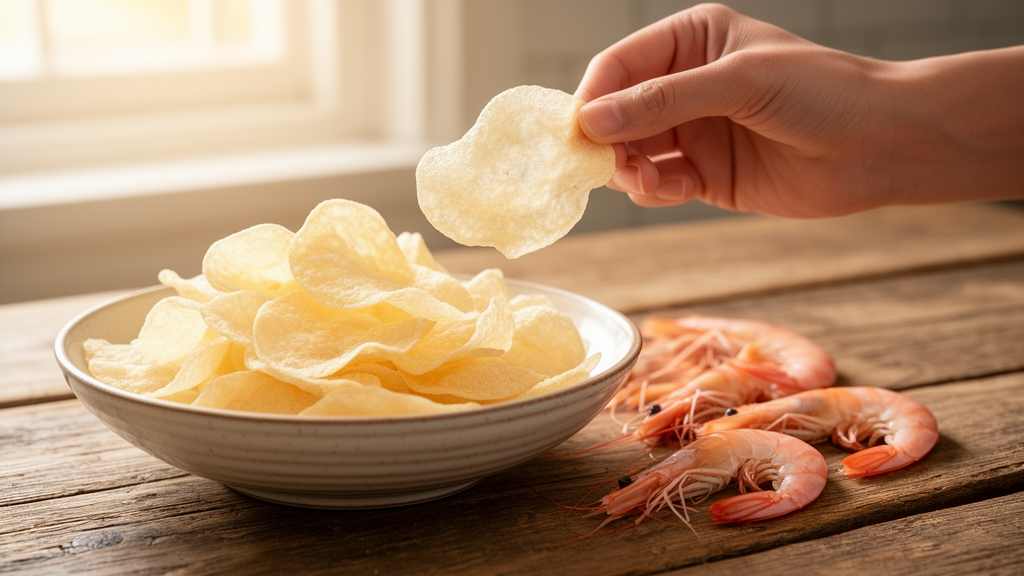
Prawns rejected during commercial grading for size or appearance are usually treated as waste, yet they carry real nutritional value. A new open-access study in Discover Food set out to turn those discards into a ready-to-eat snack, testing how formulation and drying technology shape the final prawn chip. The research team, led by Palmira Javier-Pisco and colleagues including Isabel Escriche R., Purificación Garcia-Segovia and María Jesus Pagan M., published the peer-reviewed work on 15 October 2026.
The experiment was built around two variables. The first was formulation: a control chip containing 99% discarded prawn meat, and three recipes in which prawn meat made up 56% of the mix, one bound with rice flour, one with potato starch, and one combining rice flour with mashed potato. The second variable was the drying method. Every formulation was processed two ways, once with conventional drying, abbreviated CD, and once with freeze-drying, abbreviated FD. That design allowed the researchers to separate the influence of the recipe from the influence of the drying technology on the same prawn base.
Each batch was then measured on multiple fronts: physicochemical properties, colour, texture, volatile compounds and consumer sensory responses. The sensory work used a technique called JAR analysis, short for just-about-right, in which consumers rate whether an attribute is too weak, just right or too strong, followed by penalty analysis that links any deviation from ideal to a drop in overall liking.
Colour turned out to be one of the clearest dividing lines between the two drying routes. Conventionally dried chips showed higher mean values for the redness coordinate a* at 16.6, the yellowness coordinate b* at 26.2, and the chroma value C* at 31.1, indicating deeper, more saturated colour. Freeze-dried chips, by contrast, were markedly lighter, with a mean lightness value L* of 84.5. The conventional method also produced greater differentiation among the four formulations in both colour and mechanical resistance, meaning the recipe mattered more visibly when heat was involved in drying.
Texture followed the same split. Freeze-drying produced chips that were more brittle and had lower moisture content, a profile typical of crisp, airy snack structures.
The volatile analysis reinforced that contrast. Conventionally dried samples showed a greater abundance and diversity of volatile compounds, particularly aldehydes such as hexanal at 66.8 mg/kg and nonanal at 47.0 mg/kg, along with pyrazines reaching up to 11 mg/kg.
Sensory results did not follow the drying method alone. In the JAR analysis, the proportion of consumers rating an attribute as just right ranged from 9% to 62% depending on the attribute, the formulation and the drying method combined. This spread shows that neither drying technology was universally superior; the ideal choice depended on which recipe it was paired with and which eating quality was being judged.
Penalty analysis, which quantifies how much each off-target attribute hurts overall liking, delivered the study’s clearest verdict. The RFPM formulation, the one combining rice flour with mashed potato, dried by freeze-drying, recorded the lowest penalty for overall liking among all eight formulation-and-method combinations evaluated.
The authors conclude that the drying method significantly influences the physicochemical and volatile properties of prawn chips, while sensory responses depend on the combination of drying method with formulation type. Among the options tested, RFPM-FD emerged as the best-performing choice. Because the study evaluated a fixed set of four formulations and two drying methods, the findings apply to those specific combinations rather than to prawn chip production in general, and the article is currently shared as an accepted manuscript subject to further edits before the final version of record.
Subject of Research: Effects of formulation and drying method on the physicochemical, volatile and sensory properties of snack chips made from discarded prawns
Article Title: Influence of drying methods on the physicochemical, volatile profile, and sensory characteristics of chip formulations prepared from discarded prawns
Article References: Javier-Pisco, P., Escriche R., I., Garcia-Segovia, P., & Pagan M., M. J. (2026). Influence of drying methods on the physicochemical, volatile profile, and sensory characteristics of chip formulations prepared from discarded prawns. Discover Food. https://doi.org/10.1007/s44187-026-01282-4
Image Credits: AI Generated
DOI: 10.1007/s44187-026-01282-4
Keywords: discarded prawns, prawn chips, freeze-drying, conventional drying, volatile compounds, JAR analysis, penalty analysis, food valorisation, ready-to-eat snacks, rice flour, potato starch, sensory evaluation
News Source: Alan Morgan. (October 30, 2026). Freeze-Dried Chips Made from Discarded Prawns Win the Taste Test. Scienmag.