


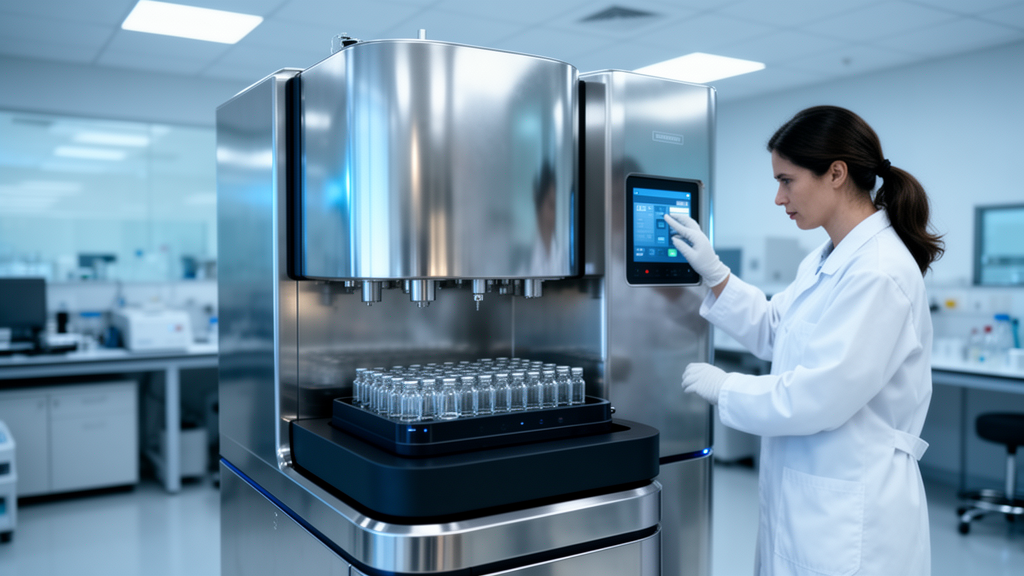
Liquid chromatography–tandem mass spectrometry, or LC–MS/MS, has quietly become one of the most consequential instruments in pharmaceutical science, and a new review published in Future Journal of Pharmaceutical Sciences maps just how far its reach now extends. Written by Sunita Sunil Gagare, Vaishnavi Bhau Thorat and Ashish Suresh Jain, the review traces the technique through nearly every stage of drug development, from the first quantification of a candidate molecule in plasma to the detection of carcinogenic impurities in finished tablets. The authors describe LC–MS/MS as a combination of liquid chromatography and mass spectrometry in which high-performance liquid chromatography separates analytes, an ion source charges them, and mass filters sort the resulting ions by mass-to-charge ratio, with signal strength revealing concentration. That chain of steps, they argue, delivers sensitivity, specificity and multi-analyte capability that surpass traditional high-performance liquid chromatography and immunoassays, while offering better throughput than gas chromatography–mass spectrometry and accommodating higher molecular weight or highly polar molecules that GC–MS struggles to handle.
The core advantage lies in how the technique identifies and measures compounds simultaneously. In a typical run, liquid chromatography separates the components of a sample over time based on physical and chemical properties such as hydrophobicity, molecular size and functional groups. The effluent then enters the mass spectrometer’s ion source, where the analyte is ionized and passes through a first mass filter, a collision cell and a second mass filter. Because the analyte concentration correlates with the mass spectrometer’s signal strength, and because retention times and mass-to-charge ratios together pinpoint specific components, a single injection can both identify and quantify dozens of substances. The review notes that new LC–MS/MS procedures run faster than HPLC and that analyte preparation is frequently easier, with assays often developed in-house to give laboratories greater flexibility than commercial immunoassay kits allow.
In bioanalysis, the discipline that underpins pharmacokinetic and pharmacodynamic studies and toxicological evaluation, LC–MS/MS has replaced HPLC–UV as the most widely used instrument in clinical institutions in developed countries. The review catalogs a striking range of drug classes measured in blood, plasma, serum, urine and other matrices. Deborah Montenarh quantified antidepressants including bupropion, amoxapine and amitriptyline in serum, plasma and whole blood using an AB SCIEX 3200 QTRAP linear ion-trap quadrupole instrument in multiple reaction monitoring mode with positive electrospray ionization. Stephanie J. Marin developed methods for benzodiazepines such as oxazepam and temazepam in urine, serum, plasma and meconium, while Mitsuhiro Nakamura identified diazepam, flurazepam and bromazepam with solid-phase extraction and a triple quadrupole mass spectrometer. Madeleine Pettersson Bergstrand extended the approach to eleven designer benzodiazepines in urine using selected reaction monitoring transitions.
Antipsychotics present a particular challenge because multi-analyte procedures like HPLC–UV and GC-NPD cannot detect low-dose compounds with the necessary sensitivity and selectivity. LC–MS/MS sidesteps this by eliminating pretreatment steps such as hydrolysis and derivatization for compounds with polar sites in biological matrices. Aneta Wojnicz detected aripiprazole with a triple quadrupole instrument, positive-ion electrospray ionization and a three-step microelution solid-phase extraction that excludes phospholipids. Ryh-Nan Pan built an effective test for quetiapine in human plasma, Dinesh Patel measured olanzapine, Jian-Jun Zou devised an accurate approach for perospirone, Manickam Aravagiri quantified ziprasidone, Ya Moon detected tiaprides through hydrophilic interaction liquid chromatography, and M.H. Gschwend determined amisulpride with excellent sensitivity and specificity. Similar methodological detail runs through the review’s treatment of antifungals, where Jennifer Cunliffe rapidly detected posaconazole in human plasma with mixed-mode cation-exchange extraction, and antihypertensives, where Liliya Logoyda quantified bisoprolol, amlodipine and enalapril maleate using protein precipitation and positive electrospray ionization.
Therapeutic drug monitoring, the practice of measuring drug levels in patients to optimize dosage, benefits enormously from this capability. The review explains that TDM traces back to the late 1960s, when Lewis Sheiner of the University of California, San Francisco, pioneered pharmacometrics to enhance patient care. Plasma drug concentration monitoring helps adjust dosage especially for drugs with narrow therapeutic ranges such as aminoglycoside antibiotics, lithium and cyclosporine, where the difference between an effective dose and a toxic one is small. LC–MS/MS allows simultaneous measurement of drugs and metabolites in one sample, improving patient care and laboratory data while enabling faster method development with reduced analyte volume. Carlo Artusi applied it to the immunosuppressants sirolimus and everolimus in whole blood after protein precipitation. N.A.G. Lankheeta analyzed anticancer tyrosine kinase inhibitors in plasma on a TSQ Quantum Ultra triple quadrupole system. Sun Joo Yoon simultaneously evaluated the antifungals voriconazole, itraconazole and posaconazole, Manel Aouri measured the anti-HIV drugs elvitegravir and rilpivirine, Dora Koller quantified clozapine, olanzapine and aripiprazole in human plasma, and Mirjana Radovanovic measured ten antibiotics in the plasma of critically ill patients.
Beyond drug measurement, the review highlights LC–MS/MS as a central tool in metabolomics, the systematic study of small molecules in biological samples. Steven Oliver first used the word metabolomics in a 1998 review paper on yeast functional genomics, and the field now aims to identify and measure metabolites under 1500 daltons using both targeted and untargeted approaches. Targeted analysis concentrates on a specific class of chemicals linked to a particular metabolic pathway, while untargeted research evaluates overall metabolic alterations brought on by illness, genetic mutations and environmental stressors. Selected reaction monitoring on triple quadrupole instruments quantifies metabolites accurately by establishing calibration curves with stable isotope-labeled analogs, and has been applied to screen for infant diseases related to carbohydrate, fatty acid and amino acid metabolism. The review notes that newer triple quadrupole instruments enable reliable quantification of numerous metabolites with short dwell durations without sacrificing sensitivity, and that hybrid QTRAP instruments solve the qualitative limitations of pure SRM by allowing complete product ion scans.
The same platform quantifies drug metabolites with equal precision. Ajay Gupta developed a rapid LC–MS/MS approach for oseltamivir carboxylate, the active metabolite of the influenza prodrug oseltamivir, using solid-phase extraction and an API-4000 triple quadrupole in positive electrospray mode. Xin Xiong measured itraconazole and its CYP3A4 metabolite hydroxyitraconazole with liquid–liquid extraction and atmospheric pressure chemical ionization. Valquiria A.P. Jabor detected 1-hydroxy midazolam, the active metabolite formed when CYP3A4 hydroxylates midazolam, and Mark-Jean Gnoth assessed M-1, the active metabolite of the pulmonary hypertension drug riociguat. Nirav P. Patel quantified doxepin and its active form nordoxepin, produced by the cytochrome P450 enzyme 2C19, while Luana Mifsud Buhagiar measured amitriptyline, nortriptyline and their hydroxy metabolites in human serum. The review notes that approximately 80 percent of clinical drug metabolism is carried out by members of the CYP1, 2 and 3 families out of 57 functioning human cytochromes, underscoring why tracking these transformations matters for safety, activity, bioavailability and resistance.
Perhaps the most safety-critical application involves genotoxic impurities, residues of DNA-reactive electrophilic reagents or intermediates that can arise during drug manufacturing, synthesis or storage. Standard analytical tools such as HPLC with ultraviolet detection frequently fall short of offering trustworthy assessment at small parts-per-million levels, with the low sensitivity of the UV detector being the primary disadvantage at the 10 ppm level. Tian Guo identified twelve genotoxic sulfonate esters by LC–MS/MS after comparing atmospheric pressure chemical ionization and electrospray ionization, using the selected reaction monitoring mode of a TSQ Quantum Ultra AM triple quadrupole to increase detection limits. Bo Jin simultaneously measured sulfonate esters in amlodipine besylate, tosufloxacin tosylate and phentolamine mesylate on a Sciex QTRAP 5500. On the nitrosamine front, Shu-Han Chang created a sensitive method to identify twelve nitrosamines in sartan blood pressure medicines including NDMA and NDEA, which the International Agency for Research on Cancer considers among the most carcinogenic of the class, while Zhen Wang examined the nitrosamine NTTP in sitagliptin phosphate monohydrate with a 6470 TripleQuad in positive electrospray mode.
In proteomics, the large-scale study of proteins in complex biological samples, LC–MS/MS addresses problems that have long plagued antibody-based methods. Immunoassays can suffer from the high-dose hook effect, autoantibodies and inconsistent results that lead to false conclusions, and each antibody-based experiment often finds only one or a small number of proteins. Tandem mass spectrometry eliminates endogenous immunoglobulin interference and the hook effect by breaking down interfering immunoglobulins with trypsin, and it finds peptides that are part of the protein itself rather than just epitopes. The review describes bottom-up approaches in which proteins are broken into peptides, targeted techniques such as parallel reaction monitoring and selected reaction monitoring that preselect surrogate peptides, and non-targeted strategies including data-dependent and data-independent acquisition. Thousands of proteins can be precisely measured through these methods, and stable isotope-labeled tryptic peptide-based SRM assays have proven useful for measuring proteins in human serum.
The review closes by situating LC–MS/MS across the full development lifecycle, from discovery-stage proteomic and metabolomic studies through preclinical bioanalysis, clinical therapeutic drug monitoring, and regulatory quality assessment through genotoxic impurity quantification and stability-indicating methods. Forced degradation studies on drugs such as darunavir, zuclopenthixol, repaglinide, selexipag, letermovir, bilastine and montelukast sodium used LC–MS/MS to identify and characterize degradation products under hydrolysis, oxidation, thermal and photolytic stress. Yet the authors are candid about limitations: matrix effects can cause ion suppression or enhancement, carryover between injections may affect subsequent analyses, analyte instability during storage can compromise measurements, and the technique demands stringent validation, specialized expertise and high instrument costs. A lack of standardization across laboratories, where variations in extraction procedures, internal standards and chromatographic conditions lead to inconsistent outcomes, remains a significant hurdle. Ongoing developments focus on improving workflow automation, reducing manual intervention and harmonizing protocols, with the authors predicting that enhanced sensitivity, automation, miniaturization and AI-driven data analysis will further entrench the technique as an integral tool in pharmaceutical and biomedical research.
Subject of Research: Applications of liquid chromatography–tandem mass spectrometry across drug development stages
Article Title: Recent applications of liquid chromatography tandem mass spectrometry at various stages of drug development
Article References: Gagare, S. S., Thorat, V. B., & Jain, A. S. (2026). Recent applications of liquid chromatography tandem mass spectrometry at various stages of drug development. Future Journal of Pharmaceutical Sciences, 12(1), Article 78. https://doi.org/10.1186/s43094-026-01011-9
Image Credits: AI Generated
DOI: 10.1186/s43094-026-01011-9
Keywords: LC–MS/MS, drug development, pharmaceutical analysis, therapeutic drug monitoring, genotoxic impurities, metabolomics, proteomics, bioanalysis, mass spectrometry, stability-indicating methods, nitrosamines, pharmacokinetics
News Source: Ophelia Keating. (October 30, 2026). LC–MS/MS emerges as the workhorse of modern drug development. Scienmag.



