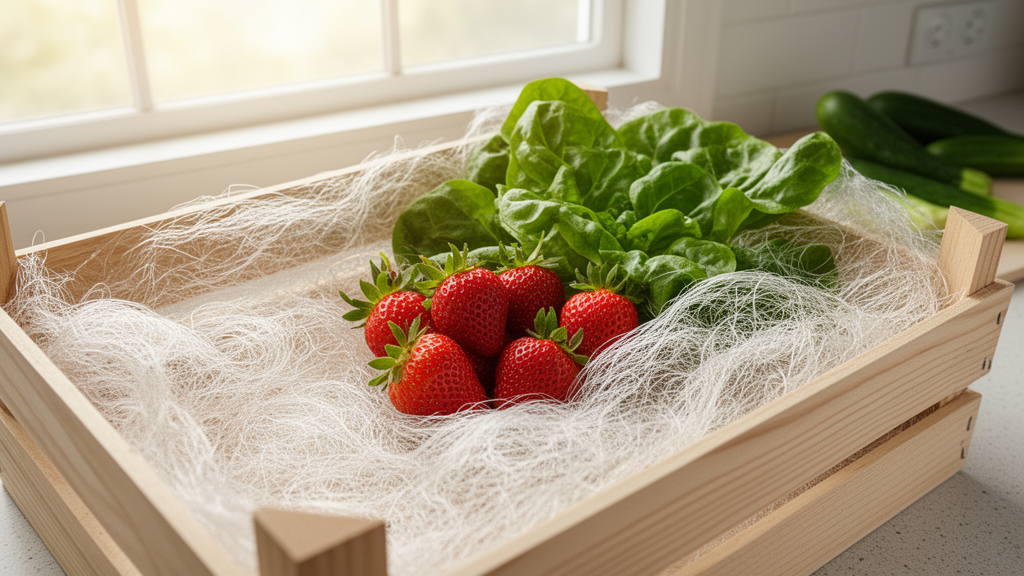
Fruits and vegetables are among the most perishable foods on the planet, and the numbers behind their loss are staggering. According to the Food and Agriculture Organization of the United Nations, roughly 1.3 billion tons of food are wasted every year, and fruits and vegetables account for 40 to 50 percent of that waste. Sub-Saharan Africa alone loses more than 4 billion dollars’ worth of food after harvest annually, while a survey at a large Italian fresh-cut company found that at least 35 percent of lettuce head weight ends up discarded.
The review, written by Wenyan Huang, Kexin Zhang, Haiying Ou, Tianyu Li, Ming Xin, Ruojun Man, Changbao Li and colleagues, synthesizes the preparation methods, functional effects and current applications of nanofiber active packaging films. These nanofiber mats can extend shelf life, maintain quality, and, because they are built from biodegradable polymers, align with sustainable development principles. The authors note that a keyword analysis of 1,479 papers on fruit and vegetable preservation published between 2015 and 2025 revealed frequent, interlinked terms such as antibacterial and antioxidant, exactly the characteristics that nanofiber packaging combines.
At the heart of the technology is electrospinning, the most widely used fabrication method. A high-voltage electric field, typically between 10 and 30 kilovolts, draws a polymer solution from a syringe into a Taylor cone, stretching and solidifying the droplet into continuous fibers that wind onto a collector as a membrane. Solution concentrations generally fall between 5 and 30 percent depending on the polymer. Electrospinning offers controllable porosity, the ability to load multiple functional components and good mechanical properties, though it demands sophisticated equipment. Examples cited in the review include a polyacrylonitrile-citral composite membrane that formed a slow-release antibacterial interface through acetalization grafting, and a polylactic acid film embedded with oregano essential oil and beta-cyclodextrin inclusion complexes that extended the shelf life of post-harvest blueberries. In another study, a smart packaging based on polylactic acid, chitosan and anthocyanin changed color at different pH levels, and films containing 6 percent anthocyanin showed optimal preservation performance for blueberries.
Electrospinning is not the only route to nanofibers. Microfluidic blow spinning pulls a polymer solution out of a tiny nozzle with a high-speed gas flow, with gas flow rates of roughly 5 to 50 liters per minute and nozzle diameters of 0.4 to 1.2 millimeters. Handheld versions of this technique are portable enough to work in the field; one research group sprayed a nanofiber cling film directly onto the surface of mangoes, where it stabilized the activity of catalase and ascorbate peroxidase and adhered well because of its low tensile strength. A polycaprolactone and ethyl cellulose film carrying two natural antibacterial agents, natamycin and trans-cinnamic acid, significantly improved strawberry quality during storage compared with controls. Solution casting, a simpler and cheaper method in which a film-forming solution is poured onto a flat substrate and left to dry, trades mechanical strength for flexibility in adjusting thickness and composition.
What makes these films active rather than passive is their functionalization, and the review catalogs an impressive range of capabilities. Biodegradability is a headline feature: researchers extracted nano-lignocellulose from peanut shells using a deep eutectic solvent and combined it with chitosan to make cling film that reduced the spoilage rate of cherry tomatoes and blueberries by 28.57 and 33.33 percent respectively after 21 days of storage compared with uncoated samples. Agricultural waste streams are being converted into packaging raw materials across the board, from grape residue phenolics to red onion peel cellulose nanocrystals to carbon dots made by hydrothermal carbonation of discarded pumpkin waste. In one striking demonstration, a commercial polyethylene film remained largely intact after 10 days of soil burial while a cellulose nanocrystal composite film degraded by 78.13 percent, a vivid illustration of the environmental gap the technology aims to close.
Antibacterial function is perhaps the most intensively researched capability. Essential oils disrupt microbial cell structures and interfere with metabolism; phenolic compounds such as eugenol alter cell membrane permeability and eliminate mature biofilms of Staphylococcus aureus; nano-silver releases silver ions that bind to negatively charged cell membranes and block DNA replication while generating reactive oxygen species; and antimicrobial peptides increase membrane permeability. When 3.0 percent silver nanoparticles were added to a film, the largest inhibition zone diameters were produced against both test bacteria. Films encapsulating pepper essential oil in polyvinyl alcohol and beta-cyclodextrin nanofibers kept strawberries and cherries fresh for 10 days while comparable untreated products became severely moldy. Antioxidant function works in parallel, with phenolic hydroxyl groups scavenging free radicals and tannic acid exploiting its polyhydroxy aromatic structure, both measured through standard DPPH and ABTS assays.
Gas regulation adds another layer of sophistication. Fresh produce continues to respire after harvest, consuming oxygen and releasing carbon dioxide, while naturally produced ethylene accelerates ripening and shortens shelf life. Nanofiber films can be engineered to manage this microclimate. Metal-organic frameworks act as gas switches, with smaller pore sizes producing stronger molecular sieving effects; one framework with a pore diameter of 0.694 nanometers allowed carbon dioxide to permeate roughly 8.65 times faster than oxygen. A package using nano iron powder and sodium polyacrylate held oxygen and carbon dioxide concentrations stable at 16.8 and 5 percent respectively for 25 days. Films reinforced with jute fiber grafted silica nanoparticles reduced oxygen permeability by about 95 percent while increasing carbon dioxide permeability by roughly 161 percent, precisely the asymmetry needed to keep produce breathing comfortably.
Controlled release rounds out the functional toolkit, ensuring that active ingredients are delivered steadily rather than in a single burst. Thermosensitive membranes built around poly(N-isopropylacrylamide) accelerate the release of lemon essential oil when temperatures exceed 32 degrees Celsius, prolonging antibacterial and antioxidant effects. Temperature-sensitive liposomes tested on peaches released trans-2-hexenal on demand between 10 and 40 degrees Celsius. Humidity-responsive systems exploit the swelling of polyvinyl alcohol or ethylene-vinyl alcohol copolymer shells to trigger citral release as moisture rises. Barrier properties complete the picture: double-coated paper packaging with nanofiber layers and kaolin pigment achieved water vapor transmission rates only around 30 percent of single-coated systems, and cellulose nanocrystals, carbon dots and sulfur quantum dots are emerging as green barrier materials that enhance protection without environmental cost.
The review is candid about the obstacles standing between laboratory promise and supermarket shelves. Uniformity of nanofiber films is difficult to guarantee at scale, requiring optimized process parameters and real-time monitoring of pore size and thickness. Stability is another concern: polyvinyl alcohol hydrolyzes under high humidity, anthocyanin indicators degrade under light and temperature fluctuations, and epigallocatechin gallate oxidizes in high-oxygen environments, though nano-encapsulation within cyclodextrins slowed its release from 90 percent by day three in a blank film to only 50 percent by day eleven in the experimental group. Energy consumption is higher than for traditional packaging, consumer acceptance remains low because of limited public knowledge about nanotechnology in food, and compatibility with cold chain transport and modified atmosphere storage is underexplored. Safety looms largest: nano-silver at concentrations of 20 micrograms per milliliter and above induced significant oxidative stress in human intestinal epithelial Caco-2 cells, and nano-titanium dioxide at doses as low as 2 milligrams per kilogram per day caused oxidative stress, inflammation and apoptosis in the livers of mice and rats. Nanomaterials may migrate into food under high temperature, acidity, alkalinity or high fat conditions, and standardized international regulations are lacking, although the European Union already requires explicit authorization and a specific migration limit of 0.01 milligrams per kilogram of food for nanoform substances.
The authors close with a roadmap that reads like a blueprint for the field’s next decade: standardized release kinetics reporting with rate constants and correlation coefficients above 0.92, a three-tier safety database for migration into fruit and vegetable matrices modeled on the Joint FAO and World Health Organization Expert Committee on Food Additives framework, multifunctional integration combining antibacterial, gas-regulation and smart detection properties, green processes that turn bagasse and other agricultural by-products into low-cost raw materials, digital management through Internet of Things sensors monitoring ethylene concentration, humidity and temperature in real time, and pilot-scale demonstration with life cycle assessments targeting a carbon footprint below 2 kilograms of carbon dioxide per kilogram and a return on investment above 15 percent. If even a fraction of that agenda materializes, the thin, active, biodegradable mats now being spun in laboratories around the world could help ensure that far less of the global harvest rots before it reaches a plate.
Subject of Research: Nanofiber active packaging for fruit and vegetable preservation
Article Title: Research progress of nanofiber active packaging in fruit and vegetable preservation: a review
Article References: Huang, W., Zhang, K., Ou, H., Li, T., Xin, M., Man, R., & Li, C. (2026). Research progress of nanofiber active packaging in fruit and vegetable preservation: a review. Agricultural Products Processing and Storage, 2(1), Article 30. https://doi.org/10.1007/s44462-026-00064-6
Image Credits: AI Generated
DOI: 10.1007/s44462-026-00064-6
Keywords: nanofiber packaging, fruit and vegetable preservation, electrospinning, food waste, antibacterial packaging, controlled release, ethylene removal, biodegradable materials, gas regulation, food safety, nanomaterials, postharvest technology
News Source: Alan Morgan. (October 30, 2026). Nanofiber Packaging Emerges as a Fresh Answer to Fruit and Vegetable Waste. Scienmag.