


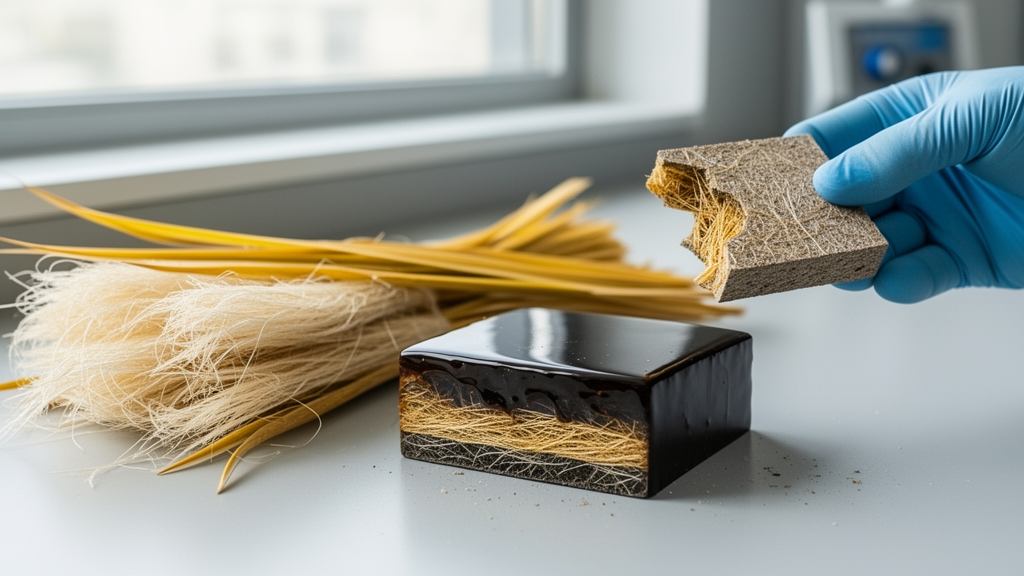
Researchers in India report that a hybrid epoxy composite reinforced with surface-treated Grewia optiva, known locally as Bhimal, fibers and pineapple leaf fiber, with marble dust as a filler, shows substantially improved thermomechanical performance. The study, published as open access research in Discover Materials on 21 October 2026, aimed to systematically characterize the thermomechanical properties and interfacial bonding of the surface-modified composites to evaluate their potential as a sustainable structural material. The work is being shared early as a peer-reviewed, accepted article carrying a permanent DOI, with a final version of record to follow.
The Bhimal fibers were sourced from the Dehradun region of Uttarakhand, India, and served as the primary reinforcement, while pineapple leaf fiber, or PALF, was introduced as a secondary natural-fiber reinforcement in an epoxy resin matrix. Marble dust was added as a filler to improve mechanical and physical properties. To strengthen the bond between the fibers and the matrix, the team applied alkaline treatment with sodium hydroxide, followed by benzoyl peroxide initiation, a surface-modification route intended to improve fiber-matrix interfacial adhesion.
Dynamic Mechanical Analysis showed a storage modulus of up to 16.14 gigapascals, alongside a reduction in the damping factor, tan δ, and improved glass-transition-related parameters, suggesting improved interfacial stress transmission and increased crosslink density. Thermogravimetric analysis indicated thermal stability up to 290 degrees Celsius. Scanning electron microscopy images of fractured surfaces showed that the fiber and matrix were well bonded, and Fourier transform infrared spectroscopy confirmed the chemical modification induced by the surface treatments.
Among the mechanical results, the impact strength of the Bhimal fiber-based composite material was improved by 305 percent. Taken together, the authors state that the findings help determine the value of Grewia optiva fiber-based composites and increase understanding of interfacial behavior in Bhimal-based structural composites, with relevance to circular economy applications in which agricultural and mineral by-products are diverted into material use.
Because the article is an early-shared accepted version subject to further edits, detailed comparisons with untreated counterparts, statistical treatment, and full methodological context will be clearer in the final version of record. The reported figures describe the specific treated hybrid composite system tested in this study and should not be generalized to other fiber-matrix combinations without direct evidence.
Subject of Research: Surface-modified natural-fiber and marble dust reinforced epoxy composites for sustainable structural applications
Article Title: Interfacial engineering and thermomechanical enhancement of bio-based grewia optiva fiber/PALF/marble dust reinforced-reinforced epoxy composites for circular economy applications
Article References: Tomar, P., Gori, Y., Kumar, A., & Yadav, A. K. (2026). Interfacial engineering and thermomechanical enhancement of bio-based grewia optiva fiber/PALF/marble dust reinforced-reinforced epoxy composites for circular economy applications. Discover Materials. https://doi.org/10.1007/s43939-026-01016-4
Image Credits: AI Generated
DOI: 10.1007/s43939-026-01016-4
Keywords: Grewia optiva, Bhimal fiber, PALF, epoxy composites, marble dust, interfacial adhesion, dynamic mechanical analysis, thermal stability, impact strength, circular economy, surface treatment, sustainable materials
News Source: Denise Maddox. (October 30, 2026). Treated Bhimal and Pineapple Leaf Fibers Boost Epoxy Composite Strength. Scienmag.



