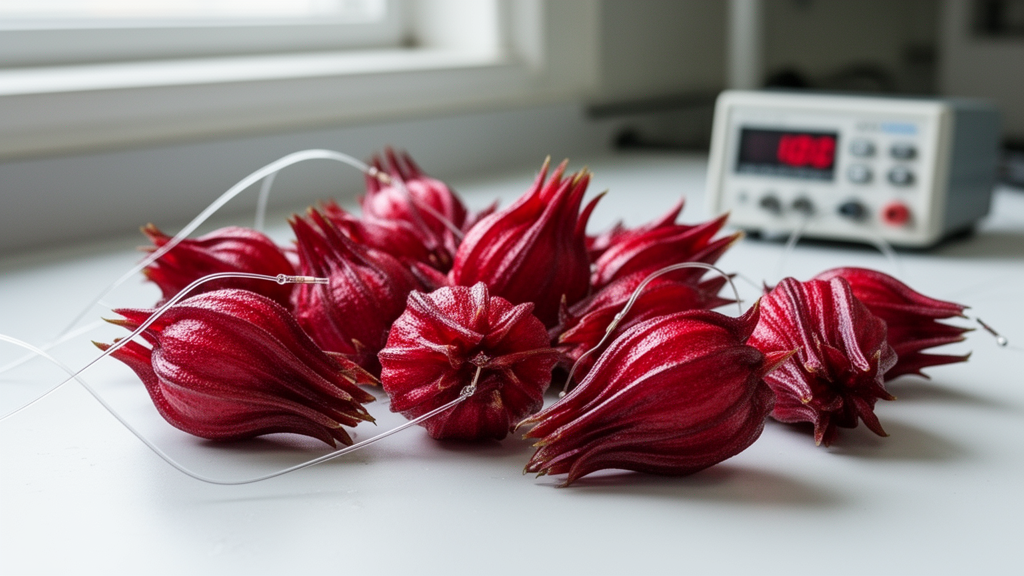
A short burst of electricity may be all it takes to keep one of the tropics’ most prized edible flowers from wilting into disappointment. Hibiscus sabdariffa, the deep-crimson roselle flower prized for teas, jams and nutraceuticals, deteriorates within days of harvest because its water-rich petals race through respiration, lose pigments and collapse under their own metabolic demands. Now researchers report that treating freshly harvested flowers with pulsed electric field (PEF) technology before storage can slow that decline, preserving weight, colour, sugars and antioxidant compounds for at least eight days at ambient temperature.
The research team, based in Indonesia where roselle grows widely, harvested flowers of the Roselindo 1 cultivar from a farm in Pekalongan, Central Java, during September. They selected buds with dark red calyces, firm texture and uniform size of roughly 3.5 to 4 grams, indicators of peak anthocyanin and citric acid content. The flowers were then exposed to short-duration electrical pulses from a PEF device operating at a maximum output voltage of 16 kilovolts, a frequency of 2.9 to 5.5 kilohertz and a pulse width of 90 to 110 microseconds. Treatment lasted two minutes inside a batch chamber with stainless steel electrodes spaced four centimetres apart. Five intensity levels were tested: an untreated control, and four treatments at 1, 2, 3 and 4 kilovolts per centimetre, corresponding to specific energy inputs of 3.3, 6, 9 and 11.6 kilojoules per kilogram respectively.
After treatment, the flowers were packed in low-density polyethylene bags and stored at 25 degrees Celsius with 80 percent relative humidity for eight days, with measurements taken every two days. The researchers evaluated a broad suite of quality markers, from microscopic tissue structure and water retention to soluble sugars, hydrogen peroxide, malondialdehyde, anthocyanins, total phenolics and the activities of two key enzymes, superoxide dismutase and polyphenol oxidase. Each parameter was measured in triplicate with three biological replicates, and differences were assessed using two-way ANOVA followed by Duncan’s multiple range test.
Scanning electron microscopy revealed what the electric pulses actually did to petal tissue. Control flowers retained a smooth cell surface, dense cell arrangement and organised epidermal layers throughout. PEF-treated samples, by contrast, showed micro-gaps within cell walls and loosening of epidermal cells, changes that grew more pronounced with increasing field strength. At 1 and 2 kilovolts per centimetre, morphological alterations remained relatively slight, preserving tissue integrity. At 3 and 4 kilovolts per centimetre, the cell surface became rougher, tissue arrangement turned irregular and cell wall damage became clearly visible. These observations align with the principle of electroporation, in which externally applied electric fields cause charge to accumulate across cell membranes until transient or permanent pores form, increasing permeability without necessarily destroying the cell.
That controlled permeabilisation translated into measurable physical benefits. Flowers treated at 2 kilovolts per centimetre maintained a relative fresh weight 32.33 percent higher than untreated controls by the end of storage. The untreated group lost weight down to a relative fresh weight of just 9.37 percent, while samples treated at 1, 2, 3 and 4 kilovolts per centimetre retained 12.08, 12.40, 11.9 and 10.77 percent respectively. The mechanism appears linked to PEF’s ability to slow respiration and reduce water loss through partially permeabilised but still intact membranes. Colour stability followed a similar pattern. Over eight days, untreated flowers showed the greatest colour change, with a ΔE value of 3.03, while PEF-treated samples recorded lower values of 2.03, 1.69, 2.31 and 2.56 at the four intensity levels. The 2-kilovolt treatment produced a ΔE 44.22 percent lower than the control, suggesting that mild electroporation preserves pigment visibility by modifying light scattering within the tissue rather than by preventing pigment degradation outright.
Metabolic indicators reinforced the physical findings. Total soluble solids, a proxy for sugar content and overall metabolic state, declined in all groups but fell most steeply in controls, which dropped to 2.67 degrees Brix by day eight. PEF-treated flowers at 1, 2, 3 and 4 kilovolts per centimetre retained 3.03, 3.17, 3.10 and 3.00 degrees Brix respectively, a significant difference of roughly 0.5 degrees Brix compared with untreated samples. Hydrogen peroxide, a reactive oxygen species that accumulates during storage and signals oxidative stress, rose in all treatments but reached 629.40 micromoles per kilogram fresh weight in controls, compared with 554.21, 484.03, 539.18 and 588.48 micromoles per kilogram in the four PEF groups. Malondialdehyde, a marker of lipid peroxidation and membrane damage, followed the same trajectory, climbing to 0.138 micromoles per gram fresh weight in controls but remaining at 0.096, 0.087, 0.102 and 0.118 micromoles per gram in treated flowers, all significantly lower than the untreated group.
Perhaps most striking were the changes in bioactive compounds. Anthocyanin content, the pigment family responsible for roselle’s signature crimson hue and much of its antioxidant reputation, increased in all samples during storage, but the magnitude differed dramatically. Controls reached just 1,116.26 parts per million, while flowers treated at 1, 2, 3 and 4 kilovolts per centimetre produced 2,233.88, 1,599.27, 1,398.03 and 1,364.05 parts per million respectively. The researchers attribute this to electroporation facilitating the release of anthocyanins from vacuoles into the surrounding matrix, making them more extractable rather than necessarily more abundant. Total phenolic content showed a similar trend, rising to 0.506 milligrams per gram at 1 kilovolt per centimetre versus 0.372 milligrams per gram in controls by day eight. Superoxide dismutase activity, the first enzymatic line of defence against superoxide radicals, declined less steeply in treated flowers, with the 2-kilovolt group maintaining 683.19 units per gram fresh weight, a 1.39-fold increase over the control’s 491.46 units per gram. Polyphenol oxidase, the browning enzyme, fell to 0.05 units per gram at 2 kilovolts per centimetre compared with 0.15 in controls.
The pattern across all these markers points to a narrow optimal window. At moderate intensity, PEF appears to trigger a mild, controlled stress that activates antioxidant defences without overwhelming the tissue. At higher intensities, particularly 4 kilovolts per centimetre, irreversible electroporation causes membrane rupture, electrolyte leakage and pigment destabilisation, eroding the very quality attributes the treatment aims to protect. The researchers conclude that 2 kilovolts per centimetre represents the ideal processing intensity, balancing structural preservation, metabolic stability and bioactive compound retention across the eight-day assessment period. This intensity provides sufficient energy to permeabilise the cell matrix and enhance extractability of phenolics and anthocyanins while avoiding the excessive hydrogen peroxide accumulation and enzymatic browning seen at stronger fields.
The implications extend beyond a single flower species. Roselle’s global market value is estimated to reach 244.9 million US dollars by 2027, driven by demand in herbal products, beverages, pharmaceuticals and cosmetics. PEF has already shown promise for blueberries, persimmons, strawberries, loquat fruit and other perishables, and this study extends that evidence base to edible flowers, a category where visual appearance and pigment retention carry direct commercial weight. The non-thermal nature of the process means sensory and nutritional components remain largely untouched, distinguishing it from drying or heat-based preservation methods that inevitably degrade delicate bioactive compounds.
Important caveats remain before growers and distributors rush to wire up their packinghouses. The study did not measure microbial deterioration, sensory acceptability or performance beyond eight days, so the quality retention observed here cannot yet be equated with commercial shelf-life extension. The researchers also note that direct measurement of respiratory gas exchange, intracellular signalling molecules and gene expression would be needed to confirm the proposed mechanisms linking electroporation to antioxidant activation. Still, the convergence of microscopic, physical and biochemical evidence within a single storage trial makes a compelling case that carefully calibrated electric pulses can buy fresh roselle flowers, and perhaps other delicate edible blooms, precious extra days of marketable quality without a single degree of cooling.
Subject of Research: Pulsed electric field treatment for post-harvest quality maintenance of fresh Hibiscus sabdariffa flowers
Article Title: Evaluation of pulsed electric field for the quality maintenance of fresh Hibiscus sabdariffa L. flowers during ambient storage
Article References: Yudhistira, B., Subowo, R. A. M., & Kawiji (2026). Evaluation of pulsed electric field for the quality maintenance of fresh Hibiscus sabdariffa L. flowers during ambient storage. Food Chemistry: X, 40, Article 104697. https://doi.org/10.1016/j.fochx.2026.104697
Image Credits: AI Generated
DOI: 10.1016/j.fochx.2026.104697
Keywords: pulsed electric field, Hibiscus sabdariffa, roselle, post-harvest preservation, electroporation, anthocyanins, antioxidant activity, ambient storage, food quality, non-thermal processing, edible flowers, superoxide dismutase
News Source: Bethany Barker. (October 30, 2026). Electric pulses keep fresh roselle flowers vibrant and antioxidant-rich for eight days. Scienmag.