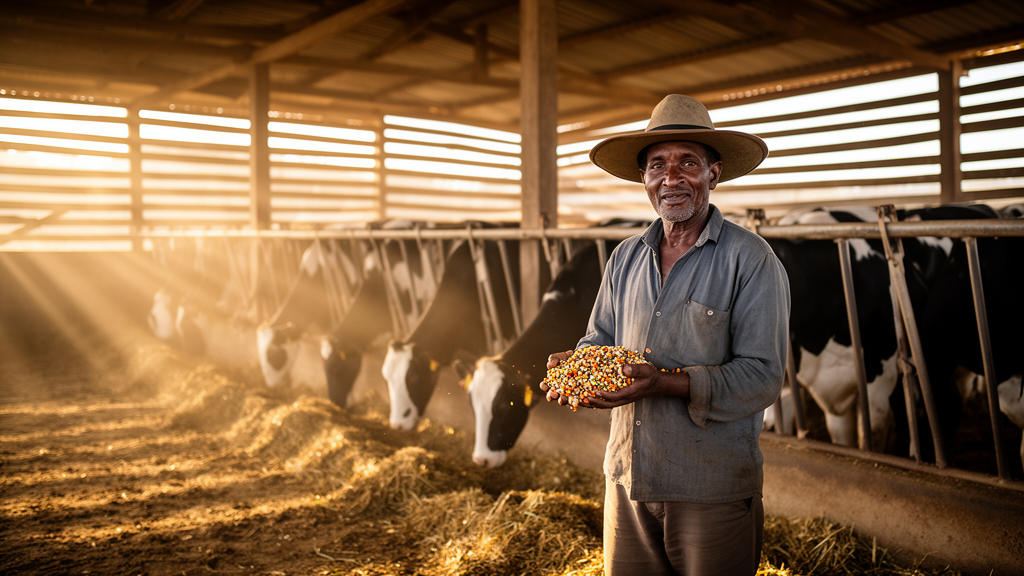
A survey of 150 smallholder dairy farmers in Ethiopia’s Siltie Zone has found alarming gaps in awareness of aflatoxins, the toxic fungal metabolites that can contaminate animal feeds and pass into milk. The study, published in Dairy Science and Management, reported that 90 percent of respondents had never seen mold on their feed and 60 percent had never even heard of aflatoxins, despite the fact that these carcinogenic compounds can be metabolized into animal milk and reach consumers through dairy products.
The research, led by Sister Hossae Tsegaye and Bayesa Tolasa Itafa, assessed knowledge, attitudes, and practices (KAP) among dairy cow producers in the Dalocha, Werabe, and Kibet districts of Siltie Zone in Southern Ethiopia. Overall mean scores pointed to inadequate knowledge (2.54), unfavorable attitudes (2.58), and low practices (2.55) regarding feed contamination on the study’s rating scales. The authors conclude that targeted educational interventions and improved feed management training are urgently needed in this farming community.
Aflatoxins are secondary metabolites produced by storage fungi, and contaminated feed is a global food and feed safety concern because the toxins reduce the quality of feeds and animal-sourced foods while posing health risks to both livestock and humans. In stall-feeding systems, which are increasingly popular in Ethiopian crop-livestock farming, animals confined to pens may be fed kitchen wastes, purchased feeds, grasses, hay, and agro-industrial byproducts, creating opportunities for fungal contamination under poor management conditions.
The concern is not hypothetical for Ethiopia. The study cites earlier work by Gizachew and colleagues, who recorded an average of 97 micrograms per kilogram of aflatoxin B1 in animal feeds in Addis Ababa and its surroundings, with all sampled feeds exceeding the 5 micrograms per kilogram threshold considered hazardous for animal feed. High aflatoxin B1 concentrations in feed raise the risk that animals excrete aflatoxin M1 into milk and milk products consumed by people.
To capture a representative picture, the researchers used a three-stage sampling design. Three districts were selected to represent different agro-ecological zones: Dalocha from the lowland, Werabe from the midland, and Kibet from the highland. Within each district, three kebeles, the smallest administrative units, were purposively chosen based on active engagement in dairy farming, and a proportionate systematic random sampling technique then identified 150 dairy cow producers for structured household interviews.
The questionnaire covered household demographics, feeding systems, feed resources, storage systems, storage duration, and feed collection and drying methods. Knowledge was measured with five statements, attitudes with three, and practices with seven, each scored and compared against mean thresholds to classify respondents as knowledgeable or not, holding good or poor attitudes, and practicing good or poor mitigation behavior. Data were analyzed in SPSS using descriptive statistics, mean ranking on Likert scales, one-way ANOVA with Tukey post hoc tests, and logistic regression.
The knowledge results were sobering. Most respondents had neither seen mold on feed nor heard of aflatoxins, and 66.7 percent lacked knowledge that aflatoxins have adverse health impacts. These findings align with earlier surveys elsewhere in Africa: over 90 percent of participants in Rwanda had never heard the terms mycotoxins or aflatoxins, and more than 75 percent of participants in Tanzania had never heard of aflatoxins. The authors warn that such widespread unawareness may contribute to high aflatoxin contamination in the feed supply.
Attitude and practice data revealed economic drivers behind risky choices. All respondents who preferred field grazing over stall feeding cited cost rather than aflatoxin concerns, reflecting financial constraints that push farmers toward short-term savings over long-term health outcomes. In practice, 60 percent of respondents used hay as their major feed resource, grass hay was the primary basal diet for 70.67 percent, 58 percent used stall feeding, and the high cost of concentrates, cited by 62.67 percent, was the major feeding constraint. Storage was often suboptimal: most stored feed on the floor or on raised surfaces, conserved feed as hay, monitored it mainly through sun drying at 50.6 percent, and stored feed for roughly six months, a duration consistent with previous reports from the Greater Addis Ababa region.
Logistic regression identified six significant variables influencing farmers’ mitigation practices: attitude, major feed resource, basal diet, method of feeding, monitoring, and storage duration. Farmers who provided a basal diet were 4.56 times higher in their mitigation practices than those who did not, those implementing proper monitoring were 3.98 times higher, those choosing feeds and feeding methods appropriately were 3.78 and 3.24 times higher respectively, and those with proper storage were 2.87 times higher. The authors note that closed metal bins with restricted air exchange can reduce aflatoxin production during storage.
The study’s limitations are considerable. The 150-farmer sample may not represent all smallholder dairy farmers in the Siltie Zone or Ethiopia, self-reported data may be biased by social desirability, the cross-sectional design cannot establish causal relationships, knowledge was assessed with a limited number of statements, and confounding factors such as education access and economic conditions were not thoroughly examined. Geographic constraints limit generalizability, language barriers may have affected comprehension, and other contaminants were not addressed. Even so, the authors argue the findings make a clear case for prioritized training programs that raise awareness of aflatoxin sources and health impacts, paired with practical steps such as airtight storage containers, elevated platforms, feed source diversification, and affordable regular feed testing.
Subject of Research: Knowledge, attitudes, and practices of smallholder dairy farmers regarding aflatoxin contamination in animal feeds in southern Ethiopia
Article Title: Smallholders’ knowledge, attitude, and practices towards aflatoxins contamination in animal feeds
Article References: Tsegaye, S. H., & Itafa, B. T. (2025). Smallholders’ knowledge, attitude, and practices towards aflatoxins contamination in animal feeds. Dairy Science and Management, 2(1), Article 6. https://doi.org/10.1186/s44363-025-00007-9
Image Credits: AI Generated
DOI: 10.1186/s44363-025-00007-9
Keywords: aflatoxins, animal feeds, dairy farming, smallholder farmers, Ethiopia, food safety, mycotoxins, feed storage, milk contamination, knowledge attitude practice, logistic regression, Siltie Zone
News Source: Alan Morgan. (October 30, 2026). Ethiopian Dairy Farmers Largely Unaware of Aflatoxin Risks in Animal Feeds. Scienmag.