


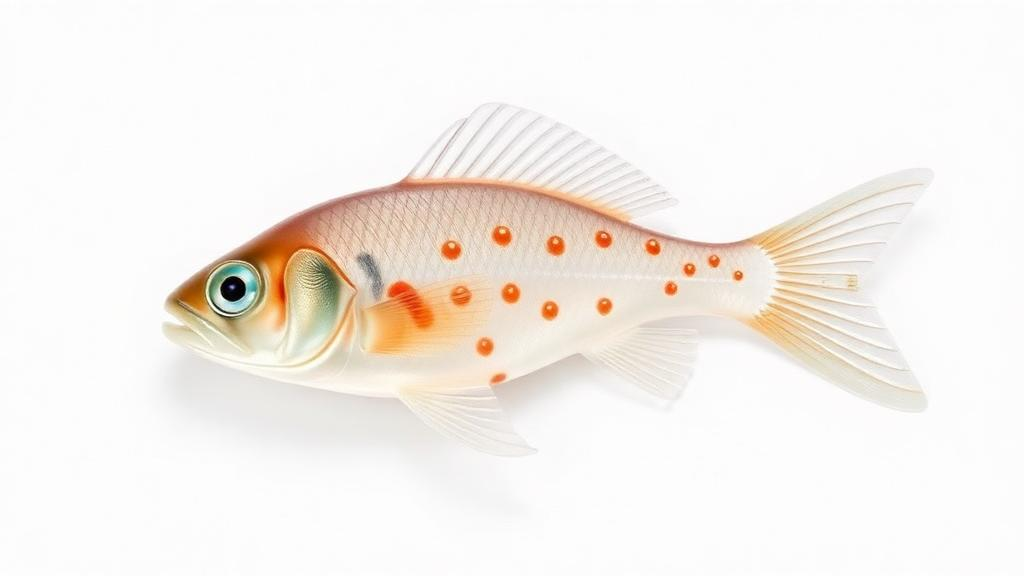
Scientists at Whitehead Institute for Biomedical Research have built the first comprehensive map of cell types and gene activity across an entire adult vertebrate, using a tiny, transparent fish called Danionella cerebrum. In a study published in the journal Science on October 29, the team profiled more than 600,000 cells collected from across the fish’s body, producing what researchers call a single-cell transcriptome atlas: a whole-body record of which genes are active in which cell. The achievement, described in a Whitehead Institute news release, opens a new window onto how cells in different tissues coordinate their responses and how changes in one part of the body may influence others.
A cell’s transcriptome is the full set of RNA molecules it has made from its DNA at a given time, providing a snapshot of which genes the cell is using. By measuring that snapshot in individual cells and then organizing the results, the researchers assembled a molecular reference for the cell types found throughout Danionella, the patterns of gene activity that distinguish them, and the locations of many of those cells within the animal. According to the team, the atlas also gives researchers a baseline for exploring how injury, aging, drugs, or other changes affect cells across the whole animal, rather than tissue by tissue.
The choice of organism was central to the project. Cell atlases have become increasingly detailed in recent years, but extending them across a whole adult vertebrate has been difficult for a simple reason: size. Profiling the cellular diversity of larger animals comprehensively is technically demanding and expensive. Danionella offered a way around that problem. Its miniature body, barely one centimeter long, makes the experiment feasible, while its close relationship to zebrafish allows researchers to draw on the extensive genetic tools developed for one of biology’s most widely used model organisms.
Danionella cerebrum is itself a relatively new addition to the laboratory. Viewed from above, the fish offers a rare sight among vertebrates: its brain is visible through the top of its head. Since the species was adopted for neuroscience research in 2018 and formally described in 2021, the tiny transparent fish has drawn rapidly growing interest for its unique biology. Printed letters can be seen through its nearly transparent body, a feature that has made it especially attractive for studying the vertebrate brain in living animals.
Kutay Deniz Atabay, who led the work as a postdoctoral researcher in the laboratory of Whitehead Institute Member Peter Reddien, first became interested in Danionella in early 2019 while searching for a small, transparent animal in which he could watch the nervous system regenerate. The fish’s miniature size and accessible brain made it especially promising for that work, and the researchers found that the species has broad regenerative capacity, including in the brain and fins. Reddien’s laboratory, meanwhile, had already seen the value of a comprehensive whole-animal cell atlas through its work on planarians, regenerative flatworms whose small size had made such an atlas possible.
“Deniz and I had the thought: Would it be possible to get a cell-type transcriptome atlas for a complete vertebrate?” said Reddien, who is also a professor of biology at Massachusetts Institute of Technology and an Investigator with the Howard Hughes Medical Institute. “Here’s an animal where we’d have a chance.” Atabay emphasized that the spatial dimension of the atlas is as important as its breadth. “Once you have a spatially resolved atlas, you know what cell types exist, but you also know the neighbors of those cell types in this context,” he said. “This gives you access at multiple different levels of complexity, from molecular to cellular to systems.”
To build the atlas, the researchers used single-cell RNA sequencing to measure gene activity in individual cells collected from across the brain, spinal cord, eyes, internal organs, fins, head, and trunk. They paired those data with spatial methods that mapped cell types and patterns of gene activity back to their locations in tissues. The resulting atlas was extensive enough to capture even exceptionally rare cell populations, giving researchers a resource that spans the animal from molecular detail to whole-body organization.
Looking across the animal in this way revealed patterns that can be difficult to see when tissues are studied separately. In the nervous system, neurons from the same region often had more similar patterns of gene activity, even when they used different neurotransmitters, the chemicals neurons use to communicate, than neurons using the same neurotransmitter in different regions. Similar patterns have been observed in other vertebrates, including mammals, suggesting that regional and developmental identity may be an important organizing feature of vertebrate nervous systems generally, not just a quirk of this small fish.
The atlas also revealed signs that adult cells retain a molecular memory of where they belong in the body. Fibroblasts, a type of connective-tissue cell, maintained region-specific activity of genes best known for establishing different parts of the body during development. Cells in the pectoral and pelvic fins, for example, retained gene programs associated with forelimb and hindlimb development in other vertebrates. What these persistent signals do in adult Danionella remains unknown, but the researchers suggest they may help tissues maintain or rebuild the appropriate structures. In planarians, positional information provides molecular guidance that helps regenerating tissues rebuild the correct structures, and the fish may use its retained programs in an analogous way.
The team also used the atlas as a reference for studying Danionella’s remarkable regenerative abilities. After injuring the telencephalon, a region of the forebrain, the missing neurons regenerated, and by tracing the process the researchers followed a progression from an early wound and immune response to neural stem-cell activity and the production and maturation of new neurons. The atlas has been made publicly available through DigiFish, an interactive resource for exploring cell types and gene activity throughout the animal. Paired with Danionella’s transparency and growing experimental toolkit, the resource can help researchers identify specific cells and genes to study or manipulate and then follow their activity in the living animal. For Reddien, the advance presents numerous and diverse opportunities for new science. “There’s been this era of genome sequencing, where you get the complete list of all the genes that it takes to make an organism,” he said. “The transcriptomes of cells tell you how that genome is being utilized in the different cell types. To have the transcriptome of every cell type seems like a big turning point in how one would investigate the biology of an organism.”
Subject of Research: A whole-body single-cell transcriptome atlas of the adult vertebrate Danionella cerebrum, covering cell types, gene activity, spatial organization and regeneration.
Article Title: Researchers create first whole-body single-cell atlas of an adult vertebrate
Article References: Researchers create first whole-body single-cell atlas of an adult vertebrate. Original publication (Bibliographic details unavailable.)
Image Credits: AI Generated
DOI: Not provided
Keywords: single-cell RNA sequencing, transcriptome atlas, Danionella cerebrum, vertebrate biology, Whitehead Institute, regeneration, neural stem cells, fibroblasts, spatial mapping, zebrafish, Science journal, cell types
News Source: Juliet Wilcox. (October 29, 2026). Tiny transparent fish yields first whole-body single-cell atlas of an adult vertebrate. Scienmag.



