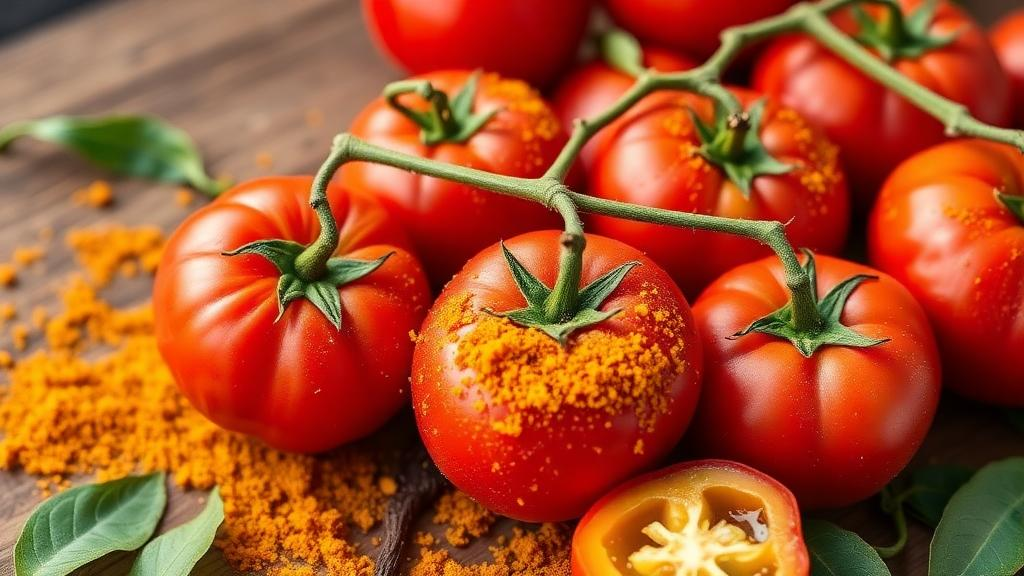
Researchers in India have turned fruit waste into edible food packaging films that kept cherry tomatoes free of spoilage for 30 days in storage tests, while the films themselves completely broke down in soil within 15 days. The study, published as open access research in Discover Polymers on 30 June 2026, describes films built on waste from amla (Phyllanthus emblica), a citrus fruit whose sour, astringent taste leaves large quantities unconsumed and discarded. Post-harvest losses of amla reportedly range from 30 to 40 percent due to fungal, bacterial and viral infections, making the fruit’s waste stream a locally abundant raw material for the experiment.
The team, led by Kibrya Farooq with co-authors including Kashma Sharma, Oluwafunmilola Ola, Santosh K. Tiwari and Vijay Kumar, used a straightforward solution-casting technique to fabricate two film formulations. The base film combined purified amla powder with agarose, a seaweed-derived polysaccharide, gelatin and glycerol as a plasticizer; the second formulation added curcumin, the yellow pigment extracted from the roots of Curcuma longa. In a typical preparation, 0.14 grams of amla powder and, for the curcumin version, 0.10 grams of curcumin were dispersed in 30 millilitres of distilled water, followed by 0.4 grams each of gelatin and agarose, microwave heating to boiling, and dropwise addition of 0.5 millilitres of glycerol. The resulting slurry was cast into petri dishes, gelled, and dried at 60 degrees Celsius for 24 hours. The finished films measured 0.03 millimetres thick without curcumin and 0.05 millimetres with it.
The choice of amla as the backbone polymer is presented by the authors as novel. According to the paper, no previous work has reported using amla waste as the backbone material for biofilm preparation or packaging applications. The motivation sits against a stark backdrop: global plastic production has reached 460 million tonnes and accounts for 3.4 percent of greenhouse gas emissions, roughly 90 percent of plastic is derived from petroleum products, and the use of plastics in food packaging is anticipated to grow from 267.38 billion dollars in 2021 to 429.13 billion dollars by 2030. Conventional plastic packaging can also release substances such as bisphenol A and phthalates into food, the authors note.
Characterisation of the two films relied on a battery of laboratory techniques. Fourier-transform infrared spectroscopy showed a strong absorption peak at 1634 wavenumbers attributed to carboxylate stretching, a band near 1036 wavenumbers corresponding to C–O stretching in polysaccharides, and broad hydrogen-bonded O–H peaks at 3285 and 3287 wavenumbers in the curcumin-containing and curcumin-free films respectively. The authors report that the identical peaks in both samples suggest the chemical structures of the base film remained essentially unchanged when curcumin was added, with differences in peak intensity ascribed to hydrogen bonding and other non-covalent interactions.
X-ray diffraction told a similar story of structural continuity. Although amla powder itself is semicrystalline, the films became amorphous after synthesis, and adding curcumin produced no significant changes in the diffraction pattern. Notably, no new peaks or shifts appeared even though pure curcumin is described in the literature as crystalline; the authors attribute the disappearance of curcumin’s peaks to its low concentration in the film. Scanning electron microscopy, by contrast, revealed visible differences: the curcumin-free film showed pores and a relatively smoother surface, while the curcumin-containing film displayed increased roughness, square-shaped granules and visible cracks, suggesting that curcumin is unevenly distributed within the polymer matrix.
Thermal analysis showed that both films degrade in three distinct stages. The first stage, ascribed to evaporation of absorbed moisture, produced weight losses of 11.7 percent for the curcumin-free film between 62 and 144 degrees Celsius and 10.5 percent for the curcumin film between 98 and 188 degrees Celsius. The primary degradation stage, attributed to glycerol volatilization and amla’s thermal decomposition, caused weight losses of 58 percent and 56.65 percent respectively. A final stage of depolymerisation led to complete degradation, with the curcumin-free film breaking down fully by 699.2 degrees Celsius and the curcumin film by 600 degrees Celsius under the argon atmosphere of the test.
The films’ interaction with water varied with composition. Maximum swelling reached 205 percent for the curcumin film and 196.6 percent for the film without it, measured at pH 6, with the hydrophobic, nonpolar aromatic structure of curcumin credited for the lower swelling in the curcumin-containing film. Water solubility ran in the opposite direction: the curcumin film dissolved to 52.2 percent in water over 24 hours at 30 degrees Celsius, compared with 47 percent for the base film, which the authors link to weaker intermolecular interactions. The mechanical tests, performed on a universal testing machine at a stretching rate of one millimetre per second, recorded tensile strengths of 3.8 megapascals without curcumin and 4.6 megapascals with it, alongside elongation-at-break values of 82 percent and 84 percent respectively.
Biodegradation was assessed by burying pre-weighed dried films two centimetres deep in soil collected from the National Institute of Technology Srinagar. After three days, weight-loss measurements showed degradation rates of 63.21 percent for the curcumin film and 64.53 percent for the film without curcumin. The buried films initially turned smooth, translucent and light brown or yellow, changes the authors attribute to microbial activity. Follow-up infrared spectroscopy of the degraded films revealed peak shifts and reductions in intensity across the 1030 to 3290 wavenumber region, associated with the breakdown of covalent bonds and crosslinked network structures, and the analysis indicated 100 percent decomposition within 15 days.
The food preservation test used cherry tomatoes bought at a local market in Chandigarh, stored for 30 days at 24 degrees Celsius and 32 percent relative humidity. Tomatoes sealed in conventional polyethylene sachets and those left uncovered in open air both showed decay after just 10 days, with the plastic-bagged samples developing black and white fungal patches and bacterial growth, and the open-air samples suffering internal spoilage, bursting and foul smells. Tomatoes wrapped in the biofilms, by contrast, showed no colour change or signs of spoilage, and the curcumin-containing film was reported as the more effective of the two. After the full 30 days, the wrapped tomatoes remained free of fungal and bacterial growth, although the authors note the fruit could by then be used only in dry form.
Antimicrobial performance was modest. Using the disc diffusion method against Staphylococcus aureus and Escherichia coli at a standardized concentration of 1.5 times ten to the eighth colony-forming units per millilitre, the films produced small inhibition zones: 1.13 millimetres against E. coli without curcumin and 1.33 millimetres with it, and 1.066 millimetres against S. aureus without curcumin versus 1.43 millimetres with it. The authors describe the films as exhibiting weak antibacterial activity against both Gram-positive and Gram-negative bacteria and position them for low-load packaging applications rather than as strong antimicrobial barriers. The study is a laboratory-scale materials investigation, and the authors frame the results as showing potential for sustainable, biodegradable alternatives to conventional plastics rather than demonstrated commercial performance. Even so, the combination of complete soil biodegradation, improved tensile strength with curcumin, and a month of tomato preservation in a film made substantially from fruit waste gives the work a concrete, testable claim that distinguishes it from much of the aspirational literature on biopolymer packaging.
Subject of Research: Edible biodegradable food packaging films made from amla waste, curcumin and agarose
Article Title: Development of amla, curcumin, and agarose-based edible films for sustainable food packaging
Article References: Farooq, K., Sharma, K., Ola, O., Tiwari, S. K., & Kumar, V. (2026). Development of amla, curcumin, and agarose-based edible films for sustainable food packaging. Discover Polymers, 3(1), Article 16. https://doi.org/10.1007/s44347-026-00052-w
Image Credits: AI Generated
DOI: 10.1007/s44347-026-00052-w
Keywords: amla, Phyllanthus emblica, curcumin, agarose, edible films, biodegradable packaging, food preservation, cherry tomatoes, solution casting, tensile strength, soil burial biodegradation, antimicrobial activity
News Source: Bethany Barker. (October 29, 2026). Amla waste and curcumin yield edible films that keep tomatoes fresh for 30 days. Scienmag.