


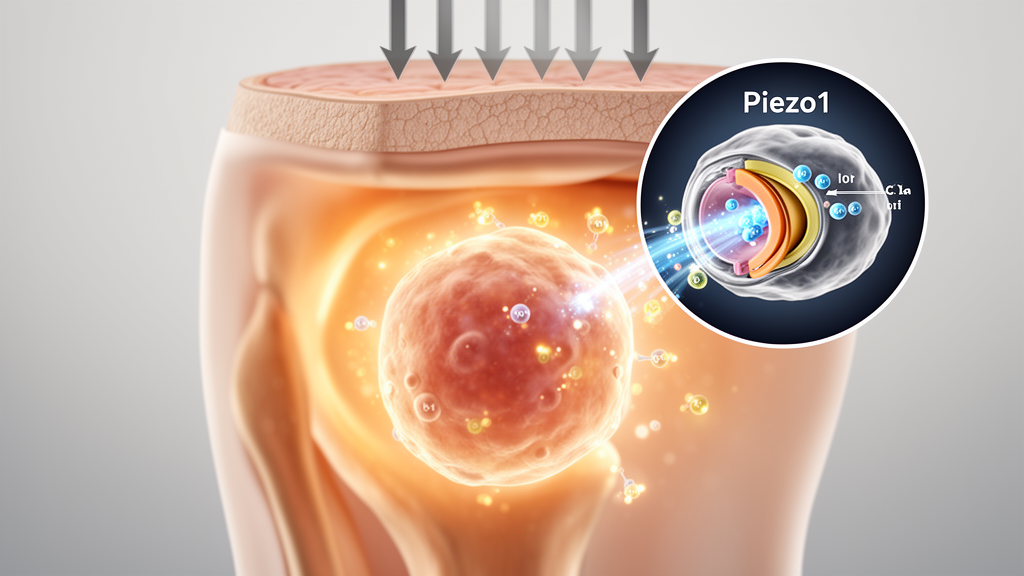
Knee osteoarthritis is increasingly described not as simple wear of cartilage but as a whole-joint mechano-inflammatory disorder, in which abnormal mechanical loading, tissue remodeling, and inflammatory sensitization reinforce one another. A new focused review published in Arthritis Research & Therapy examines Piezo1, a calcium-permeable ion channel that converts mechanical cues into biochemical signals, and argues that it acts as a context-dependent hub connecting mechanical stress to inflammatory, catabolic, cell-death, and organelle-stress responses across the joint.
The review, authored by Jing Li, Bo Dong, Xueqin Zeng, Fei Gao, and Baohui Wang, was published on October 17, 2026, as an open-access article. It is supported by a structured search of PubMed, Web of Science, and the China National Knowledge Infrastructure covering the literature from database inception through June 2, 2026. Rather than reporting a single experiment, the authors synthesize evidence spanning several compartments of the knee: articular cartilage, synovium, subchondral bone, osteophyte formation, and the pain-related microenvironment.
Across these compartments, the authors report that dysregulated Piezo1-associated signaling has been implicated in extracellular matrix degradation, chondrocyte dysfunction, imbalance in cell fate, and organelle stress. Mechanically, Piezo1 opens in response to physical forces and permits calcium influx, which can trigger downstream signaling cascades. In the joint, where cells normally experience carefully balanced loading, excessive or abnormal mechanical stimulation of this channel is proposed to tip the balance toward catabolic and inflammatory programs that degrade cartilage and sensitize pain pathways.
A central caveat runs through the review: Piezo1 is not uniformly pathogenic. According to the authors, excessive activation can aggravate injury in mature chondrocytes and other joint cells, yet Piezo1 activity may support reparative responses in selected progenitor-cell populations. This dual role means that blunt, systemic suppression of the channel could undermine beneficial regeneration, and it motivates the review’s emphasis on local, reversible, and cell-specific intervention strategies rather than indiscriminate targeting.
The review also surveys preclinical work on traditional Chinese medicine-related interventions that have been investigated for effects on components of the Piezo1-associated mechano-inflammatory network. Artemisinin, wogonin, Shengyu Decoction, and Gubi Zhitong Formula have each been associated with changes in distinct molecular modules within this network. However, the authors stress that direct target engagement and causal validation remain limited, meaning these associations do not yet demonstrate that the compounds act on Piezo1 itself.
Physical interventions receive a similarly cautious assessment. Evidence linking acupuncture and acupotomy to Piezo1 remains confined to heterogeneous preclinical models and, the review concludes, does not establish direct or Piezo1-specific therapeutic mechanisms. In other words, while these procedures may alter mechano-inflammatory signaling in animal or laboratory models, attributing their effects specifically to this mechanosensor is not currently supported.
The authors identify several barriers that limit translation from preclinical findings to clinical practice. These include heterogeneous experimental models, insufficient compartment- and cell-specific validation, incomplete exposure and target-engagement data, and inconsistent procedural standards across studies. Without knowing precisely which cell types were targeted, at what exposures, and through which confirmed molecular interactions, it is difficult to compare results across laboratories or to design rational trials.
To address these gaps, the review calls for future studies that integrate local and reversible intervention strategies, rigorous quality control, standardized procedural and stimulation parameters, and cell-specific causal validation. Such work would allow researchers to determine whether manipulating Piezo1 in specific joint compartments and cell types produces distinct outcomes, supported by cell-specific causal validation.
The practical significance of this framing is stratification. Because knee osteoarthritis involves multiple tissues responding to shared mechanical and inflammatory signals, the authors propose that Piezo1 may serve as a stratifiable and testable organizing axis for developing more precise interventions.
It is worth emphasizing what this publication is and is not. It is a peer-reviewed review article, currently shared ahead of final production editing, that synthesizes existing literature rather than presenting new experimental data. Its conclusions about Piezo1’s roles in cartilage, synovium, bone, and pain signaling rest on preclinical evidence, and the therapeutic possibilities it discusses, whether pharmacological or procedural, remain unvalidated in humans. The review’s contribution lies in organizing a scattered literature around a single mechanotransduction hub and in specifying the experimental standards, particularly cell-specific causal validation and standardized stimulation parameters, that would be needed before Piezo1-centered strategies could be tested in patients with knee osteoarthritis.
Subject of Research: The role of the mechanosensitive ion channel Piezo1 in mechano-inflammatory signaling across knee osteoarthritis joint tissues
Article Title: Piezo1-centered mechanotransduction in knee osteoarthritis: multicompartment mechano-inflammatory networks and therapeutic opportunities
Article References: Li, J., Dong, B., Zeng, X., Gao, F., & Wang, B. (2026). Piezo1-centered mechanotransduction in knee osteoarthritis: multicompartment mechano-inflammatory networks and therapeutic opportunities. Arthritis Research & Therapy. https://doi.org/10.1186/s13075-026-03927-2
Image Credits: AI Generated
DOI: 10.1186/s13075-026-03927-2
Keywords: Piezo1, knee osteoarthritis, mechanotransduction, chondrocytes, mechano-inflammation, subchondral bone, synovium, cartilage degradation, traditional Chinese medicine, preclinical research, ion channels, review
News Source: Ophelia Keating. (October 29, 2026). Piezo1 Mechanosensor Emerges as a Hub Linking Load and Inflammation in Knee Osteoarthritis. Scienmag.



