


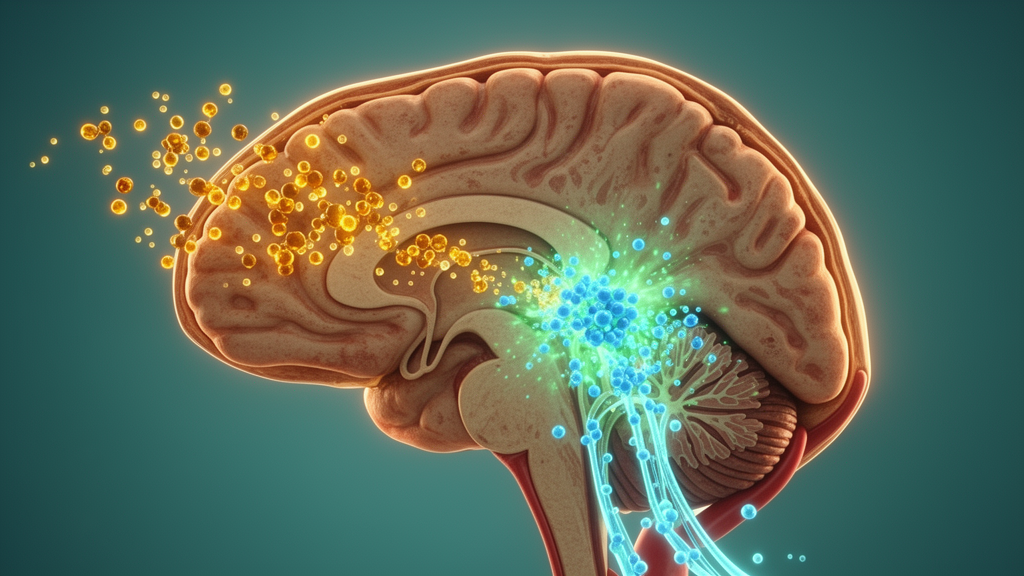
Apigenin, a plant flavonoid found in several traditional Chinese medicinal herbs, improved learning and memory in mice with chemically induced cognitive impairment by promoting the release of norepinephrine in the brain and raising lactate levels that fuel neurons, according to a new study published in Frontiers in Pharmacology. The research, conducted by a team at Heilongjiang University of Chinese Medicine, traced the effect to a specific molecular pathway involving the G protein-coupled estrogen receptor GPR30 and a calcium-dependent vesicle release mechanism in noradrenergic neurons. The work offers a detailed mechanistic account of how a common dietary phytoestrogen might support brain energy metabolism, though the findings come with important caveats about the animal model used and the sex of the animals studied.
The researchers used a well-known experimental approach: injecting mice with D-galactose over eight weeks to induce aging-like cognitive deficits. This model is widely employed to recapitulate aging and aging-related cognitive decline, producing impairments in spatial learning and recognition memory that resemble, in limited ways, the deficits seen in patients with dementia. The team emphasized, however, that the D-galactose model primarily mimics aging-related decline rather than the full spectrum of Alzheimer’s disease pathology, since amyloid plaques and tau tangles were not evaluated in the study. All mice in the experiments were male, a choice made to avoid hormonal fluctuations across the estrous cycle given apigenin’s phytoestrogenic nature, but a limitation the authors themselves flag because Alzheimer’s disease is more prevalent in women.
In the behavioral tests, mice receiving D-galactose showed significantly reduced novel object recognition index, fewer platform crossings in the Morris water maze, lower spontaneous alternation rates in the Y-maze, and less time spent in the target quadrant, along with markedly prolonged escape latency. Their body weights also dropped significantly compared with controls. Histological examination of the hippocampus revealed loosely arranged neurons with irregular shapes, nuclear atrophy, increased necrotic cells, and reduced Nissl body counts, particularly in the CA1, CA2, and CA3 subregions, while the dentate gyrus appeared largely spared. When apigenin was administered daily by oral gavage at 40 milligrams per kilogram throughout the eight-week modeling period, these behavioral and morphological changes were substantially reversed.
To probe the metabolic basis of this protection, the team turned to the locus coeruleus, a small brainstem nucleus that supplies norepinephrine to the hippocampus and is among the earliest sites of dysfunction in Alzheimer’s disease. Untargeted metabolomics using UPLC-Q-TOF-MS identified fifteen differentially expressed metabolites in locus coeruleus tissue of D-galactose-treated mice. Nine metabolites, including glucose-6-phosphate, adenosine diphosphate, and ribose 5-phosphate, were markedly decreased, while six, including aspartic acid, pyroglutamate, and glutathione, were significantly increased. Apigenin treatment substantially reversed these alterations. Pathway enrichment analysis pointed to energy metabolism routes including the tricarboxylic acid cycle, glycolysis and gluconeogenesis, the pentose phosphate pathway, purine metabolism, and glutathione metabolism.
Targeted metabolomics then focused on two molecules of particular interest: norepinephrine and L-lactate. Both were significantly decreased in the hippocampus of D-galactose-treated mice compared with controls, and both were significantly elevated after apigenin treatment. This pattern suggested a chain of events in which norepinephrine released from locus coeruleus projections acts on hippocampal astrocytes, the star-shaped glial cells that store most of the brain’s glycogen, prompting them to break down glycogen and release lactate. Neurons cannot store glucose as glycogen and depend heavily on lactate supplied by astrocytes through what is known as the astrocyte-neuron lactate shuttle, particularly when glucose uptake is compromised.
The next question was how apigenin triggers norepinephrine release. Building on the authors’ previous work with the herbal formula Erzhi Wan, from which apigenin is considered a primary bioactive component, the team identified GPR30 as a candidate target. Molecular docking predicted favorable binding, with a binding energy of −7.7 kilocalories per mole, and a cellular thermal shift assay in PC12 cell lysates showed that apigenin stabilized the GPR30 protein, raising its melting temperature and supporting physical target engagement. In live mice, the effects of apigenin were mimicked by G1, a GPR30 agonist, and largely abolished by G15, a GPR30 antagonist, which suppressed both the behavioral improvements and the elevations in hippocampal norepinephrine and lactate.
In vitro experiments using PC12 cells, a rat adrenal pheochromocytoma cell line widely used as a surrogate for studying neurosecretion, dissected the signaling cascade downstream of GPR30. Apigenin treatment upregulated the protein levels of GPR30, PLCβ1, and synaptotagmin 1, increased intracellular calcium fluorescence, and raised norepinephrine levels in the culture medium. These effects were attenuated by the GPR30 antagonist G15 and by D609, an inhibitor of phospholipase C signaling. The picture that emerges is that apigenin activates GPR30 on noradrenergic neurons, which through PLCβ1 drives calcium mobilization; calcium then acts through synaptotagmin 1, the calcium sensor for synaptic vesicle fusion, to promote the docking and fusion of norepinephrine-containing vesicles with the cell membrane.
The astrocyte side of the pathway was tested in primary astrocyte cultures. Apigenin alone did not significantly restore lactate levels in injured astrocytes, whereas norepinephrine treatment significantly increased both L-lactate and pyruvate levels. Periodic acid-Schiff staining showed that both apigenin and norepinephrine increased glycogen staining intensity, which the authors interpret as reflecting a dynamic balance between glycogen synthesis and breakdown rather than a static increase in glycogen stores. When glycogen phosphorylase was blocked with the inhibitor CP-316819, all measured glycolytic and glycogen-related metabolites dropped significantly, confirming that glycogenolysis, rather than glycolysis, is the source of the norepinephrine-driven lactate. Blocking hexokinase with 2-DG selectively reduced glucose-6-phosphate and UDP-glucose levels.
The authors conclude that apigenin improves hippocampal energy metabolism in this model by enhancing the locus coeruleus to hippocampus noradrenergic axis, stimulating astrocytic glycogenolysis and lactate production, and thereby supporting the astrocyte-neuron lactate shuttle. They also caution that aging may weaken the responsiveness of the GPR30 pathway, and that whether apigenin exerts comparable effects in aged animals, in female mice, or in authentic Alzheimer’s disease models remains to be determined. As with all preclinical work, these results in mice and cell cultures cannot be directly translated into recommendations for human use, and the study’s scope, an aging-like model rather than verified Alzheimer’s pathology, means the findings should be interpreted as evidence relevant to aging-related cognitive impairment specifically.
Subject of Research: How the flavonoid apigenin promotes norepinephrine release and astrocytic lactate production in a mouse model of aging-related cognitive impairment
Article Title: Apigenin promotes neuronal norepinephrine release via GPR30/PLCβ1-Ca2+-Syt1 signaling to enhance astrocytic lactate and exert neuroprotection in D-galactose-induced cognitive impairment
Article References: Jiang, S., Kong, L., Bai, X., Yang, M., Ding, J., Wang, Y., Fan, W., Yan, Y., Pu, C., & Zhang, N. (2026). Apigenin promotes neuronal norepinephrine release via GPR30/PLCβ1-Ca2+-Syt1 signaling to enhance astrocytic lactate and exert neuroprotection in D-galactose-induced cognitive impairment. Frontiers in Pharmacology, 17, Article 1979963. https://doi.org/10.3389/fphar.2026.1979963
Image Credits: AI Generated
DOI: 10.3389/fphar.2026.1979963
Keywords: apigenin, norepinephrine, locus coeruleus, GPR30, lactate, astrocytes, D-galactose model, cognitive impairment, glycogenolysis, hippocampus, phytoestrogen, brain energy metabolism
News Source: Cassandra Pierce. (October 29, 2026). Apigenin boosts norepinephrine release and brain lactate in aging-model mice. Scienmag.



