


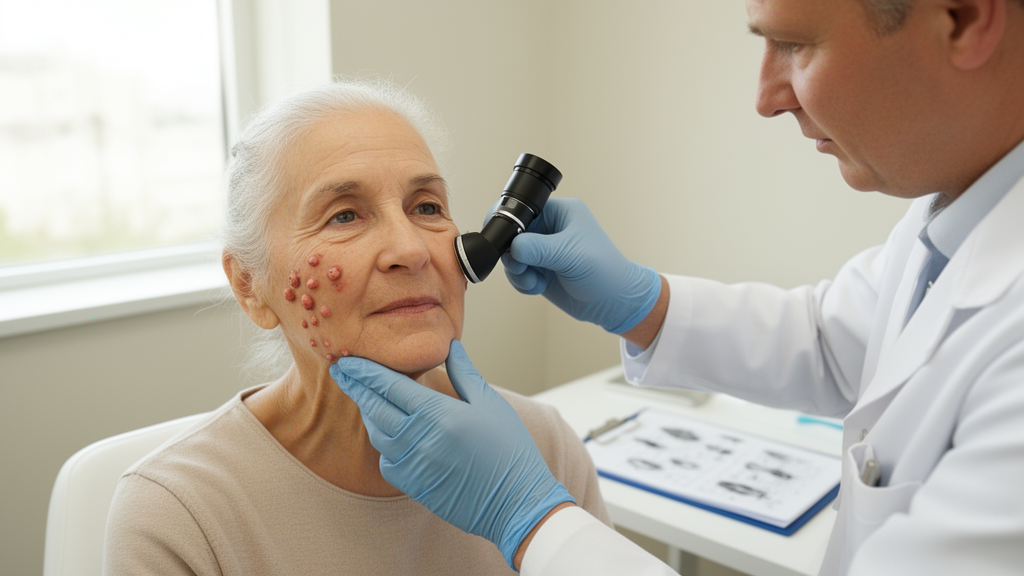
A 75-year-old woman with advanced sigmoid colon cancer and bone metastases developed an explosive eruption of skin lesions while taking oral capecitabine, according to a case report published in the journal Skin on September 22, 2026. Over just two months, densely distributed, uniform papules and nodules spread across her entire face and neck, some capped with tiny hemorrhagic crusts. The diagnosis: capecitabine-induced eruptive keratoacanthoma.
Eruptive keratoacanthoma is a sudden outbreak of multiple skin lesions whose causes remain incompletely understood. Reported contributing factors include ultraviolet exposure, immune dysfunction, viral infection, trauma and immunomodulatory medicines. Capecitabine, an oral prodrug of the chemotherapy agent 5-fluorouracil, is an unlikely suspect on first glance, because 5-FU is itself commonly used to treat keratoacanthomas. That paradox is precisely what makes this drug-related skin reaction easy to overlook in clinical practice, the authors warn.
The patient had not received any immunosuppressive therapy, which strengthened the suspicion that the chemotherapy itself was the trigger. Histopathological examination showed well-differentiated squamous epithelial proliferation within the dermis, with keratin pearls, mild atypia and pushing rather than infiltrative borders.
One additional laboratory finding proved decisive. Ki-67, a marker of cell proliferation, was positive only in the basal layer of the squamous nests. Combined with the clinical history of rapid, widespread onset during capecitabine treatment, these features supported a diagnosis of benign eruptive keratoacanthoma rather than malignant disease.
The authors emphasize that without clinical correlation, the lesion could easily be misdiagnosed as squamous cell carcinoma on histopathology alone.
No standardized treatment protocol has been established for this condition. Reported attempts described in the literature include topical corticosteroids, 5-fluorouracil, methotrexate and triamcinolone acetonide, intralesional injections of these agents, and oral acitretin.
The teaching points the authors draw from the case are threefold: integrate clinical and pathological findings rather than relying on histology in isolation; recognize capecitabine as an atypical trigger of eruptive keratoacanthoma despite the drug’s 5-FU lineage; and consider drug-induced eruptive keratoacanthoma in patients with advanced cancer who suddenly develop widespread multiple skin papules and nodules, even when no immunosuppressive treatment has been given.
As a single case report, the findings describe one patient’s experience and do not establish how frequently capecitabine causes these eruptions. Nevertheless, the authors argue that awareness of this diagnostic trap could spare similar patients unnecessary interventions for suspected squamous cell carcinoma, and they call for clinicians managing advanced cancer to keep this rare reaction in mind when widespread facial lesions appear during treatment.
Subject of Research: Capecitabine-induced eruptive keratoacanthoma in a patient with advanced colon cancer
Article Title: A cancer drug triggered widespread skin growths—and a diagnostic trap
Article References: A cancer drug triggered widespread skin growths—and a diagnostic trap. Original publication (Bibliographic details unavailable.)
Image Credits: AI Generated
DOI: Not provided
Keywords: capecitabine, keratoacanthoma, colon cancer, skin lesions, histopathology, squamous cell carcinoma, 5-fluorouracil, MTOR, case report, drug reaction, dermatology, oncology
News Source: Nathaniel Bowman. (October 29, 2026). Chemotherapy drug capecitabine linked to sudden facial skin growths in case report. Scienmag.



