


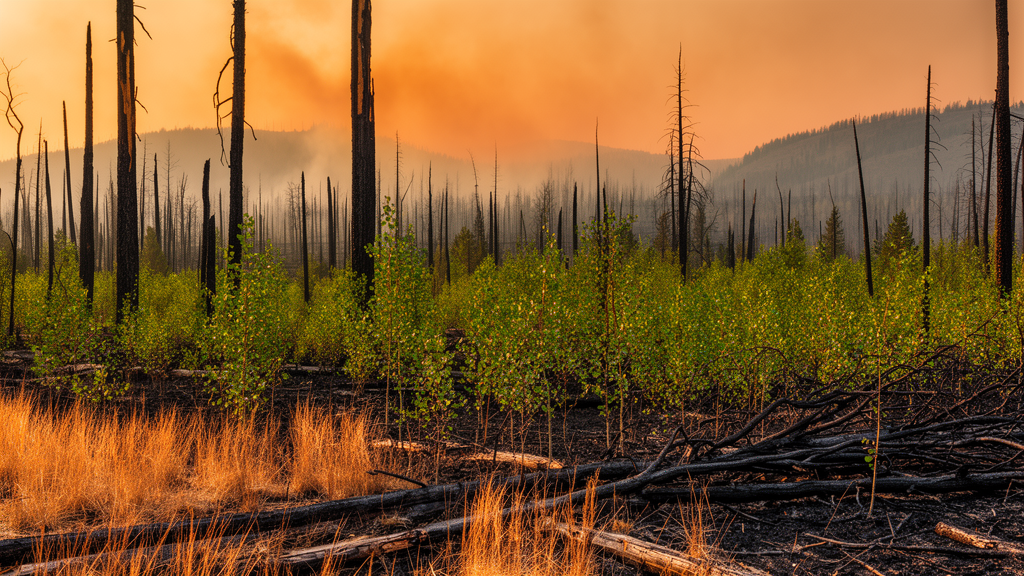
Across the American West, landscapes are burning twice — and sometimes more — within the span of a single human generation. A new study drawing on two decades of satellite records finds that whether a second fire burns gently or fiercely depends not on the fact of a previous fire alone, but on an interplay between fire history, the passage of time, and the dryness of the air during the reburn. The research, published in the journal Fire Ecology, analyzed 755 forested reburn events between 2001 and 2024, spanning 23 EPA Level III ecoregions in the western United States, and used hierarchical Bayesian models to disentangle the forces that govern how severely a reburned forest burns.
The team, led by researchers including Matthew Bitters, Nathan Korinek, and Jennifer Balch, defined reburns as areas that burned multiple times within short intervals of roughly two decades. Using fire event perimeters derived from the MODIS Burned Area Product, they compared reburned areas with adjacent portions of the same second fire that had not previously burned. This within-fire comparison, they argue, isolates the influence of fire history while minimizing confounding from event-level weather and environmental context — though the authors caution that reburned and non-reburned areas can still differ systematically in fuel type, topographic position, fire spread pathways, and suppression activity.
The headline result is deceptively simple: reburned areas burned at lower severity than unburned areas. Model-predicted severity, measured with the Composite Burn Index (CBI), a field-anchored scale from 0 to 3, averaged 0.90 in reburn areas versus 1.07 in non-reburn areas — a difference of about 16 percent. Raw observed means showed a nearly identical pattern. But the authors emphasize that this marginal reduction reflects the distribution of conditions in the dataset rather than a strong independent effect of reburning once fire history and climate covariates are held constant.
The real story lies in the interactions. Atmospheric drying, quantified as vapor pressure deficit (VPD), emerged as the dominant driver of reburn severity. Increasing VPD from 0.5 to 3.5 kilopascals raised predicted reburn severity by roughly 0.7 to 1.0 CBI units, depending on the severity of the initial fire. Predicted severity ranged from about 0.6 CBI under cool, moist conditions and short intervals to about 1.7 CBI under high atmospheric drying and longer intervals — nearly a full-unit shift across observed conditions, with a scenario difference of 0.96 CBI units.
Time since fire mattered too, but in a way that depended on what happened the first time around. Following low-severity initial fires, atmospheric drying exerted the strongest influence, presumably because fuels remained abundant and dry air could drive combustion unimpeded. Following higher-severity initial fires, the interval between fires became the more important control: reburn severity increased by 0.28 CBI units between 5- and 20-year intervals under dry conditions, suggesting that fuel recovery gradually erodes the dampening legacy of a severe first burn. The authors interpret this as a shift from climate-mediated to fuel-mediated controls on reburn severity.
The suppressive effect of a severe initial fire itself weakened with time. Under high atmospheric drying and 5-year intervals, increasing first-fire severity from unburned to high reduced predicted reburn severity by 0.33 CBI units; after 20 years, that effect shrank to 0.16 units, with credible intervals overlapping zero. In other words, a hot first fire buys a forest only a temporary reprieve. As shrubs and regenerating trees re-accumulate over one to several decades, the fuel limitation that once constrained fire behavior dissipates, and the stage can be reset for severe reburning.
Regional patterns added another layer of complexity. Predicted reburn severity under standardized scenarios ranged from 0.19 CBI in the Columbia Plateau to 1.29 in the Coast Range under short intervals, with high values also in the Sierra Nevada and Idaho Batholith and lower values in the Southern Rockies and Arizona/New Mexico Mountains. Interval effects were strongest in productive coastal and montane systems — the Central California Foothills, Klamath Mountains, and North Cascades saw severity rise by roughly 0.42 to 0.68 CBI units between 5- and 20-year scenarios — while drier interior regions such as the Columbia Plateau and Mojave Basin and Range showed little change, indicating persistent fuel limitation. The authors caution that several extreme estimates came from sparsely sampled ecoregions, including the Coast Range with just one event.
The study’s methods carry both strengths and caveats. Severity was estimated using a bias-corrected, random-forest-modeled CBI from Landsat imagery, and weather was summarized as event-level averages from the gridMET dataset, which cannot capture the short-duration wind and dryness extremes that often drive rapid fire growth. The analysis was restricted to areas that remained forested through both fires, excluding post-fire transitions to shrubland or grassland, so its conclusions apply to persistent forest systems rather than regime shifts. Very high-severity initial fires were largely absent from the dataset for the same reason, and extrapolations beyond the observed first-fire severity range should be read cautiously. Residual spatial autocorrelation was weak, and a sensitivity analysis excluding areas with undocumented pre-2001 fires did not alter the findings.
For land managers, the implications are sobering. Strategies that rely on recent fire — managed wildfire or prescribed burning — to reduce future severity may deliver short- to medium-term benefits, particularly where fuel recovery is slow. But the study suggests such buffers are perishable: they weaken as fuels regrow and as fire weather turns warmer and drier. The authors argue for regularly maintaining restoration treatments at broad scales, including repeated treatments within the windows when prior disturbance is most likely to constrain severity, rather than treating any single fire as a lasting shield.
More broadly, the work reframes how scientists and managers should think about fire-fire interactions. Rather than a single dominant mechanism, reburn severity reflects shifting constraints between fuels and climate, with at least two pathways to severe outcomes: reburns after mild initial fires under extreme atmospheric drying, and reburns after severe initial fires once fuels have recovered. As climate change intensifies atmospheric drying and lengthens fire seasons, the conditions under which prior-fire buffering fails may become increasingly common — and lower reburn severity, the authors note, should not be mistaken for ecosystem resilience, since repeated burning can still drive long-term compositional and structural change even when flames burn cooler.
Subject of Research: How fire history, time since fire, and atmospheric drying interact to control burn severity in reburned western U.S. forests
Article Title: Fire history and atmospheric drying jointly control forest reburn severity
Article References: Bitters, M. E., Korinek, N., McIntosh, T. L., Cattau, M. E., Tuff, T., & Balch, J. K. (2026). Fire history and atmospheric drying jointly control forest reburn severity. Fire Ecology, 22(1), 170. https://doi.org/10.1186/s42408-026-00604-2
Image Credits: AI Generated
DOI: 10.1186/s42408-026-00604-2
Keywords: wildfire, reburn, fire severity, vapor pressure deficit, fuel recovery, western United States, forests, hierarchical Bayesian model, Composite Burn Index, fire ecology, climate change, fire management
News Source: Drew Townsend. (October 29, 2026). When Wildfires Reburn: Fuel Recovery and Drier Air Erode Nature’s Fire Buffer. Scienmag.



