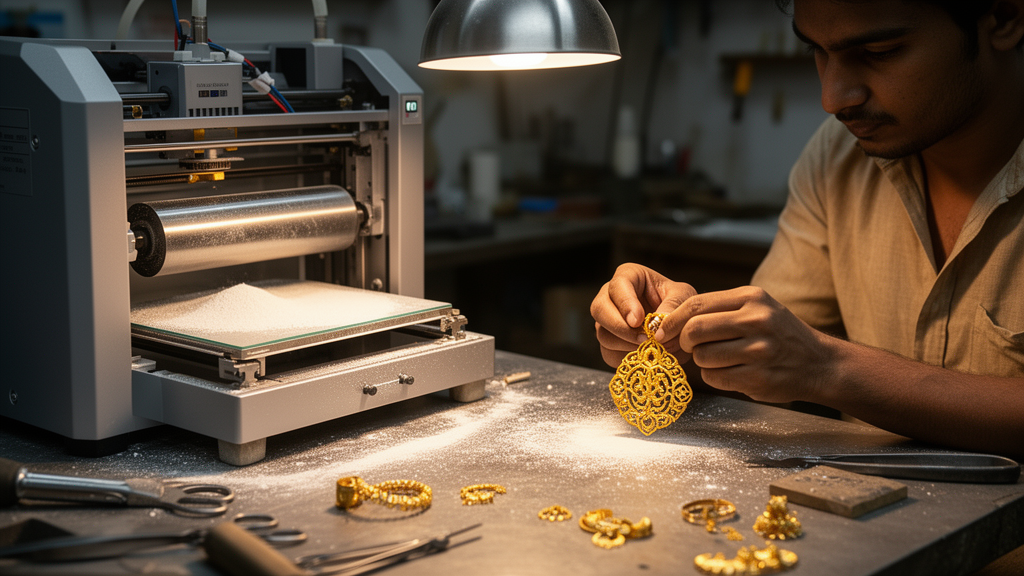
India’s gold jewellery industry, built on roughly 5,000 years of artisanal tradition, may be on the verge of its most significant technological shift yet. A review published in Gold Bulletin examines whether binder jetting 3D printing, an additive manufacturing technique that builds metal parts layer by layer from powder, could address the material waste, design constraints and labour challenges that currently limit both traditional handcrafting and lost wax casting in the Indian market. The authors, Hansal Kachhara and Neelanchali Asija Bhalla, frame the technology not as a replacement for skilled craftspeople but as the foundation for what they call a “Digital Goldsmith” era, in which digital fabrication and traditional artisanship operate side by side.
The scale of the industry at stake is considerable. The paper cites projections that India’s jewellery revenue would exceed US$81 billion in 2024, growing at a compound annual rate of 4.59 percent, with the country ranking as the world’s second-largest gold consumer and importing most of its gold. Yet the sector faces mounting pressure. Rising gold prices, shifting consumer tastes toward lightweight and minimalist designs, and an ageing workforce of karigars, the master artisans who have passed their skills down through generations, are straining a manufacturing model that depends heavily on individual hand skill and is difficult to scale reliably.
The review details why the conventional manufacturing route struggles with modern demands. In a typical workshop, gold ingots are melted in electric furnaces or, in smaller operations, with hand-held torches, then shaped by rolling or hammering on an anvil. Components are joined by soldering, a process where improper heat control can damage surrounding gold and where fumes require ventilation to protect the artisan. Polishing, done in multiple stages with buffing and abrasive compounds, can erase subtle design details if overdone, and polishing dust poses health risks. The authors note that scrap and dust generated at each stage are often inefficiently collected, raising both production costs and environmental concerns, and that intricate designs increase production time and the likelihood of errors.
Lost wax casting, long a mainstay of the industry, improves on handcrafting for intricate pieces but remains inherently wasteful. A wax model is formed, attached to a wax tree, encased in investment material such as ceramic slurry, and then melted away to leave a cavity for molten gold. Because the cast piece emerges with sprues and runners attached, significant post-processing with saws and files is required, generating substantial scrap metal. The paper quantifies the loss with a worked example: jewellers supply roughly 96 grams of 24-karat gold to manufacturers who produce a 100-gram product at 22-karat purity, which converts back to only about 92 grams of pure gold, a four-gram loss that includes labour and overhead. Casting defects such as shrinkage, cold shots and oxidation can further compromise finished pieces, and CAD model creation for a contemporary design can cost around 4,500 rupees for established sellers.
Binder jetting works differently. A fine bed of metal powder is spread across a platform, and a print head, much like the one in a two-dimensional inkjet printer, sprays a liquid binding agent onto selected areas, gluing particles together to define each layer. The platform lowers, fresh powder is applied, and the cycle repeats until the full object is built. The resulting fragile “green part” is then depowdered, thermally debound to vaporize the binder, and sintered at temperatures near the metal’s melting point, where solid-state diffusion fuses the particles into a dense metallic structure. Crucially, the process is near-net-shape, meaning far less excess material is produced in the first place.
Evidence for gold-specific binder jetting is still early but encouraging. The review highlights recent work with gas-atomized 18-karat 5N gold alloy powder, in which researchers produced complex-shaped green bodies with a relative density above 60 percent, demonstrating that the alloy was suitable for the initial shaping step, with post-sintering density providing a potential basis for quality jewellery pieces. On the efficiency side, the paper cites research indicating that printing powder can be recycled up to 16 times, yielding roughly 96 percent overall material usage efficiency, and that binder jetting reduces greenhouse gas emissions by 38 percent compared with traditional casting. Swiss firm Neoshapes, working with machine manufacturer ExOne, already uses binder jetting to print components in precious metal alloys for luxury goods.
The technology’s limitations are equally candid. Binder jetting remains a relatively new additive manufacturing method with limited industrial data at large scale. Achieving precise dimensional control is difficult because shrinkage during binding and sintering is hard to predict and correct, and the intrinsic porosity of binder-jetted parts can degrade mechanical properties, restricting structural applications. Sintering can distort parts, the debinding and sintering stages lengthen production times and raise costs, and the selection of materials suitable for jewellery production may still be narrower than for conventional casting. The authors stress that further research is needed to optimize the process for gold jewellery at scale, including developing eco-friendly binders tailored to Indian gold alloys.
Cost is another substantial barrier. Entry-level binder jetting printers start at around $100,000, advanced systems such as the ExOne X1 25Pro begin near $250,000, and high-end industrial units like the X1 160Pro exceed $500,000. Post-processing vacuum furnaces are estimated between $100,000 and $500,000, metal powders generally cost more than $100 per kilogram, and gold powder pricing, while not publicly disclosed, is expected to be substantially higher. The authors estimate an initial setup of roughly $1,000,000 with annual operational costs up to $20,000, and suggest that government subsidy schemes could help small and medium enterprises absorb the investment. To bridge this gap, they propose a Manufacturing-as-a-Service model in which centralized facilities serve wholesalers, established brands and emerging designers alike, supported by ERP-based integration linking online orders directly to production cycles of approximately four to five days.
Case studies from other industries illustrate what adoption could look like. KSB Limited, a Maharashtra-based steel foundry, cut production time for a complex propeller impeller from eight to ten weeks down to four and halved its cost using 3D-printed sand moulds and cores. EAC Metal Ornaments increased leather hardware output from 10,000 pieces per week to more than 73,000 after going tooling-free, while Tamau Italia now nests up to 200 stainless steel watch cases in a single binder jetting build cycle, compressing production timelines from four to six weeks to five to seven days. Canopy Aerospace reports cutting material waste by roughly 50 percent and processing time by nearly 40 percent for thermal protection components. These are findings from steel, sand and stainless steel applications, not gold, so the authors present them as indicative of the technology’s trajectory rather than proof of jewellery-sector results.
For India’s karigars, the review argues the transition offers opportunity alongside threat. Hand skills in design-heavy tasks such as stone fitting, Kundan setting and Moti fitting remain irreplaceable, and the authors envision retrained artisans operating machines, overseeing quality control in post-processing, and performing fine hand-polishing and custom work within hybrid production systems. Industry leaders, government bodies, gold councils and educational institutions are called on to build retraining modules and incorporate 3D design into jewellery curricula. The paper closes by acknowledging its own scope: it is a review and proposal, not an experimental demonstration, and future work must address market acceptability, worker training, regulatory frameworks and the technology’s known drawbacks before the Digital Goldsmith era can move from concept to workshop floor.
Subject of Research: Binder jetting 3D printing as a proposed manufacturing alternative for the Indian gold jewellery industry
Article Title: Digital Goldsmith: evaluating the traditional methods and exploring the potential of binder jetting 3D process for the Indian gold jewellery industry
Article References: Kachhara, H., & Bhalla, N. A. (2025). Digital Goldsmith: evaluating the traditional methods and exploring the potential of binder jetting 3D process for the Indian gold jewellery industry. Gold Bulletin, 58(1), Article 9. https://doi.org/10.1007/s13404-025-00361-1
Image Credits: AI Generated
DOI: 10.1007/s13404-025-00361-1
Keywords: binder jetting, 3D printing, gold jewellery, India, additive manufacturing, lost wax casting, karigars, manufacturing, sustainability, materials science, jewellery design, Digital Goldsmith
News Source: Denise Maddox. (October 29, 2026). Binder Jetting 3D Printing Could Reshape India’s Gold Jewellery Industry. Scienmag.