


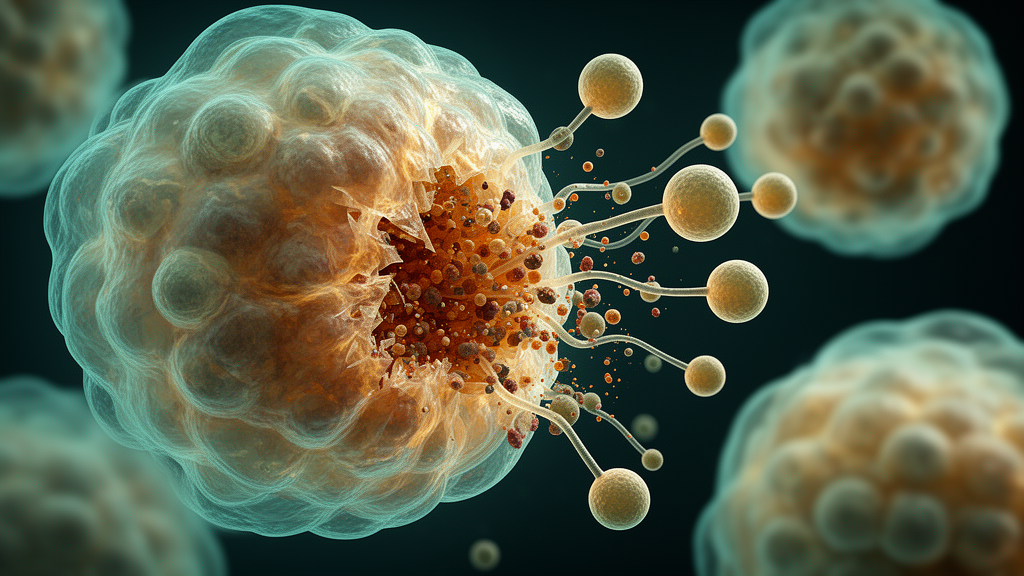
A new review in Cell Biology and Toxicology argues that necroptosis, a caspase-independent form of regulated cell death driven by the RIPK1–RIPK3–MLKL signaling axis, cannot be treated as a generic cell-death mechanism in cancer. The same program, the authors contend, can either prime potent antitumor immunity or fuel the chronic inflammation that promotes tumor growth, and the field has lacked a framework for predicting which outcome a given tumor will produce.
To address that gap, the review synthesizes evidence across more than a dozen tumor models and distills five variables that govern the balance: the acuity and context of necroptosis induction, the specific downstream mediator engaged, host immune competence, the tumor’s genetic background, and the pathway’s dependence on RIPK3 itself. The authors map the existing literature against these variables in a dedicated comparative table, offering a structured basis for deciding when triggering necroptosis is likely to help and when it may backfire.
Radiotherapy emerges as a particularly tractable setting for exploiting this duality. In several tumor models, irradiation activates RIPK1–RIPK3–MLKL or ZBP1–MLKL signaling that caspase-8 normally restrains. That engagement recruits cGAS–STING–type I interferon signaling, dendritic-cell cross-priming, and CD8-positive T-cell responses, with the efficiency of the effect shaped directly by radiation dose and fractionation. In other models, however, the same signaling instead drives IL-8-mediated tumor repopulation, illustrating how context determines whether necroptosis amplifies immune attack or assists tumor recovery.
The review also cautions against assuming that restoring the pathway is straightforward. Pharmacologically re-activating silenced RIPK3 or MLKL is a common strategy for re-sensitizing resistant tumors, but the authors find it is often insufficient on its own. Parallel resistance mechanisms, such as compensatory ADAR1 upregulation, can independently block the necroptotic pathway even after successful epigenetic reversal of the silenced components.
Clinical translation, the authors note, remains constrained by the absence of a validated necroptosis biomarker. Emerging circulating markers and trial data on the sequencing of checkpoint blockade relative to radiotherapy are presented as concrete starting points for building such tools. By reframing necroptosis as a mechanistic hub linking radiotherapy, immune sensing, and therapeutic resistance, the review aims to provide an actionable foundation for the combination therapies needed to harness the pathway safely in the clinic.
Subject of Research: The role of RIPK1–RIPK3–MLKL-driven necroptosis in radiotherapy, antitumor immunity, and treatment resistance
Article Title: Necroptosis in cancer therapy: bridging radiotherapy, tumor immunity, and treatment resistance
Article References: Ordibeheshti, S., Mousavikia, S. N., Khakshour, E., Mokhtari Zamenjani, M. S., & Azimian, H. (2026). Necroptosis in cancer therapy: bridging radiotherapy, tumor immunity, and treatment resistance. Cell Biology and Toxicology. https://doi.org/10.1007/s10565-026-10319-4
Image Credits: AI Generated
DOI: 10.1007/s10565-026-10319-4
Keywords: necroptosis, RIPK1, RIPK3, MLKL, radiotherapy, tumor immunity, cGAS-STING, treatment resistance, cancer therapy, ZBP1, checkpoint blockade, biomarkers
News Source: Nathaniel Bowman. (October 29, 2026). Necroptosis emerges as a decisive switch between tumor immunity and cancer growth. Scienmag.



